- Place
- Kaunas City Municipality
- Region
- Kaunas
- Type
- nationally significant 1883-1889 fort, Holocaust killing site, and 7 ha Kaunas Theriological Reserve
- Address
- 15 Plytinės Street, Kaunas
- Coordinates
- 54.84979, 23.95399
Kauno tvirtovės IV fortas, Kauno IV fortas, IV Fort, Fourth Fort, Rokai Fort, 4th Fort of the Kaunas Fortress
The 7 ha fort follows the Rokai terrain, making its plan asymmetrical and removing any one continuous central postern
IV Fort stands in Rokai on the upper terrace of the left Nemunas valley slope, near the headwaters of the Linksmė stream. Its official address is 15 Plytinės Street, while Google coordinates 54.849790, 23.953993 mark the entrance and gorge area. The map names 4th Fort of the Kaunas Fortress and Kauno tvirtovės IV fortas refer to the same place, also known as Rokai Fort.
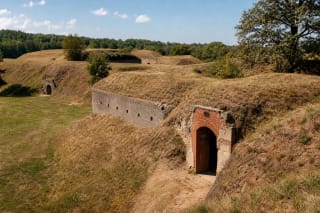
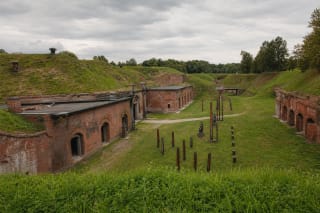
The approximately 7 ha enclosure forms an irregular quadrilateral close to a triangle. A standard first-ring fort design was modified to suit the land: buildings are distributed asymmetrically, and no single central postern runs the full length of the capital. Barracks, a guardhouse, and a gorge caponier defending the gate stand at the rear; a central caponier occupies the front, with half-caponiers and additional intermediate half-caponiers at the sides.
A ditch, or fosse, with a counterscarp wall surrounds the south-western, southern, and south-eastern sides. Surviving components include eastern and western gorge ammunition stores, a central magazine, concrete gun shelters, lift casemates, barrack sections, and the northern entrance gate. The heritage designation protects not just masonry but earthworks, ditch, circulation pattern, killing site, and the entire fortified landscape.
The Likhachev lift was the only practical realisation of a two-man disappearing-artillery system
The fort was built in 1883-1889, although Kaunas Fortress Park interpretation begins the wider construction period in 1882. It was reconstructed in 1892-1894, intermediate half-caponiers were completed in 1905, and part of the barracks received concrete strengthening in 1914. These layers show the continuous effort to adapt a red-brick fort to rapidly more powerful artillery.
Its defining innovation was engineer Dmitry Likhachev's system for anti-assault guns. Two four-storey concrete casemates were built between the central ammunition magazine and caponier in 1893, and the mechanism was installed and tested in July 1894. By turning a mechanical drive, two soldiers could lower the gun platform into a protected casemate or raise it directly to a firing position; armoured doors closed the opening during bombardment.
The mechanism was tested with a gun for three years, and Likhachev received an award in 1897, but cost prevented mass production. The two casemates remained the project's only practical implementation, while the lift itself was dismantled for metal during the Second World War. Surviving elements in damp lower rooms are not an independent adventure route and may be viewed only when included in that day's guided itinerary.
In 1915 IV Fort fired on a III Fort still held by friendly troops, then its own retreating garrison demolished key rooms
During the First World War, IV Fort's artillery covered the second and part of the first defence sectors. The principal German attack in August 1915 developed farther west, so this fort did not experience bombardment as heavy as that inflicted on I and II Forts. Its masonry consequently survived comparatively well.
After the first sector was breached, the IV Fort commander received a false report that III Fort had fallen. An order followed to open fire on it even though friendly defenders remained there. The episode reflects the collapse of communications and command rather than a technical failure. On withdrawal, the garrison blew up the anti-assault gun shelter and damaged an ammunition store.
The Lithuanian army assumed the fort between the wars, using it to train War School cadets and as a range. During the Soviet occupation, the 108th Airborne Regiment used it for stores and shooting. Clearance, mine-removal, and drainage work began in 1998-1999 but stopped when funding ended; a maintained event area today therefore does not mean that every tunnel is stable or open.
Four mass-killing operations took place here in 1941, making every visit an act of remembrance as well as military history
The LGGRTC chronology of the Kaunas Ghetto records four 1941 operations at IV Fort. On 2 August, 205 Jews and four Lithuanian communists were murdered; on 9 August, 484 Jewish men and 50 Jewish women. On 18 August, the victims were 698 Jewish men, 402 Jewish women, 711 Jewish intellectuals, and one Polish woman; on 26 September, 412 Jewish men, 615 women, and 581 children.
Those entries total 4,163 victims, including 4,158 Jews, although VLE and public descriptions commonly use a rounded figure of about 4,000. VLE also notes that some sources place the 26 September operation at IX Fort, while the LGGRTC's 2024 synthesis assigns it to IV Fort. The responsible presentation is to preserve both the documented total and this uncertainty of attribution rather than manufacture a single falsely undisputed figure.
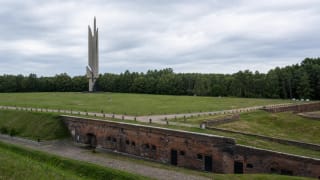
Nazi German security-police and SD structures organised the killings, and members of the subordinate Lithuanian National Labour Protection Battalion's third company participated in at least the early operations. A reddish-granite monument marks the Holocaust killing site. Quiet respect is appropriate there: this is not neutral military scenery, but a place where people were murdered, distinct in meaning from the creative events held elsewhere in the fort.
Protected bat colonies have taken over the underground rooms, making the winter closure a conservation necessity
The fort's boundaries coincide with the 7 ha Kaunas Theriological Reserve, created in 1988 to protect Lithuania's most numerous bat hibernation sites. Stable low temperature, high humidity, darkness, and quiet, once useful for ammunition and troops, now provide favourable winter conditions. Seven protected species have historically been recorded in the fort.
The Aukštaitija protected-areas authority counted 556 bats at Rokai Fort in 2026; annual counts between 2018 and 2026 ranged from 409 to 1,419. Species protected in the Kaunas forts include pond bats and western barbastelles. Even a brief awakening consumes energy accumulated for winter, and without insects available in cold weather that disturbance can prove fatal.
Unauthorised visiting is prohibited from 1 October to 1 May, and grilles increasingly secure the entrances. Do not break barriers, shine lights into gaps, touch animals, or alter ventilation. Official 2026 overview tours likewise stated that they did not enter rooms where bats hibernate; the guide's route and every locked zone take priority over curiosity.
Google says open 24 hours, but actual access depends on season, gates, and an announced tour
On 13 July 2026, Google Maps labelled the fort open around the clock, but this is not a timetable authorising underground or winter-reserve entry. Kaunas Fortress Park's Monday-Friday 08:00-17:00 hours belong to its administration, not to a permanently staffed fort ticket desk. The reliable option is an officially announced tour or advance arrangement by telephone on +370 37 309350.
For IV Fort tours announced in July 2026, tickets cost EUR 9 for an adult and EUR 6 for a school pupil under 18 or a senior; tickets were sold online or on site by bank card only. The general services page listed EUR 2 for the small Muziejukas exhibition but gave no separate daily opening schedule. Dates and prices change, so check the official page before travelling rather than relying on an older visitor listing.
For announced tours the guide waits by the entrance barrier. Wear sturdy non-slip footwear and carry a warm layer even in summer, remaining on the marked route; ditches, dampness, steps, low openings, and unlit areas are not universally wheelchair-accessible. Ask the organiser in advance about the exact surface itinerary. On 13 July 2026, the Google entry had 491 reviews averaging 4.7 out of 5.