- Place
- Kaunas City Municipality
- Region
- Kaunas
- Type
- private interwar interior and Kaunas modernism museum
- Address
- Gedimino g. 48, Kaunas
- Coordinates
- 54.89940, 23.91980
Art Deco muziejus
Kaunas modernism from the inside
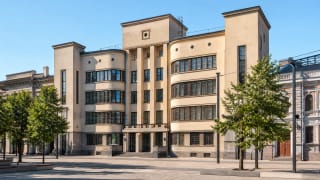
Most Kaunas modernism routes begin with facades. The Art Deco Museum offers another angle: step inside an interwar apartment and see how a modern city was created at the scale of everyday life. The museum is in apartment no. 5 of a 1929 apartment building at Gedimino g. 48, at the corner of Gedimino and K. Donelaičio streets.
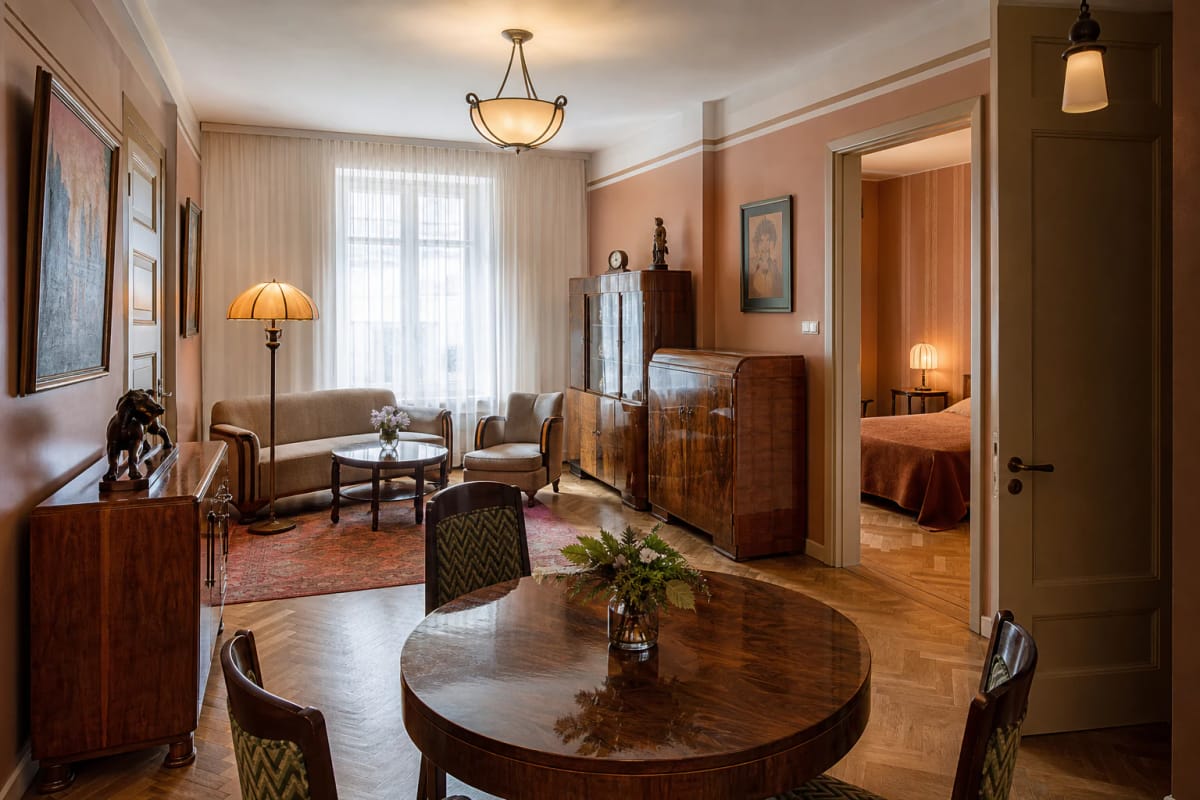
This matters because architecture is not only an exterior volume. Furniture, 16 doors, floor tiles, oak parquet, light fittings, colours, layout, and domestic conveniences show the quality of life sought by interwar Kaunas residents and the meeting point between international Art Deco and Lithuanian national-style searches.
Edmundas Alfonsas Frykas's 1929 house
The building was designed by engineer and architect Edmundas Alfonsas Frykas (1876-1943), who in the 1920s headed the Construction Department of Kaunas City Municipality and designed many well-known interwar Kaunas buildings, including the Seimas and Ministry of Justice palace, the Neo-Lithuania corporation palace, and apartment buildings at Gedimino g. 48 and K. Donelaičio g. 77, both from 1929.
The exterior and interior use many fashionable Art Deco signs recognizable in New York, London, or Paris. At the same time, the Lithuanian strand is clear: the 1929 oak doors carry tulip and lily motifs, the stepped little tower is patterned like national textile designs, and the facade is decorated with granite render and masks.
From apartment no. 5 to museum, 2017-2021
The museum founders, Petras Gaidamavičius and Karolis Banys, bought the apartment on December 18, 2016. Despite the difficult history of the building, the apartment retained its authentic layout and many untouched original elements. From 1929 to 1940 apartments here were rented by figures such as Professor Vincas Čepinskis, Pranas Dailidė, and the Latvian military attache.
In 2017-2020 the apartment was carefully restored: polychrome research helped recreate the 1929 wall colours and Art Deco and national-style wall bands hidden under paint; original features were restored; period furniture, books, and household technology were collected and repaired. The Art Deco Museum opened on June 9, 2021.
Experiential tours and the private museum format
The Art Deco Museum operates as a private experience based on guided visits. Its founders, who did not come from the usual art or heritage-preservation background, created a format they called an experiential tour. It is described as the first such tour in Lithuania and was later adopted by other museums.
That format has a practical advantage: a guide helps visitors notice details they would probably miss alone. In an interior museum, every small feature matters, from materials to the way objects are restored and maintained.
UNESCO Kaunas modernism context
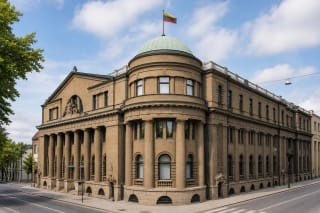
On the UNESCO World Heritage List, Kaunas modernism is framed as the architecture of optimism of 1919-1939. The Art Deco Museum makes that story concrete: international recognition becomes a room, a chair, a light fitting, and a choice of everyday aesthetics.
It helps to visit with at least a basic sense of Kaunas modernism. Then the museum is not just a beautiful apartment, but a key to understanding how modernism shaped the residential environment.
Tickets, booking, and visiting
At the time of source review, the official Art Deco Museum website linked visits with pre-purchased experiential tours lasting about 2 hours. It also asked visitors to bring indoor footwear, slippers, or socks. Check the official page for current hours, prices, group sizes, languages, and cancellation rules before planning.
Because the museum operates in a real apartment, it is best not to rush and to listen to the guide. Check photography rules on site. The visit combines easily with nearby Kaunas modernist buildings on Gedimino Street and Laisvės aleja.