- Place
- Kalnujai and Palendriai, Raseiniai District Municipality
- Region
- Raseiniai District
- Type
- Raseiniai-area hillfort and memory site near Kalnujai
- Coordinates
- 55.33575, 23.08375
Palendriai Hillfort, Kalnujai Hillfort, Jovaišiai Hillfort, Žieveliškė Hillfort
The Kalnujai and Palendriai names
Travellers often search for this object as Palendriai Hillfort, while VLE's article on Kalnujai names it Kalnujai Hillfort and notes that it is also called Palendriai Hillfort. Sources also use the names Jovaišiai and Žieveliškė. All refer to the same hill west of Kalnujai.
This multiple naming is not a stylistic flourish but a practical issue. A visitor may find the place under one name and meet another in sources or maps. The page intentionally keeps the names together so the object's identity is not lost while planning a route.
Platform, two ramparts, and relief
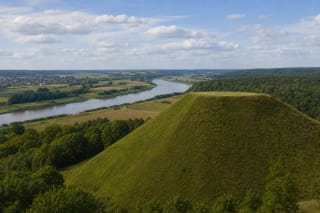
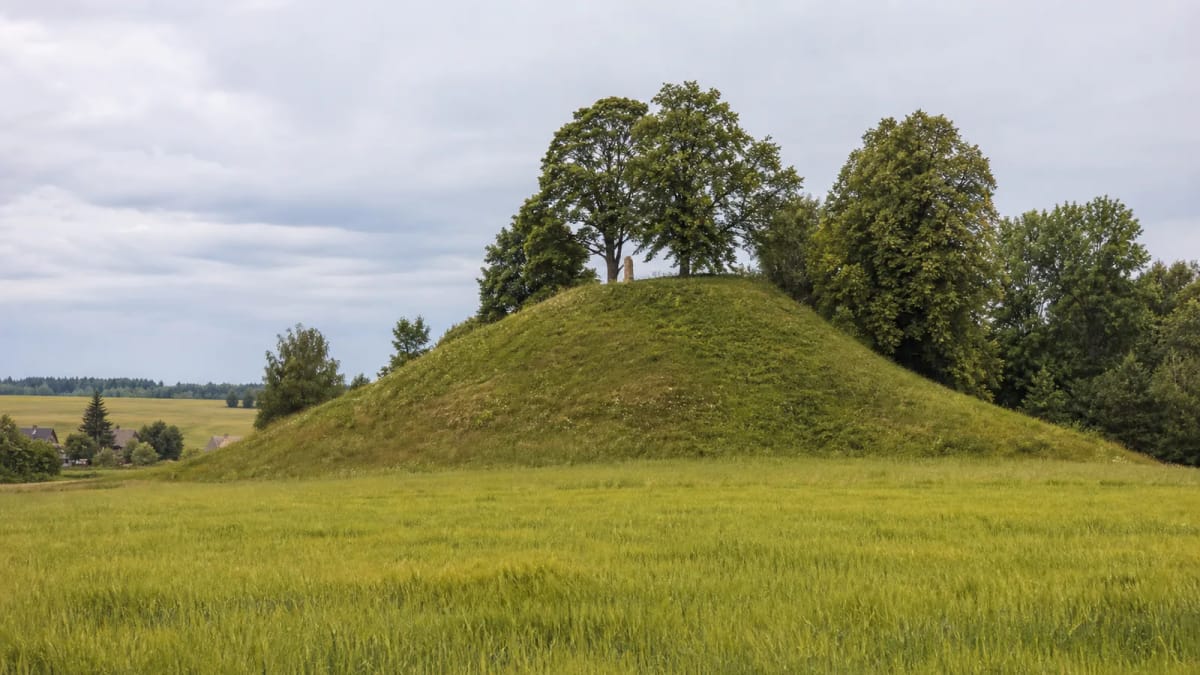
Kalnujai (Palendriai) Hillfort lies in Raseiniai District, west of Kalnujai town, about 6 km south of Raseiniai and near the Vilnius-Klaipėda highway. It is a small but legible defensive site: the platform is elongated northwest-southeast, about 27 m long and up to 13 m wide at the south-eastern end, while the whole hill is about 10 m high. The protected territory covers about 1.1 ha.
At the south-eastern end of the platform stands a rampart about 2 m high and 11 m wide. Its outer slope descends 4 m to a ditch 6 m wide and 1.5 m deep; beyond it is a second rampart, about 1 m high and 6 m wide. This combination of two ramparts and a ditch lets visitors read the defensive logic on site. The value here is not a grand panorama but preserved earthworks.
Dating and archaeological surveys
According to Cultural Heritage Register and encyclopedic data, the hillfort is dated to the first millennium and the beginning of the second millennium. The place was therefore used long before the written history of Kalnujai, which VLE mentions as a locality known from the fourteenth century.
The hillfort was surveyed early: Liudvikas Krzywicki explored it in 1903, and the Institute of History surveyed it in 1961. About 300 m northwest of the hillfort there were old cemeteries, later destroyed. This page deliberately avoids unsupported legends and dramatic dates not confirmed by sources; the safest line is the dating, rampart dimensions, early surveys, and relation to the Kalnujai landscape.
A sensitive Holocaust memory site
VLE's article on Kalnujai states that at the foot of the hillfort are graves of victims of Hitlerism: from July to October 1941, Germans shot 1,677 Jews here. This makes the site a place requiring respect. It is not only a green hill or photo stop, but a landscape of large-scale human memory.
This information should be presented without sensationalism, but also without hiding it. It reminds visitors that in Lithuania archaeology, small-town history, and twentieth-century tragedy often stand very close together. Responsible visiting means restraint and respect for the memorial place.
Kalnujai area and a folklorist's birthplace
The Kalnujai area is also important to Lithuanian culture. VLE states that near Kalnujai, in the former village of Žieveliškė, folklorist and book smuggler Mečislovas Davainis-Silvestraitis was born in 1849; a wayside shrine was erected at his homestead site in 1995. He collected about 700 tales and hundreds of songs and shorter folklore items, mostly in the Raseiniai region.
This link makes the hillfort part of a wider cultural landscape rather than an isolated archaeological object. Kalnujai cemetery also contains Lithuanian partisan graves and a memorial stone to composer Juozas Tallat-Kelpša, so the locality tells several layers of Lithuanian history.
How to visit Kalnujai (Palendriai) Hillfort
A visit usually takes 30-60 minutes. Choose dry weather, wear suitable footwear, and check access in advance because this is a local object not adapted for heavy tourism.
Stay on paths, do not damage ramparts or slopes, and behave quietly at the memorial site at the foot of the hill. If you continue through Raseiniai or Panemunė, this stop works best as a calm contextual visit combined with Šiluva Shrine, Seredžius Hillfort, or Raudonė Castle.