- Place
- Žagarė area, Joniškis District Municipality
- Region
- Joniškis District
- Type
- glacial esker and educational trail in Žagarė Regional Park
- Coordinates
- 56.35613, 23.22924
Žagarė Esker Educational Trail
An Ice Age ridge in Žagarė
Žagarė Esker is a geological object in Žagarė Regional Park. Saugoma.lt describes it as a glacial-origin ridge made of sand, gravel, and pebble deposits.
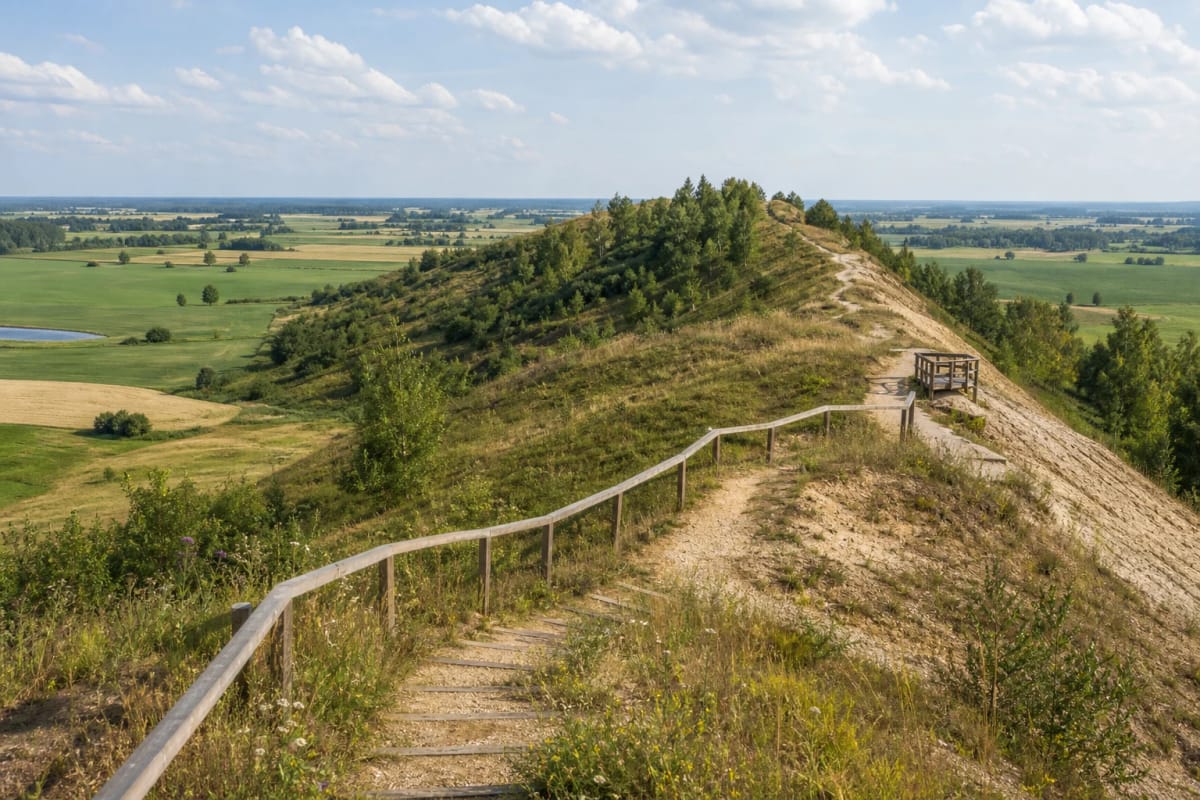
The esker formed when meltwater streams from a retreating glacier carried and deposited material. The landscape now shows a long, narrow, winding rise that differs sharply from the surrounding lowlands.
The scale of Žagarė Esker
The Saugoma.lt object page gives about 830 m as the surviving protected part of the esker, while in the wider Žagarė Regional Park context a much longer esker system is mentioned. This explains why the short visible visitor section is only part of a larger geological formation.
The most scenic part is associated with Žvelgaitis Hillfort, which rises about 20 m and shows how a geological ridge became an important and convenient place for people.
Educational trail
Žagarė Esker Educational Trail is about 3.6 km long. Saugoma.lt mentions information stands, rest areas, small viewing structures, fire places, a car park, toilets, and changing cabins.
The trail suits visitors who want to understand relief by walking. From the ridge, it is easier to see how esker slopes descend into the lowlands and why such forms matter for geological interpretation in Lithuania.
Neighbourhood of Žvelgaitis Hillfort
Žagarė Esker is also part of a historic landscape because Žvelgaitis Hillfort stands nearby. Here a natural form and human use coincide: a raised place was useful for watching, defence, and orientation.
For that reason, the esker is worth visiting not only as a geological form but as a place where an Ice Age legacy later became a cultural and historical space.
How to visit
At research time no separate object ticket was listed, but when visiting protected areas it is worth checking current protected-area visitor-ticket rules. The trail is an outdoor route, so its condition depends on weather.
After rain the slopes may be slippery. Wear comfortable shoes, use the marked trail, and do not erode the slopes, because the esker is a sensitive geological formation.