- Place
- Palanga City Municipality
- Region
- Palanga
- Type
- 2.5 m bronze fountain sculpture created in 1959 and installed in 1961
- Address
- Jūratė and Kastytis Square, west end of J. Basanavičiaus Street, Palanga
- Coordinates
- 55.91947, 21.05216
- Visit duration
- 10-25 minutes; 1-2 hours with Palanga Pier, the beach, and a seafront walk
- Best time
- a quiet morning or evening, when side light reveals the bronze patina; verify fountain operation on site
Jūratė and Kastytis Fountain Sculpture, Jūratė and Kastytis Fountain, Jūratė and Kastytis in Palanga
Finding Jūratė and Kastytis before Palanga Pier
The sculpture stands in Jūratė and Kastytis Square, where westbound J. Basanavičiaus Street reaches Meilės Avenue and the principal path to Palanga Pier. The precise Google Maps point is 55.919469, 21.052158. Use this place listing rather than a general legend search, because other works and places in Lithuania also carry the names Jūratė and Kastytis.
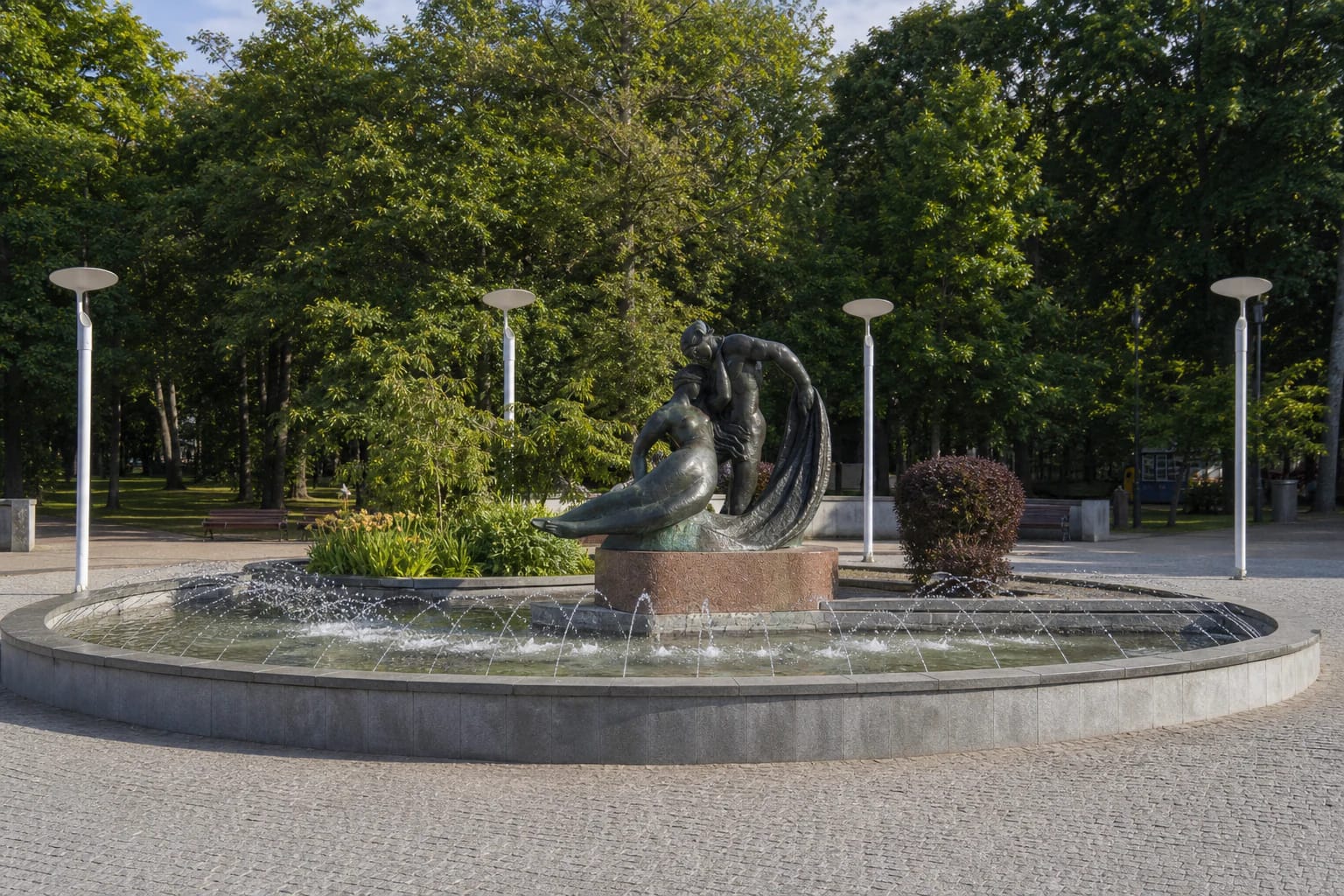
The fountain occupies the centre of the square, with a broad paved pedestrian area, benches, planting, and tall white lights around it. From J. Basanavičiaus Street, the sculpture reads as the final urban landmark before the dunes and pier, making it a clear meeting point as well as an artwork.
Walk around the work from at least two sides. The street-facing view makes the two-figure silhouette easiest to read, while a side view reveals the difference in their height, the curling bronze form, and the composition's relationship with the water jets.
Bronze figures, granite, and fountain water
The Register of Cultural Property describes cast bronze sculptures of a man and a woman on a foundation with a hewn-granite plinth. The officially recorded dimensions are 2.5 m high and 3 m wide. Dark bronze carries a greenish patina, while the pink-brown granite raises the figures above the low fountain basin.
Kastytis rises more vertically and bends towards Jūratė, whose longer figure extends lower to the left. Their heads draw close, but the bodies do not form a static symmetrical portrait. A sweeping sheet of bronze climbs behind them like a curling wave, connecting the human silhouette with the fountain water.
Alfredas Paulauskas, then Palanga's chief architect, prepared the square design in 1958. An official resort guide states that his basin avoided a strict geometric outline, and that a fountain designed by Albinas Čepys added water jets in 1965. The ensemble therefore works as a single composition of bronze, granite, water, and open square.
From a 1959 work to a nationally significant cultural property
KVR records two important dates: Nijolė Gaigalaitė created the sculpture in 1959, and it was installed in Palanga in 1961. This distinction explains why both years appear beside its name in different sources. The first marks creation, while the second marks its public arrival in the square.
Gaigalaitė graduated from the Lithuanian Art Institute in 1953 and began participating in exhibitions that year. VLE characterises her work in bronze, marble, granite, and wood as expressive and built from generalised forms. The Palanga pair shows that approach through elongated silhouettes, the broad wave form, and emotion carried by the direction of the whole body rather than minute detail.
The sculpture entered heritage records on 5 January 1993, and its present unique KVR code is 7643. The register assigns it national significance and identifies fine-art value, so the fountain setting is more than a seasonal resort decoration.
The legend and its documented route to Palanga
Jūratė and Kastytis is often presented as a very ancient Baltic legend, but its documented path requires more care. The National Museum of Lithuania stresses that folklorist and ethnographer Liudvikas Adomas Jucevičius first recorded the story in the mid-nineteenth century. VLE confirms that his Polish-language book Reminiscences of Samogitia was published in 1842.
In the best-known later version, the sea ruler Jūratė falls in love with the fisherman Kastytis, and an angered Perkūnas shatters her amber palace and kills her lover. Maironis's early twentieth-century ballad turned this into one of the most recognisable seaside narratives in Lithuanian literature. It is a literary and folklore tradition, not a documented historical event on the Palanga coast.
Gaigalaitė's sculpture includes neither Perkūnas nor a literal amber palace. She concentrates on the closeness and tension of two figures and the wave form enclosing them, so the work does not lock the viewer into one exact second of the story.
Planning a short stop in the square
The sculpture occupies a public square without gates, a ticket desk, or separate admission, so the figures can be seen at any time. Fountain jets are a seasonal and technically maintained part of the square and should not be assumed to operate continuously. If water is important for a photograph, check the latest Palanga municipality information or the actual conditions on arrival.
The principal pedestrian approach reaches the fountain edge without steps, and the basin is surrounded by paving and benches. However, the paver surface, low fountain rim, summer crowds, and temporary event structures can affect ease of movement. This is a general site description, not an official accessibility audit.
Allow 10-25 minutes for the sculpture alone, then continue naturally to Palanga Pier and the beach. Morning or evening side light reveals the bronze patina and overlapping figures more clearly, while concerts, city festivals, and winter events can bring stages, barriers, and much larger crowds into the square.