- Place
- Neringa Municipality
- Region
- Neringa
- Type
- open-air stone sculpture display on the Curonian Lagoon waterfront
- Address
- L. Rėzos Street waterfront, Juodkrantė, Neringa
- Coordinates
- 55.53588, 21.11806
- Visit duration
- 45 minutes-1 hour 15 minutes; longer if you read the labels and walk the full waterfront section
- Best time
- daylight, especially morning or late afternoon, when the relief of the stones is easier to see
Land and Water Stone Sculpture Park, Land and Water, Juodkrantė Sculpture Waterfront
Land and Water - an 800 m sculpture waterfront
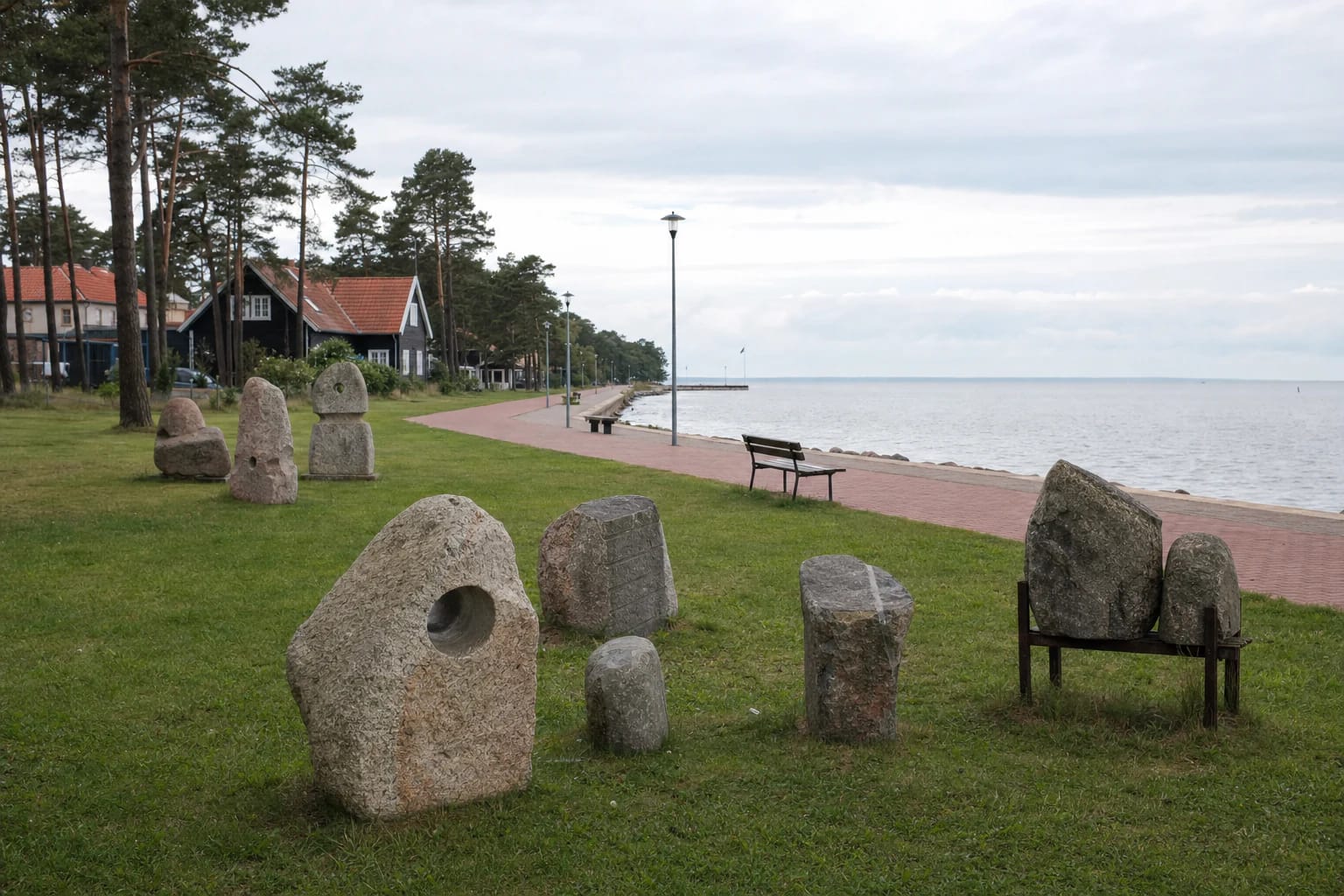
Juodkrantė Stone Sculpture Park follows the lagoon side of the settlement, between L. Rėzos Street and the Curonian Lagoon. It is not an enclosed site with one gate, nor does it occupy the whole 2.4 km waterfront. Groups of works are arranged along approximately 800 m of public path and lawn, so a map pin can only mark a representative point on the route.
The names Juodkrantė Stone Sculpture Park, Land and Water, and Sculpture Waterfront all refer to this lagoon-side collection. It is not the Hill of Witches, whose wooden folklore carvings stand in the forest across L. Rėzos Street, and it is not the separate outdoor display in the courtyard of Pamario Gallery at L. Rėzos g. 3.
From the 1995 waterfront works to the 1997-1999 symposia
Work on Juodkrantė's 2.4 km waterfront began in 1995, while the stone collection took shape during three international summer sculpture symposia in 1997, 1998, and 1999. The first works were installed by the lagoon in 1997, the display grew in 1998, and the unveiling of another 18 pieces in 1999 brought the official total to 31.
The municipal initiative was supported by Stasys Mikelis, then mayor of Neringa. The town's chief architect, Ričardas Krištapavičius, served as symposium commissioner and was one of the authors of the waterfront concept, while Aldona Balsevičienė, then head of the Juodkrantė eldership, helped receive the visiting artists and document their work. Architectural sources date the wider waterfront and sculpture-park project to 1996-2001 and associate it with Ričardas Krištapavičius and landscape architect Rolanda Krištapavičiūtė.
Field boulders, artists from seven countries, and documented works
Artists from Lithuania, the United Kingdom, Sweden, Finland, Denmark, Hungary, and Mauritius took part in the symposia. The display is based on transported field boulders, not the remains of a natural boulder field on the Curonian Spit. Some works retain a rough stone skin; others use cuts, openings, polished planes, metal supports, or arrangements of several stones.
The Curonian Spit National Park guide identifies Albertas Danilevičius's Clouds - Shore and Stasys Juraška's Three Forms of Water among the works installed in 1997. Its 1998 list includes Vytautas Narutis's Ice Age Sheep, Antanas Balkė's Arch of the Spit, and Marijonas Šlektavičius's Window. These documented examples help identify the display's scale and formal range, but the park is best read as a continuous waterfront sequence rather than the setting for one famous centrepiece.
Thirty-one works in the Curonian Spit cultural landscape
Official descriptions continue to list 31 works: 13 appeared in 1997-1998 and another 18 in 1999. No recent object-by-object condition audit could be found in public sources, while earlier reports recorded damage. The figure of 31 should therefore be read as the official catalogue size, not a promise that every work will be equally intact, labelled, or unobstructed by maintenance on the day of a visit.
The park lies within Curonian Spit National Park and the UNESCO World Heritage cultural landscape, but the stone display is not a separate UNESCO-listed property. The contrast between transported boulders and a young sandy spit is central to the place: heavy stone is deliberately set against water, wind, lawn, and the low horizon of the lagoon.
Free access, surfaces, lighting, and the Google rating
The waterfront has no gate, ticket desk, or museum opening hours, so the public outdoor display is ordinarily accessible at any time and has no separate admission fee. Temporary maintenance, event, or safety restrictions are possible. Ferry travel, entry to Neringa, and parking charges are separate and may change. Path lights help with orientation after dark, but the works are not all individually lit, so daylight is more reliable for reading their relief, artist labels, and the edges of the lawn.
The main hard-surfaced path is level and step-free, but some sculptures stand on grass that can soften after rain. A wheelchair user or a family with a pushchair can follow the main waterfront, although close access to every work may not be convenient; no independent accessibility audit of the whole section was found. Pedestrians and cyclists share the route. On 14 July 2026, Google Maps showed a place rating of 4.7/5, which can change over time.