- Place
- Neringa Municipality
- Region
- Neringa
- Type
- Blue Flag Baltic Sea beach on the Curonian Spit
- Address
- 2A Žaliasis kelias, Juodkrantė, Neringa
- Coordinates
- 55.54493, 21.09945
- Visit duration
- 2-4 hours; longer for a coastal walk or sunset
- Best time
- a summer weekday for supervised bathing or a clear evening for sunset from the central lifeguard-station steps
Juodkrantė Central Beach, Juodkrantės paplūdimys
Where exactly Juodkrantė Beach is
Juodkrantė stretches along the Curonian Lagoon, but its bathing beach is on the western side of the spit beside the open Baltic Sea. Reaching it from L. Rėzos Street and the lagoon promenade requires crossing the forested part of the spit. The principal landmark is the central lifeguard station at 2A Žaliasis kelias.
The coordinates 55.544934, 21.099455 identify a representative central-beach point in an official municipal location record. They establish the main direction but do not mark a gate or the only possible access. Follow on-site signs for the final section and use an established crossing over the protective dune ridge.
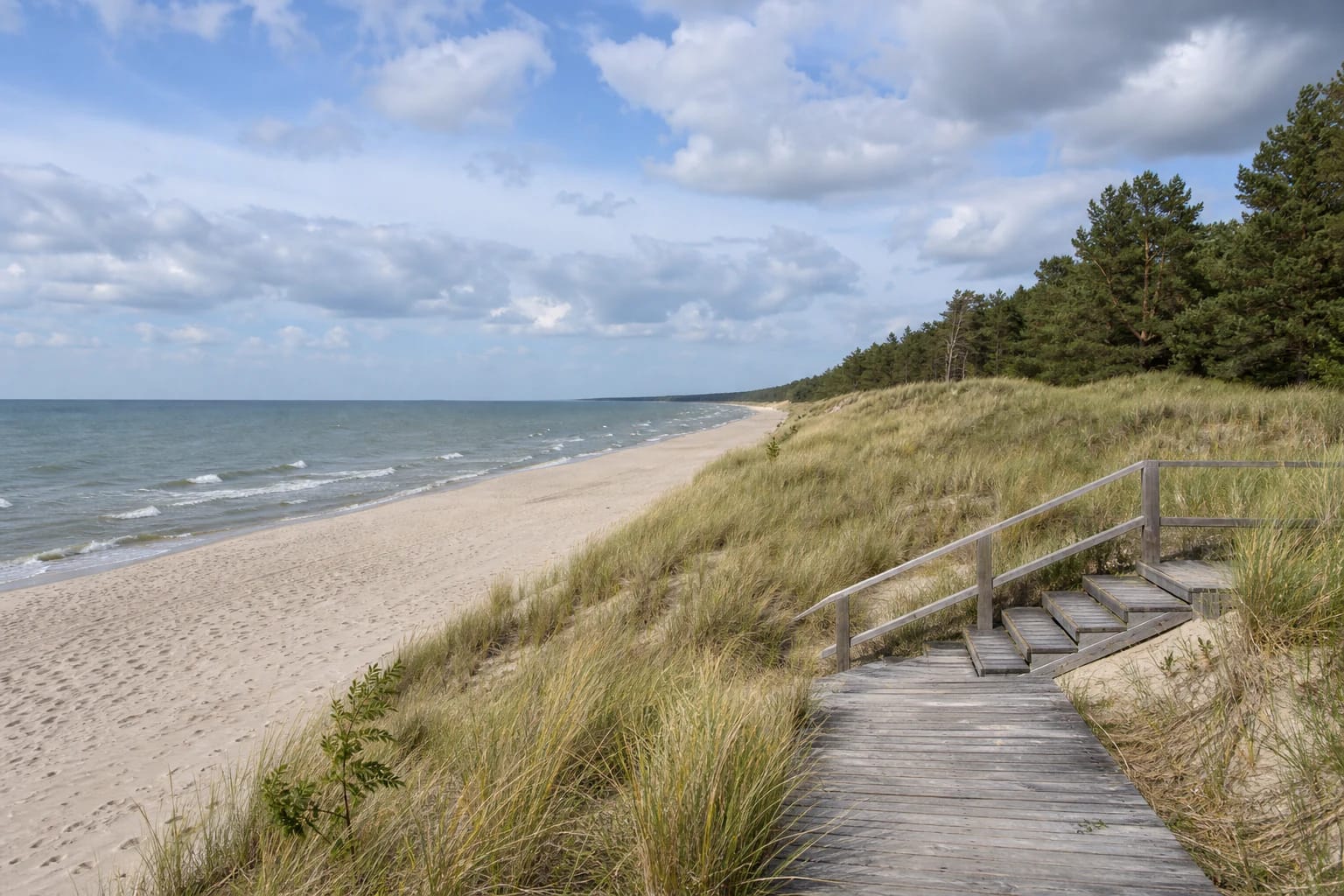
VLE reports that fine and medium-grained sand covers the Curonian Spit's beaches and gives the typical width at Juodkrantė as 25-40 metres. The shore is not fixed: storms, waves, and wind can change the width of dry sand and the shape of the ground at the end of an access path within a single season.
Blue Flag status and the central lifeguard-station area
Lithuania's State Service for Protected Areas reports that Juodkrantė Central Beach received Blue Flag certification for the 2026 and 2027 summer seasons. The programme evaluates water quality, environmental education, management, safety, and services. The award is not permanent: the flag may be temporarily lowered if mandatory conditions are not met.
The central section is marked by a renovated lifeguard station with broad timber steps designed for sitting and looking out to sea. They make an excellent place to watch the horizon and sunset, but remain part of a working rescue facility. Keep passages clear and never obstruct lifeguard work areas with personal belongings.
Blue Flag programme information lists volleyball courts, bicycle parking, an accessible path, and an accessible toilet. A specialist beach wheelchair can be made available for entering the sea when needed. Equipment condition, toilet opening, and assistance can change, so confirm essential arrangements before travelling or ask the lifeguards on arrival.
Juodkrantė Central Beach: supervised hours and water testing
The 2026-2027 Blue Flag programme lists Juodkrantė Central Beach's season as 7 June to 31 August, with lifeguards on duty daily from 10:00 to 19:00. Dates and hours can be adjusted, so check the newest official notice before travelling. The shore remains accessible outside these times, but bathing is unsupervised.
The Institute of Hygiene's 2026 monitoring schedule includes Juodkrantė among the sea bathing areas tested regularly. A Blue Flag does not replace the latest laboratory result: check current municipal data and the beach information board before entering the water, especially after heavy rain, storms, or another unusual event.
Follow lifeguard instructions and the flags displayed that day. Red prohibits bathing, while yellow warns of increased danger. Rip currents can occur in the Baltic, so keep a child constantly within arm's reach beside the waves, and never treat a calm surface as proof that an unsupervised section is safe.
Juodkrantė's dune ridge, protected for more than a century
The protective dune ridge between sea and forest is not simply a natural sand hill. Curonian Spit National Park records that a separate 5-kilometre section was created at Juodkrantė. In 1877, dune inspector L. Dempvolf formed a ridge along the Klaipėda-Juodkrantė section that successfully withstood the hurricane-force storm of 1898-1899.
The ridge was built by placing brushwood and stake barriers along the shore, allowing windblown sand to accumulate, and stabilising the surface with sand-binding plants. Planned maintenance continues because this belt checks the movement of sand towards the lagoon and helps protect the spit forest and settlements.
UNESCO inscribed the Curonian Spit on the World Heritage List in 2000 as a cultural landscape still shaped by people, sea, and wind. Reach the beach only by boardwalk or a clearly marked path, do not climb the ridge crest, and never sit among the marram grass. Even a short informal track damages the plants and can develop into a hollow deepened by wind.
Getting there, the entry charge, and separate beach sections
Juodkrantė Beach is convenient to reach on foot or by bicycle from the village centre, following the direction of Kalno Street and Žaliasis kelias. Leave a car only where current signs permit, never block rescue, forest, or cycle routes, and dismount on the final pedestrian section if local signs require it.
There is no admission ticket for the beach itself. A separate local charge applies to motor vehicles entering Neringa: on 14 July 2026, the official tariff listed EUR 50 for a passenger car from 20 June to 20 August, EUR 10 during the rest of the year, and EUR 25 for a fully electric car in the peak period. Ferry tickets and any parking charge are separate costs, so verify every price on the official page before travelling.
Juodkrantė's coast has separately signed general, women's, naturist, and pet-friendly sections. Identify their current boundaries from signs on site: not every stretch is open to naturists or pets, and Blue Flag certification applies to the central section.
For a longer stay, bring water, protection from both sun and wind, a warmer layer for the evening, and a bag for your waste. Cafés, hire concessions, and some sanitary facilities operate seasonally, so do not assume that every access has the same services.