- Place
- Kretinga District Municipality
- Region
- Samogitia
- Type
- state-protected old Jewish cemetery and Holocaust-era memory site
- Address
- Vaineikių Street, Darbėnai, Kretinga district
- Coordinates
- 56.02162, 21.27188
- Visit duration
- 30-45 minutes for a slow, respectful visit
- Best time
- in daylight and dry weather because the grassed terrain is uneven
Darbėnai Jewish Old Cemetery, Darbėnai Jewish Cemetery, Darbėnų senosios žydų kapinės
The exact cemetery lies on the eastern edge of Darbėnai
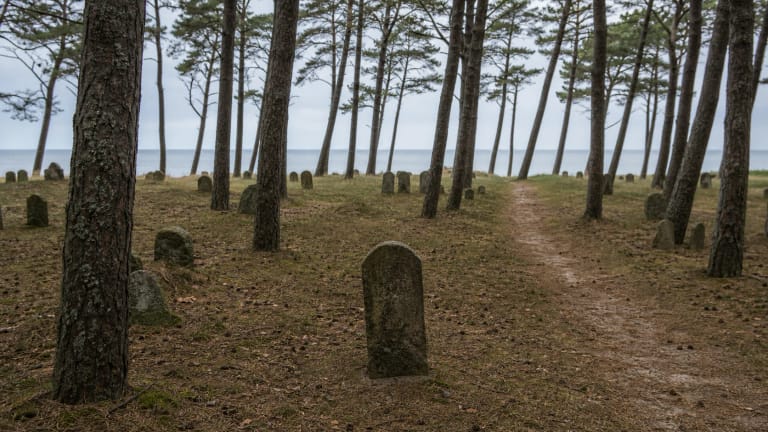
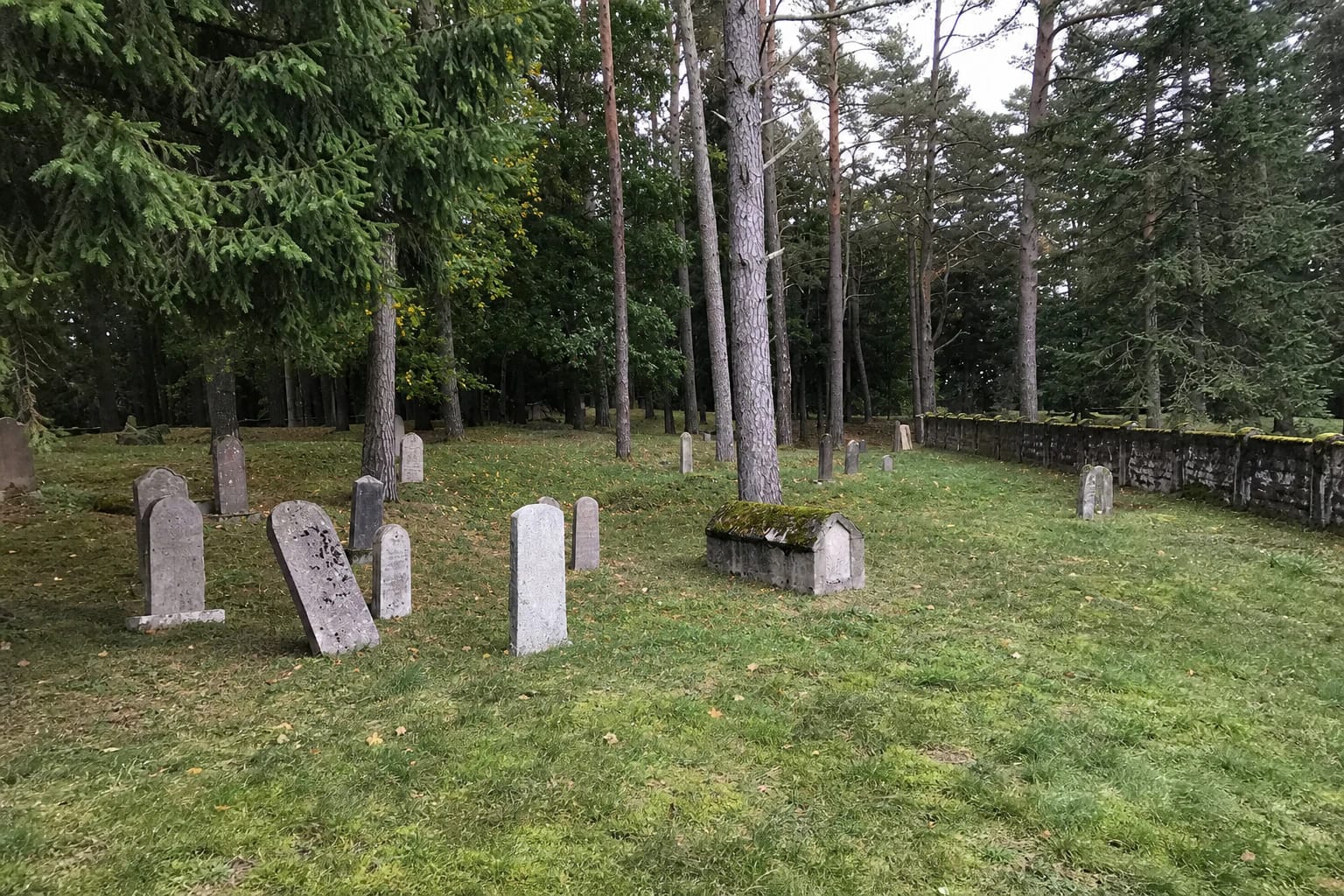
Darbėnai Old Jewish Cemetery lies beside the road towards Vaineikiai, at the edge of Balto Kalno forest, at 56.021616, 21.271877. The Register of Cultural Property records it as a state-protected site of regional significance under unique code 24196. Its registered 0.98-hectare territory forms an irregular trapezoid, approximately 128-165 metres long and about 75 metres wide.
An old concrete wall encloses uneven, hilly ground covered with grass, pine, spruce, and other trees. The map pin identifies the cemetery territory, not a confirmed car park or step-free entrance.
This is not Darbėnai's active municipal cemetery farther west. Nor is it any of the three separate murder and mass-grave sites for Darbėnai Jews near Vaineikiai and in Balto Kalno forest. All belong to the memory landscape of one destroyed community, but their Register territories and historical events are distinct.
Sources do not give a single date for the cemetery's foundation
The Kretinga Regional Encyclopaedia traces the cemetery to the late eighteenth century, while the Darbėnai Gymnasium account says local Jews had previously buried their dead at Laukžemė and received a separate plot outside Darbėnai in the nineteenth century. The earliest surviving gravestone inscription currently dated in these sources is from 1868. That date establishes the age of one surviving marker, not necessarily the cemetery's foundation year.
Jewish families are recorded in Darbėnai by the eighteenth century, and by the late nineteenth century the community formed a substantial part of the town's population. The cemetery is physical evidence of that long life, so its story begins not in 1941 but with families, religious practice, trade, and craft.
The Darbėnai Gymnasium local-history account names the parents of Zionist leader David Wolffsohn among those buried here. This is reported as evidence from a local source; their precise grave positions or translations of individual epitaphs should not be asserted without documentation.
Matzevot and inscriptions identify lives, but inventories differ
Stone and concrete grave markers of varying sizes, known as matzevot, survive alongside memorial slabs and low concrete grave structures. Some stand upright, while others lean, have sunk, or lie on the ground. Sources also record a remnant of concrete wall in the southwest, associated with a former ritual room, but the surviving structure is not a visitor building.
Different documentation campaigns report different totals. A Darbėnai Gymnasium description based on Register information mentions 98 monuments and grave structures, the 2020 ESJF survey recorded 115 gravestones, and a 2025 project publicly reported 128 documented markers. None is a count of burials. Survey date, ground conditions, and whether fragments or structures were counted separately can explain the differences.
Hebrew characters remain visible on many matzevot. They can preserve names, dates, and epitaphic formulas, but this page does not translate them: a reliable reading requires a photograph of the specific stone, its catalogue number, and epigraphic expertise. Do not rub, chalk, or clean the surface to make lettering clearer.
In 1941 the cemetery also became a crime scene
In summer 1941, at the beginning of Nazi German occupation, Darbėnai's Jewish community was persecuted, confined in a ghetto, and murdered. An archival study states that eight Jewish men were shot in the cemetery in mid-July and a ninth was killed outside its boundary; all nine were buried on the cemetery grounds. People who died in the ghetto were also buried here during the later summer months of 1941.
Other members of the Darbėnai Jewish community were murdered at separate locations outside the town and in Balto Kalno forest. The cemetery should therefore be described neither as Darbėnai's only Holocaust site nor as the mass grave of every victim. It carries two connected layers: a long-established community burial ground and one specific site of the terror of 1941.
This history calls for documentation, not sensational storytelling. A respectful visit rests on established facts rather than speculation about the number of unmarked graves or amateur interpretation of weathered inscriptions.
Conservation and documentation do not turn the cemetery into a park
The cemetery was cleared in 1993 and its metal entrance gates were renewed. Volunteer work followed in later years, and in 2025 Darbėnai Gymnasium and the cemetery-documentation initiative Maceva cleared vegetation and recorded surviving markers. This work helps locate and document features hidden by growth, but it does not make the cemetery a park or a reconstructed exhibition.
Leaning matzevot and old concrete fragments can be unstable. Visitors should not lift, straighten, relocate, wash, scrape lichen from, or remove pieces from them. Even well-meant cleaning can destroy a surface or alter a grave's context, so physical work belongs with heritage specialists and cemetery stewards.
A visit should be quiet and planned in advance
No reliable official source publishes permanent gate hours, a ticketing system, or a list of visitor facilities. If the gate is locked, do not force it or climb the wall; ask Darbėnai eldership, the gymnasium, or Kretinga District heritage staff about arranged access. Park only where local signs allow because the sources do not confirm a dedicated official cemetery car park.
Grassed slopes, roots, sunken features, and leaning stones make movement difficult. There is no published official specification for a fully step-free route, accessible toilet, or other access equipment. The safest conditions are daylight and dry weather; keep to open gaps, do not step on graves, and do not touch the stones.
In a Jewish cemetery, customary respect includes speaking quietly, keeping clear of graves, and men covering their heads. A small pebble may traditionally be left instead of flowers, but visitors need leave nothing. On 15 July 2026, the exact Google Maps listing with place ID ChIJ__B724c65UYRraXGhOkV_Bg displayed 5.0 out of 5; ratings can change and do not measure the site's historical importance.