- Place
- Vilnius City Municipality
- Region
- Vilnius
- Type
- educational centre run by the Office of the President of Lithuania, with an interactive permanent exhibition on democratic government, citizenship, and participation
- Address
- 28 Totorių Street, Vilnius
- Coordinates
- 54.68265, 25.28393
Valstybės pažinimo centras, VPC, Centre for Civil Education at the Presidential Palace
This is not a Presidential Palace tour but an independent journey through the machinery of democracy
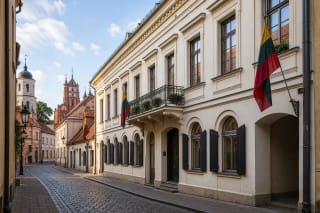
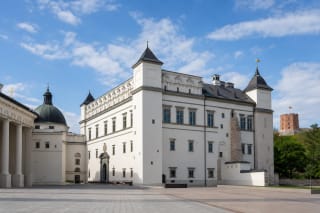
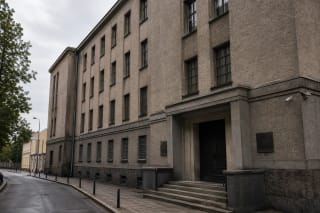
The Centre for Civil Education operates within the Presidential Palace complex, but visitors enter from 28 Totorių Street, at coordinates 54.682646, 25.2839311, rather than from Daukantas Square. A booking for the centre does not include the President's working and ceremonial rooms; palace tours have a separate registration system.
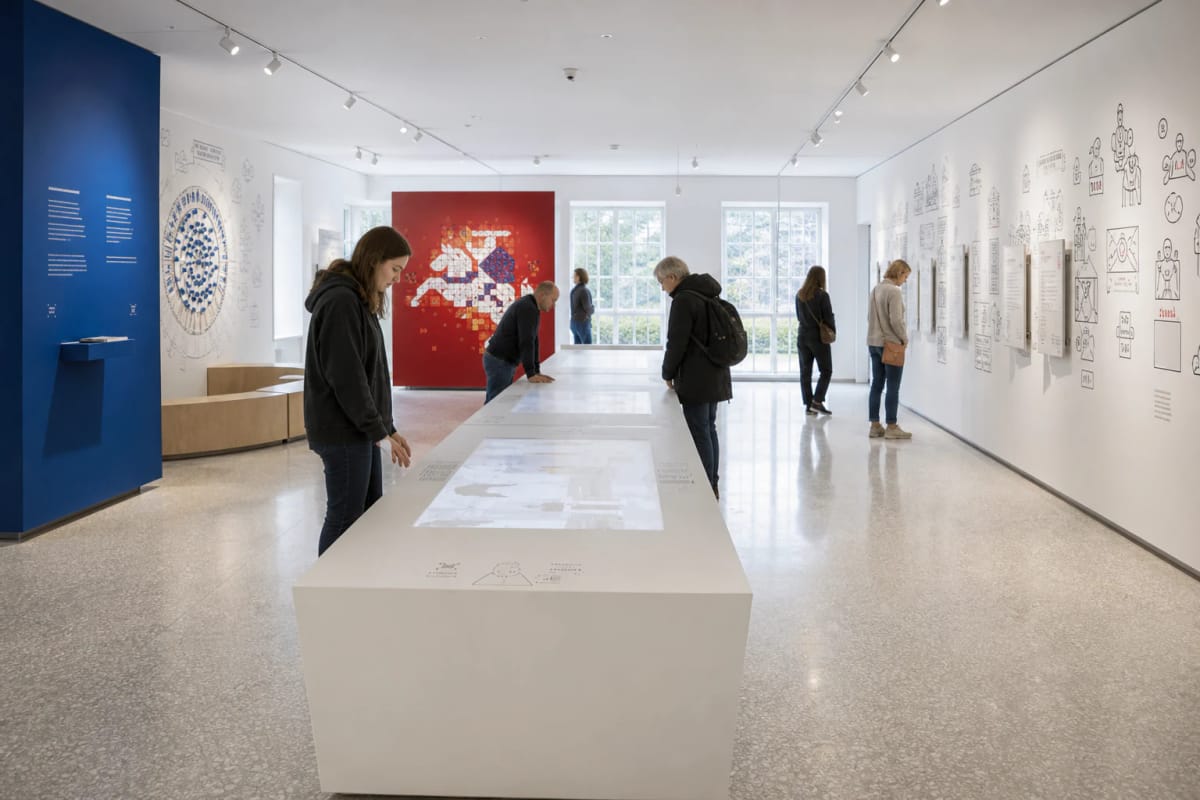
Its three exhibition floors cover far more than the office of the President. They explain four foundations of the state - territory, population, institutions, and their functions - and connect the Constitution, citizenship, elections, the separation of powers, and everyday participation. The result resembles a civic laboratory more than a museum of historical objects.
Allow 90-150 minutes for a first visit and decide in advance what interests you most. It is impossible to read and watch everything in that time: the centre itself notes that opening all the information concealed in just one exhibition section could require about four hours.
The centre opened in 2016 and made its visitors co-authors of the exhibition
The Centre for Civil Education opened on 10 March 2016, the eve of Lithuania's Day of the Restoration of Independence. Its mission is not to issue one set of correct answers but to use contemporary forms of information to encourage a conscious relationship with the state and show that democracy depends on what citizens do each day.
Visitor opinions, choices, and comments become part of the experience, allowing the galleries to serve as a forum for discussion. This distinguishes it from a monumental statehood narrative: the state appears here as shared work that must continually be negotiated, not a historical project completed in the past.
The centre's eight-pointed star logo derives from folk ornament. Its central square represents one's own land, the circle represents the sun and passage of time, and triangles pointing in four directions signify constant change. In 2016 the interior won the best public interior category in the Mano erdvė competition, and the centre later received awards for innovation.
More than 700 graphic codes allow the same exhibition to be explored at different depths
The principal tool is a tablet supplied at the centre. Pointing it at a marked graphic code opens text, images, statistics, questions, and tasks. With more than 700 codes, visitors do not follow one compulsory chain of arrows but choose which subjects to open and how deeply to pursue them.
The physical setting is deliberately restrained: white surfaces, large diagrams, maps, an amphitheatre, discussion areas, and a small number of bright colour accents allow information to dominate. Some material works without a tablet, but much of the exhibition's depth is digital, so taking a device is worthwhile even on a short visit.
This is not simply a game designed for children. A younger visitor can choose interactive tasks, while an adult can investigate the evolution of citizenship, institutional powers, statistics, or examples of civic initiatives. Dedicated family trails make the abundance of codes easier to navigate together.
Five freedoms connect personal identity, the Constitution, public decisions, and international cooperation
Freedom to Know and Be Yourself begins with Lithuania's territory, its nearly three million people, shared memory, and the question of what connects a person to home and fellow citizens. Freedom to Participate traces changing ideas of citizenship, rights, and duties, linking historical struggles for liberty to modern volunteering, initiatives, and community action.
Freedom to Agree interprets the Constitution as a common agreement within the political community. It covers elections, separation of powers, party representation, the roles of the Seimas, Government, President, and courts, and the ways in which citizens can influence laws and other decisions.
Freedom to Decide and Act shifts attention to recognising a problem and accepting responsibility for change, while Freedom to Cooperate examines Lithuania's relations with other countries and international organisations. The route can therefore begin with a personal bond to place and end with the role of a small state in a wider world.
A 90-minute tour provides orientation, while temporary exhibitions connect the permanent themes to the present
The introductory guided tour lasts 90 minutes, is available in Lithuanian and English, and must be booked for a group of at least ten. A guide selects key installations, explains how the centre was conceived, and leaves time to open codes independently. It is a useful route for a class or anyone who would rather not begin with 700 possible choices.
Schools can choose separate in-person and online education on the separation of powers, civic rights, media literacy, history, and community problems. Programmes, ages, and booking slots change, so teachers should select from the official description of each activity rather than relying only on the centre's general hours.
Temporary exhibitions examine particular symbols of statehood, historical experiences, and current choices. On 13 July 2026, the centre's website advertised Lithuania's Road to Energy Independence, open since 18 April. Displays rotate, so check what is showing before visiting.
Register 48 hours ahead on weekdays; the permanent exhibition is walk-in at weekends
In July 2026, the centre closed on Monday, opened Tuesday-Thursday from 09:00 to 16:00, and Friday from 09:00 to 15:00. An individual weekday visitor had to register by telephone or online at least 48 hours in advance, while groups had to submit a list of participants after receiving confirmation.
On Saturday and Sunday, the permanent exhibition opened from 11:00 to 18:00 without advance registration, with last admission at 17:00. Groups larger than 25 were asked to give notice even at weekends. Admission, tablets, exhibitions, and all services provided by the centre were free, but consult the official page for current hours.
The building is officially adapted for visitors with mobility disabilities, families with pushchairs, and people with visual or hearing disabilities; some content is available in Lithuanian Sign Language and easy-to-read text. On 13 July 2026, Google Maps rated the centre 4.6 out of 5 from 689 reviews. The score exceeds this catalogue's 4.5 threshold but changes over time.