- Place
- Bilioniai, Šilalė District Municipality
- Region
- Šilalė District
- Type
- Samogitian hillfort with a foot settlement and terraced slopes
- Coordinates
- 55.59694, 22.32139
Švedkalnis, Šventkalnis
Bilioniai Hillfort and the name Švedkalnis
Bilioniai Hillfort stands near Bilioniai village in Šilalė District Municipality, south of Šventpelkė, in the Samogitian Upland. VLE presents it as a hillfort with a foot settlement and gives another name for it: Švedkalnis. Such a name is common on Lithuanian hills. In folk memory, 'Swedes' often meant enemies from old wars, so many fortified places gained names such as Swedish Hill or Swedish Graves even when Swedes were not necessarily connected with them.
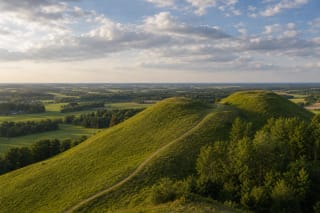
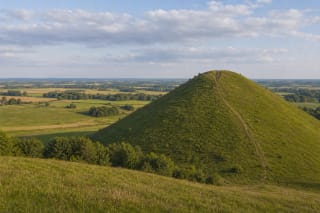
Local people sometimes also call the hillfort Šventkalnis, or Holy Hill, which points to a perception of sacred place. VLE does not separately confirm this second name, so it is best treated as local tradition rather than documented fact. The first thing a visitor notices is a massive high hill: this is not a small local mound, but a landscape landmark best viewed first from the foot before climbing.
Shape, platform, and terraced slopes
VLE states that the summit platform of Bilioniai Hillfort is oval, 57 x 37 m, with a thick cultural layer. On the slopes, 4-5 m below the platform, is a terrace 11-20 m wide, damaged in the southern and southeastern parts. From the terrace edges a 20-25 m slope descends, so the total height from foot to platform still feels impressive today.
It is especially interesting that in the early twentieth century another terrace survived below the one still visible, but was later destroyed by ploughing. This explains why the hill does not look like an ordinary cone, but like a stepped defensive hill shaped by terraces. Do not rush the visit: different slopes show how the relief may have been used for defence and movement, and the terraces are not just a photo backdrop but the archaeological feature itself.
Dating, excavations, and finds
VLE dates Bilioniai Hillfort to the first millennium and the beginning of the second millennium, and notes traces of an ancient settlement at the foot. This means the site was not only a temporary refuge, but a wider lived-in and used area where a thick cultural layer accumulated.
VLE states that the hillfort was excavated in the early twentieth century by Ludwik Krzywicki, and that exploratory investigations were carried out by the Institute of History in 1961. Hand-built rough-surfaced pottery was found, and the finds are kept at the National Museum of Lithuania. The foot settlement matters for visitors: the hill was connected with everyday life below, with homesteads, fields, roads, and water, not only with the summit.
Bilioniai Landscape Reserve
The hillfort is not an isolated object but the centre of a protected landscape. According to Saugoma.lt, the 388 ha Bilioniai Landscape Reserve protects an expressive-relief landscape with Bilioniai, or Švedkalnis, Hillfort. This status means that protection applies not only to the hill itself but also to the surrounding relief as a whole.
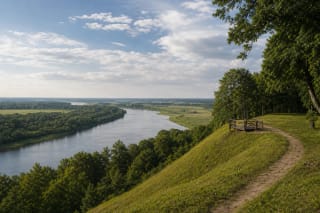
For visitors, this helps explain why the hillfort feels so prominent: it stands in an undulating, hilly area where a human-shaped hill and natural relief form a single view. The reserve status also reminds visitors not to damage the slopes or terraces and to move only where this does not harm the heritage.
The Pilėnai question and folklore layer
Bilioniai Hillfort is sometimes mentioned in popular discussions about the possible location of Pilėnai. Authoritative sources used here, including VLE and Saugoma.lt, do not separately confirm that tradition, so it should not be presented as proven fact. In historiography, the location of Pilėnai remains disputed, and different hillforts have their own arguments and local stories.
The best wording for travellers is simple: Bilioniai is valuable in its own right, independent of any legend. Its relief, 57 x 37 m platform, terraces, and Samogitian defensive context are strong enough without the Pilėnai hypothesis. The names Švedkalnis and Šventkalnis show that the place lived not only in archaeological data but also in people's imagination, like other Samogitian hillforts with their own legends.
How to visit Bilioniai Hillfort
Allow at least 45 minutes for Bilioniai Hillfort. It is best to begin by looking from the foot, then climb to the top and separately examine the slope terraces, the key feature of the relief here. On a clear spring or autumn day the terraced slopes and surrounding lowlands are easiest to see. After rain, the grass and slopes can be slippery.
Visitors should protect the slopes and avoid walking where there is no path, because the hillfort is a protected archaeological and landscape value. Bilioniai combines well with other hillforts of the Samogitian Upland, especially Medvėgalis and Šatrija, for a full day of defensive landscapes.