- Place
- Klaipėda City Municipality
- Region
- Klaipėda Region
- Type
- marine-animal treatment, research, and environmental education centre
- Address
- Lithuanian Sea Museum complex, Smiltynės g. 3, Klaipėda, behind the Dolphinarium
- Coordinates
- 55.71901, 21.09973
BJGRC, Baltic Seal Rehabilitation Centre
A working wildlife hospital, not a zoo
The Baltic Sea Animal Rehabilitation Centre presents a real treatment system rather than a permanent animal collection. Exhausted, sick, or injured seals and birds found on the Lithuanian coast and in the Curonian Lagoon are brought here, and the final objective is not display but release back into the wild.
The number and visibility of animals constantly changes. Human contact is deliberately minimised during intensive care, and visitors may see only animals whose condition, rehabilitation stage, and carers allow it. A ticket therefore guarantees a tour and learning experience, not the appearance of a particular seal pup.
The centre forms part of the Lithuanian Sea Museum complex but has a separate purpose, tour time, and ticket. It stands behind the Dolphinarium at 55.719013, 21.0997347 and should not be confused with the aquarium or dolphin-show venue.
Why seal pups needed a specialised centre
Lithuanian Sea Museum specialists had rescued seal pups for more than three decades before the dedicated centre existed. More than 20 weakened grey seal pups or injured adult animals are found along Lithuania's coast each year, yet the most vulnerable pups previously had to be cared for in bathtubs installed in a museum office.
A grey seal pup's beginning is short and intense. A mother nurses it for only about 15-20 days, during which its weight should rise from roughly 14-15 to 40-50 kg. A pup separated too soon and lacking a sufficient fat layer has neither the energy to feed independently nor adequate protection from cold water.
A conference in October 2022 marked the new centre's operational opening, and the first pups reached its specialised facilities the following spring. It opened to visitors on April 19, 2023, when 16 grey seal pups found on the coast that year were already receiving care.
Three stages on the journey back to the Baltic
The first stage is quarantine and intensive care. On arrival, veterinarians examine the animal, give first aid, and take blood, faecal, or other samples for clinical and laboratory testing when necessary. A pup unable to eat has its electrolyte balance restored and is tube-fed while contact with people is kept to a minimum.
During the second stage, stronger animals move to small outdoor pools, one or two at a time. Here they gain weight, become accustomed to water, and progress toward feeding independently on a species-appropriate diet.
In the third stage, seals prepare for natural life by taking fish themselves, moving normally, and displaying behaviour typical of their species; feeding may encourage natural competition. An animal is released only when clinically healthy, at the necessary weight, and able to feed independently.
Dune-shaped architecture and 10 pools
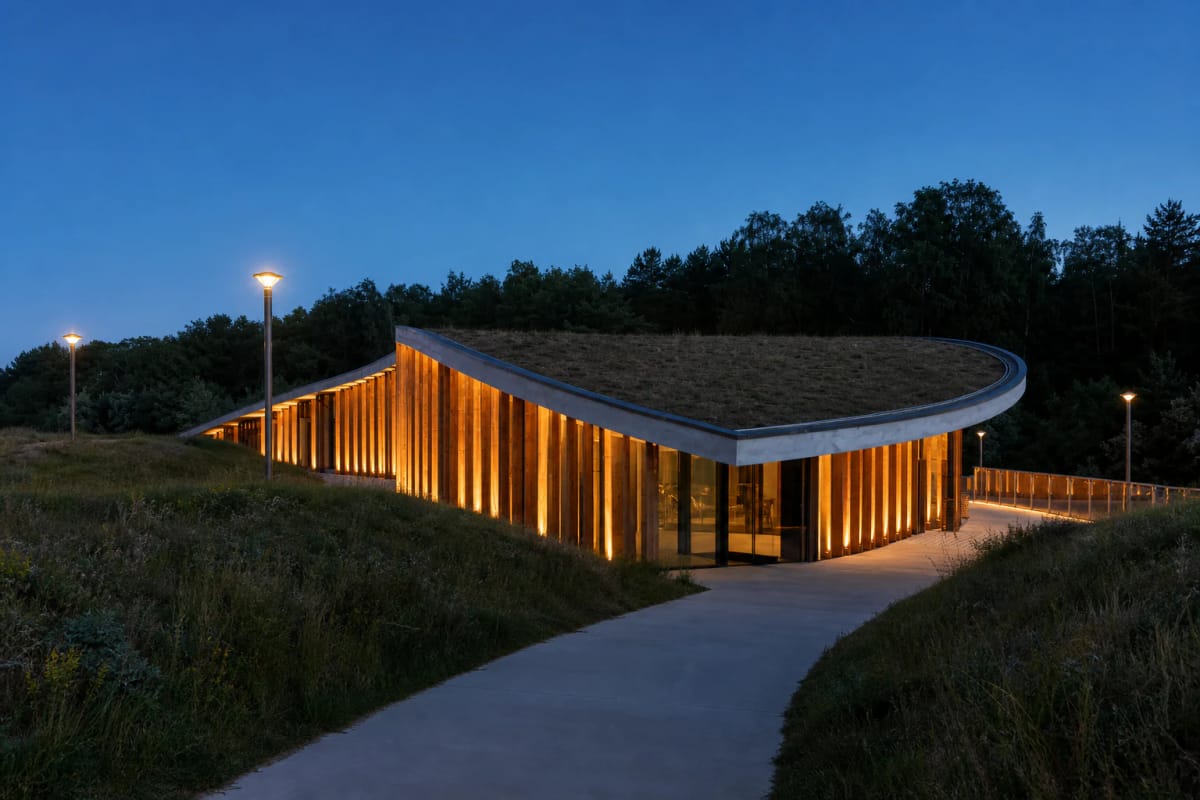
Archko designed the centre as a low, curving form that echoes Smiltynė's dunes. Vertical timber fins give rhythm to the facade, while parts of the building merge into grass-covered slopes. Its principal planted roof covers 510 sq m, with approximately another 200 sq m of green roof elsewhere.
Animals have six indoor and four outdoor pools, a separate bird pool, and a large seal pool holding 280 cubic metres. Different spaces allow carers to separate quarantine, individual recovery, acclimatisation to water, and final preparation for release.
The architecture is more than an attractive shell. Tours explain the path water follows from the sea to the pools, the functions of treatment rooms, and the systems that let staff care for wildlife safely and hygienically while avoiding habituation to people.
I Change - The Sea Changes and tracking released seals
The I Change - The Sea Changes educational exhibition explains why animals arrive at the centre. It addresses bycatch in fishing gear, overfishing, eutrophication, marine litter, oil pollution, shipping noise, climate change, and other forms of human pressure on the Baltic.
The exhibition's own materials continue its sustainability argument. Furniture board was made entirely from waste, packaging, and microplastic collected from seas; worktops incorporated recycled yoghurt pots and retired medical equipment, while old chairs received a second life.
The centre's work does not end at release. The museum acquired eight satellite tags in 2022 and ten more in 2023, attached to seal fur until moulting. They help researchers evaluate post-rehabilitation survival, movement, resting and hunting areas, and diving depth, supplying evidence for Baltic conservation and HELCOM monitoring.
Tours, admission, and getting there
Entry is only with a ticket for a timed Lithuanian-language tour. The 2026 summer timetable listed tours Tuesday-Friday at 1 pm and Saturday-Sunday at 10:50 am and 1 pm; adult admission was €6, reduced admission €3, and children under four entered free. Times and prices change, so check the official booking system and buy in advance.
The museum's visitor guide suggests about one hour for the visit, with the educational portion lasting roughly 45 minutes. The centre has a lift, toilet, coat area, and lockers; part of the programme may take place outdoors, so dress for the weather. Visitors must remain quiet by the pools, keep back, and never feed animals.
Pedestrians can take the ferry from the Old Ferry Terminal and walk 1.8 km to the museum or use a paid tourist road train. Drivers must use the New Ferry Terminal, about 8 km from the complex after crossing. Ferry timetables, fares, and summer queues need separate planning before departure.