- Place
- Vilnius City Municipality
- Region
- Vilnius
- Type
- private museum of historic transport technology in the reconstructed 1974 Vilnius Taxi Park
- Address
- 2 Dariaus ir Girėno Street, Vilnius
- Coordinates
- 54.66509, 25.27096
- Visit duration
- 1.5-2.5 hours independently; a detailed guided tour takes approximately 1.5-2 hours
- Best time
- earlier on a weekday or on a weekend morning; the museum is closed on Tuesdays
Vilniaus Automuziejus, Auto Museum Vilnius, Vilnius Auto Museum, Automuseum Vilnius
A museum whose first exhibit is the taxi depot itself
Automuziejus Vilnius operates at 2 Dariaus ir Girėno Street, where Naujininkai meets Naujamiestis. LIMIS dates the former Vilnius Taxi Park to 1974. This is not a neutral exhibition box: low floor slabs, exposed reinforced-concrete structure, long garage spaces, and vehicle ramps are central to the experience.
The museum's Google Maps point at 54.6650899727, 25.2709553768 marks the large complex as a whole, so it is classified as a site rather than one doorway. The principal visitor entrance is on the roof. Cars climb a ramp from Dariaus ir Girėno Street, while pedestrians arriving by public transport follow an overpass to roof level.
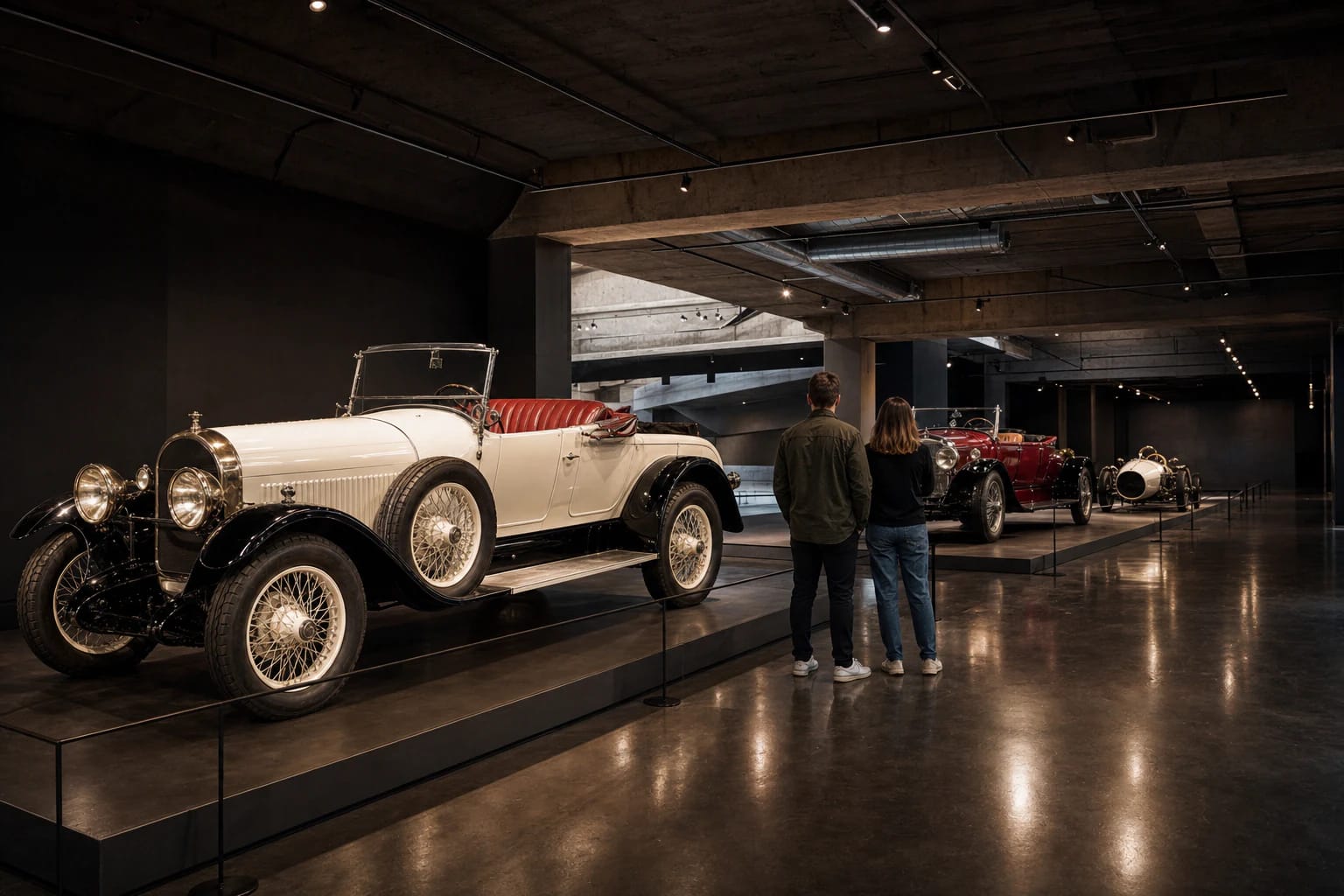
Dark exhibition backgrounds and directional spotlights separate the silhouettes of the cars from the former garage structure. Polished bodywork, chrome, timber, and leather are presented as design history, while the scale of the building recalls its former role as everyday urban transport infrastructure.
More than 100 vehicles across two floors
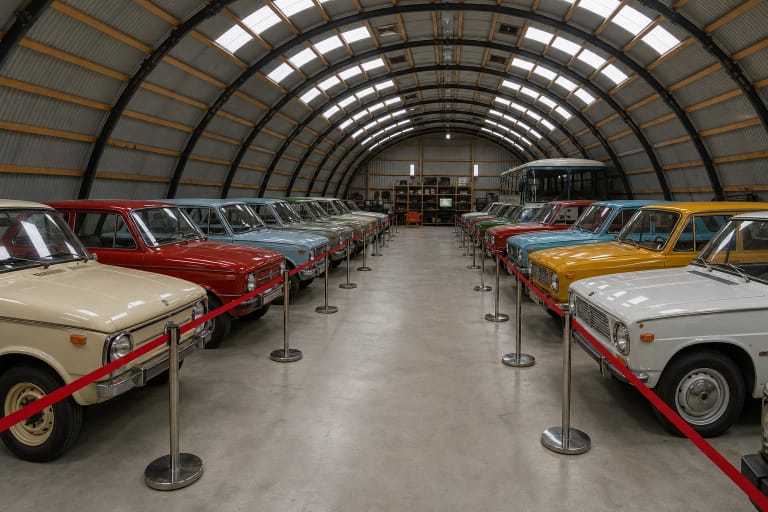
The museum's official presentation describes more than 100 permanent exhibits and approximately 110 vehicles from a private collection. The chronology begins with nineteenth-century bicycles and carriages, then moves through early motor cars, interwar luxury, wartime and postwar machinery, microcars, racing vehicles, and modern classics.
The museum advertises more than 70 marques from 10 countries important to the development of the motor industry. This is not exclusively a collection of passenger cars: motorcycles, racing machinery, and vehicles explaining the beginnings of motorisation are also included. Do not treat every machine visible today as part of an unchanging catalogue.
The Ministry of Culture's 2025 return recorded 215 borrowed cultural objects, four renewed exhibitions, and no objects held in the museum's own collection. This clarifies what permanent means here: there is a continuing core display, but many objects belong to private collections, and particular cars or thematic groups can change.
The car as evidence of technology, design, and political history
The display is best read not as a parade of expensive marques, but as a sequence of technological change. Early machines show how carriage construction became the motor car, long interwar bodies reveal hand craftsmanship and public display, and tiny postwar vehicles speak about material economy, denser cities, and a new mass mobility.
The museum's official family route highlights a Ford Model T, a Delage attributed to the King of Nepal, a Buick associated with Antanas Smetona, and an armoured Mercedes-Benz 560 SEL used to carry Vytautas Landsbergis. These are the museum's biographies for particular exhibits; for sensitive provenance and use claims, read the label beside the vehicle because displays and research can change.
Lithuanian history is further represented by interwar state cars, machines associated with the Around Lithuania rally, and early Lithuanian racing cars. The 2025 official return recorded 24,908 visitors, 66 educational sessions, and 46 events, showing that the building works as a programme and meeting place as well as a static display.
From nearly 800 taxis to a museum in 2023
The official building history states that the complex contained administration, repair workshops, car washes, garages, a fuel station, and an inspection point, serving nearly 800 taxis during the Soviet period. After Lithuania restored independence, the depot was privatised, divided among many owners, and poorly maintained for a time.
In 2016, new owners decided to return an automotive function to the complex as a history and cultural venue. The museum counts seven years from idea to opening. Vilnius municipal documents from 2021 changed the former garage's use to an administrative building with cultural, service, retail, sport, and catering premises, and the capital-repair proposal received approval after public consultation.
Automuziejus opened to visitors on May 18, 2023. This is the museum's opening date, not the beginning of the taxi depot. The reconstruction retained the industrial character and brought cars back into their old habitat, but the present display is a private museum project, not a taxi company preserved exactly as a historic workplace.
Opening hours, tickets, and guided tours
On July 21, 2026, the museum listed opening hours of 10:00-19:00 on Monday and Wednesday-Sunday and closure on Tuesday. Holiday hours can differ, so check the official visitor page before setting out. No clear last-admission time was published there, so do not plan to arrive immediately before 19:00.
On the same date, standard admission cost EUR 15. A EUR 9 reduced ticket applied to children aged 6 and above, pupils, students, seniors, visitors with disabilities, and one companion, with proof required. Children under 5, POLA cardholders, teachers, guides, museum employees, and journalists were admitted free under the published conditions. The family-ticket calculator began at EUR 20 and varied with the number of adults and children. Recheck all prices and concessions officially.
Allow 1.5-2.5 hours for an independent visit. In 2026, a detailed group tour of approximately 1.5-2 hours cost EUR 80 and had to be ordered at least three working days ahead. The museum also advertised a free guide talk on the last Sunday of the month, but admission itself was not free; find the particular month's time in the events calendar. The €80 guide fee excludes admission: each visitor needs a separately purchased museum ticket (official terms checked on 8 September 2026).
Roof entrance, free parking, and visitor rules
Prūsų is the most convenient public-transport stop. In 2026, the museum listed buses 1, 3, 4, 41, 42, and 78 and trolleybuses 10 and 17, but confirm current routes before travelling. From the stop, an overpass climbs to the roof; once through the main doors, the museum is on the left.
When driving from the centre, the official directions instruct visitors to turn around at the junction with Kapsų Street, enter from Dariaus ir Girėno Street beside the motor-parts shop, and climb the ramp to the free roof car park. Because the entrance is unusual, use the exact museum Google Maps listing rather than stopping by the facade visible at street level.
Personal photography and filming are allowed, but touching vehicles, opening doors, or climbing into exhibits is generally prohibited. Only a few specially unbarriered objects, such as the Ford Model T presented to visitors, are intended for interaction. Pets are not admitted, and there was no cafe inside in 2026. The official visitor page did not provide a detailed step-free route from the stop or roof car park, so wheelchair users should ask in advance about the entrance, gradients, lift, and toilet.