- Place
- Antazavė, Zarasai District Municipality
- Region
- Zarasai District
- Type
- restored late-Classical manor palace, museum exhibition, traditional craft centre, and historic park
- Address
- 17 Dvaro Street, Antazavė, LT-32260, Zarasai District Municipality
- Coordinates
- 55.80809, 25.92598
Antazavės dvaras, Antazavė Manor Homestead, Zalva Manor, Craft Centre at Antazavė Manor
The palace is a working museum and craft centre, not a decorative imitation of manor life
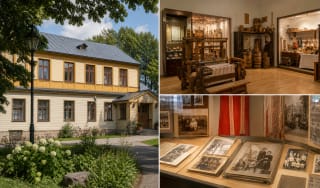
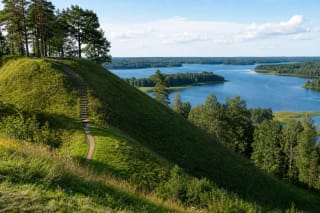
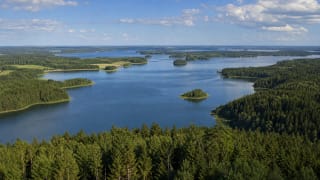
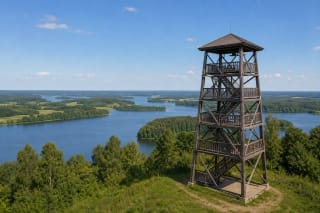
Antazavė Manor stands at 17 Dvaro Street, coordinates 55.8080897, 25.9259772, on the north shore of Lake Zalvė. The restored palace is a branch of Zarasai Regional Museum, formally titled the Craft Centre at Antazavė Manor and Emilija Pliaterytė Exhibition. The park, outbuildings, and ruins form a wider homestead, but ticketed displays are concentrated inside the palace.
Woodcarving, weaving, and pottery studios occupy the semi-basement. Other floors contain the Emilija Pliaterytė and manor-history displays, a chamber venue, rare-book library, changing exhibitions, and an artists' residence; the attic has been adapted for training and conferences. The precise content of a visit consequently depends on the temporary show and any workshop booked in advance.
In December 2025, a privately held portrait of Emilija Pliaterytė painted by Tadas Lukoševičius in the first half of the nineteenth century was placed on temporary display here. Official information also mentions work by Šarūnas Sauka, Nomeda Saukienė, Noe Kuremoto, Petras Stauskas, and others, alongside private collections. Loans and exhibitions change, so confirm a specific work before travelling.
The 1790 contract names Antanas Naglovskis, while Gucevičius remains an attribution
Antazavė was first recorded in 1560 and long formed part of the Dusetos estate, held by the Radziwiłł family and later owners. In 1686, the Tyzenhauz family sold Dusetos with its Antazavė folwark to Jonas Andrius Plater and Liudvika Marija Plater. The separate property passed in 1729 to Aleksandras Konstantinas Plater, thought to have founded a timber residence here and named it Zalva.
Liudvikas Plater and Kunigunda Wołłowicz-Plater held the estate from 1783. In 1790, the Platers contracted architect Antanas Naglovskis to deliver the masonry palace, two service wings, church, rectory, hospital, inn, and planned town within four years. Kunigunda also oversaw the road to the church and creation of the park.
Tourism accounts frequently attribute the palace to Laurynas Stuoka-Gucevičius, but the surviving contract directly names Naglovskis. The careful conclusion is that Antanas Naglovskis is the documented architect and builder, while a design by Gucevičius or influence from his school is a literary hypothesis that has not been demonstrated conclusively.
Two projecting wings shape the Classical façade, while the basement preserves an earlier residence
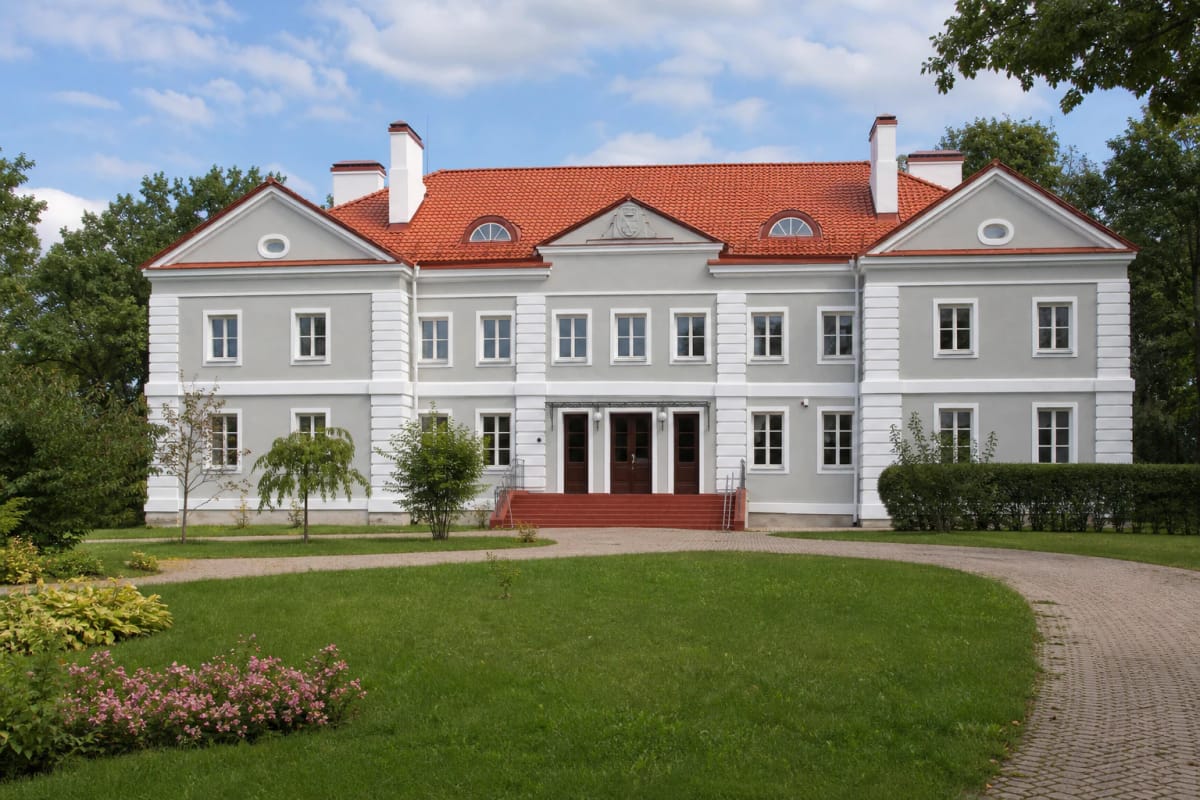
The late-eighteenth-century palace is a rectangular two-storey building with a semi-basement and attic. White rusticated strips articulate the grey rendered front and its symmetrical side projections, each capped by a triangular pediment and round oculus. Red tiles cover the main hipped roof and gabled projections, while a smaller central pediment carries a heraldic shield.
A fieldstone base supports walls of red brick. Brick barrel vaults with lunettes survive in the semi-basement, part of which incorporates fragments of the cellar beneath the preceding timber manor. Today's craft studios therefore inhabit the oldest architectural layer rather than a newly excavated service floor.
Remodelling in the late nineteenth and twentieth centuries reduced or blocked some openings and rebuilt sections of cornice. The façade was lowered from an earlier three-storey appearance, while columns and two column-supported balconies at the principal entrance disappeared. The present symmetry is a restored stage in a changing building, not a literal copy of its 1790 condition.
Emilija Pliaterytė was not born here, but declared for the uprising on 25 March 1831
Antazavė belonged to Emilija Pliaterytė's grandparents Liudvikas and Kunigunda, and her father Pranciškus Ksaveras was born here in 1785. Emilija herself was born in Vilnius in 1806 and, after her parents separated, lived with her mother principally at Līksna near Daugavpils from 1815. She visited her grandmother at Antazavė, making it an important family place but not her birthplace or permanent home.
On 25 March 1831, Emilija signed a declaration in the manor office stating that she was joining the uprising voluntarily and intended to fight for freedom. She rode from here to the Didžiadvaris estate at Dusetos, where she and her cousin Cezary Plater assembled their first insurgent detachment. This documented event makes the exhibition more than a later commemorative association.
Preparations on the Dusetos estates included forging scythes into pikes, casting ammunition, and producing two mechanical cannon. Those activities should not be assigned automatically to a particular room at Antazavė unless a source does so. The display is most valuable when it distinguishes the declaration written in the manor office from the Plater insurgents' wider activity around Dusetos.
An orphanage and boarding school followed the looting, before culture returned in 2012-2021
Later generations of Platers and the Ledóchowski and Ropp families inherited the estate during the nineteenth century. Surviving or fragmentary farm buildings were erected in 1838-1839. German forces installed a commandant's office in 1915, the palace was repaired and decorated in 1925, and part of its archive was transferred to Poland in 1936.
Elžbieta Franciška and her husband Mikołaj Woynarowski were deported to Tomsk Region on 14 June 1941. The estate was looted, documents burned, and its library dispersed. An outpatient clinic occupied the palace after the war; reconstruction in 1949 converted it to a children's home, followed by a boarding school from 1961. Local historian Stanislava Kirailytė later began a regional museum upstairs.
Renewal of the semi-basement began in 2012 and work on the upper floors in 2018. Projects upgraded services, roof, windows, façades, and interiors while adapting spaces for visitors and cultural use. Craft studios opened below in 2020, principal building work ended in 2021, and the official heritage-activation project closed in May 2022.
The protected homestead has six components, while its park only began visitor adaptation in 2026
The Cultural Heritage Register lists Antazavė Manor Homestead as complex 928 over approximately 18.88 hectares. Its six components are the palace, granary, remains of a cattle shed, remains of a threshing barn, a cellar, and the park. The three park terraces retain formal and landscape-planning areas, fragments of deciduous avenues, two enlarged ponds from a former chain of four, and a path along Lake Zalvė.
A project to make approximately 11 hectares of the park visitor-ready began in January 2026 and is scheduled through the end of 2028. It covers paths, vehicle access, parking, rest areas, lighting, and accessibility. The restored palace and still-worn park infrastructure are therefore at different stages; ask the museum about any restrictions caused by current work.
The official museum site lists Wednesday-Sunday 10:00-18:00, with Monday and Tuesday closed, although the public Google entry showed Sunday 11:00-16:00 on the research date. The museum's general tariff lists EUR 2.50 standard and EUR 1.50 concession admission for an exhibition, but its address row does not name Antazavė explicitly. Confirm admission, workshops, an accessible route, and opening by calling +370 385 56 180. On 13 July 2026, Google Maps had 511 reviews averaging 4.5 out of 5.