- Category
- Villages and Settlements
- Type
- Landholding and homestead layout type
- Context
- rėžinis kaimas, street-and-strip village, valakas, Volok Reform, land strips, three-field system
- Source status
- well attested
Street-and-strip village, Volok village, Strip-field landholding
Rėžinis Strip-Field Village: types and elements
Homestead strip: A narrow plot where the homestead faced the street and farm buildings extended inward.
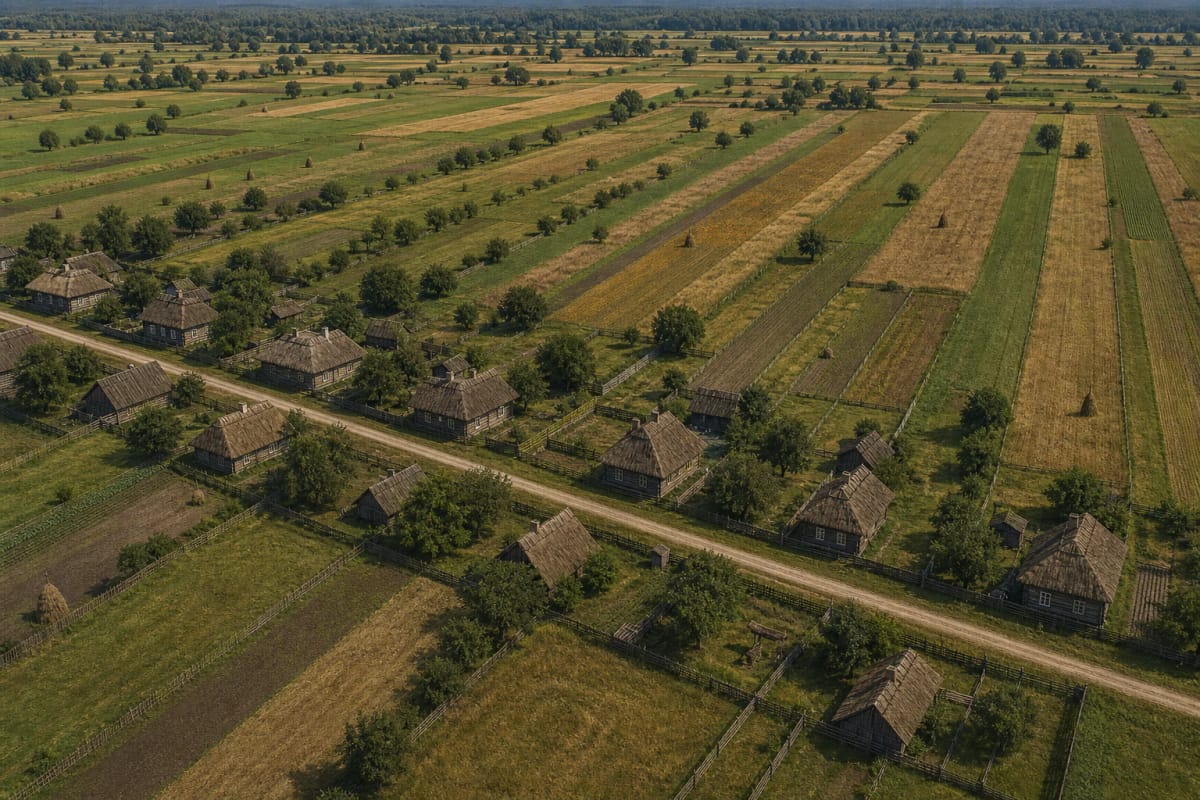
Field strips: Long strips of land assigned to families across different fields.
Street-and-strip plan: A settlement form in which land strips and the street create one coherent layout.
What is a rėžinis village?
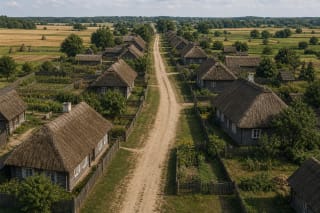
A rėžinis kaimas is a settlement whose land is divided into long, narrow strips. Homesteads usually stand along a street, with homestead and field strips stretching behind them.
Such a village is not only a row of buildings. It is a landholding system that shapes the farmyard, the placement of buildings, and the village landscape.
The Volok Reform
Strip-field landholding is especially associated with the 16th-century Volok Reform. The reform aimed to organize land, taxes, and three-field agriculture, so many settlements were replanned. According to VLE, the Volok Reform was a feudal land reform of the Grand Duchy of Lithuania, carried out in the second half of the 16th century in Lithuania and part of Belarus; its main goal was to increase the grand duke's treasury income and distribute peasant obligations evenly by introducing a common three-field system of fallow, winter crops, and spring crops.
Each family held land strips in different fields, while the homestead strip met the street.
Homestead layout
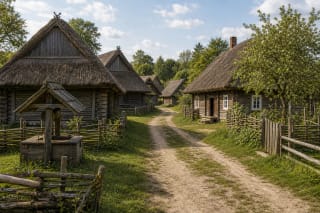
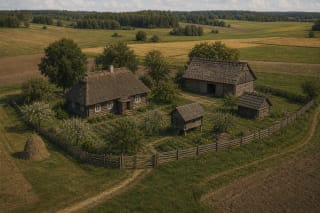
The dwelling house and klėtis granary more often stood near the street, while barns, cattle sheds, threshing barns, and other farm buildings stood deeper in the plot. In a narrow strip, buildings had to fit in an orderly sequence.

As strips narrowed, buildings could be squeezed into very limited space. This created a dense but legible village view.
Heritage value
Protecting a rėžinis village is not only about saving one troba. The row of homesteads, street, traces of strips, fences, building orientation, and connection to fields all matter.
Settlements such as Rimašiai or Poškonys help show how landholding directly shaped architecture.