- Category
- Death and Fate Birds
- Domain
- Death, fate, prophecy, black color, battlefield, devil form, mediator between worlds, juodvarnis
- Source status
- folkloric
raven, crow, juodvarnis, kranklys, black ravens
What do the crow and raven mean?
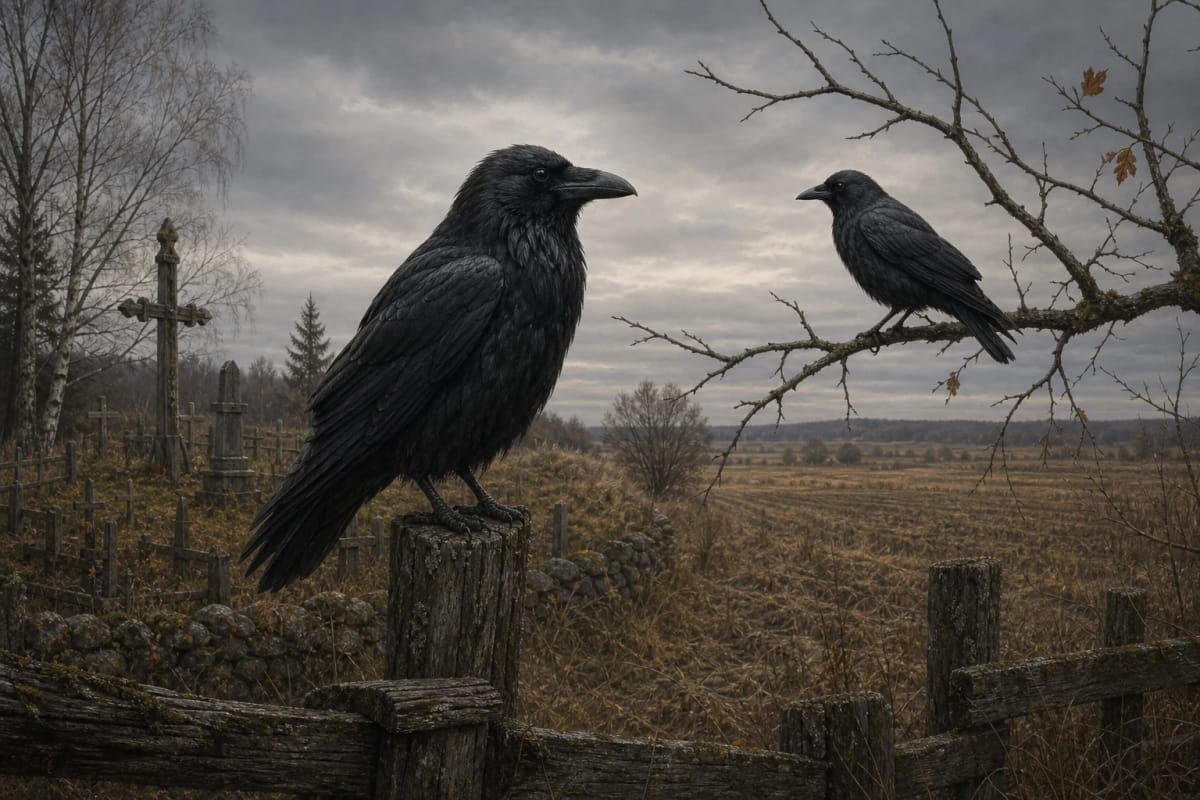
In Lithuanian folklore the crow and raven are first of all birds of death, fate, and prophecy. They are black carrion-eating creatures that circle human homes, fields, and cemeteries through winter and summer, so in folk imagery they stand on the boundary between the worlds of the living and the dead.
Their black color, cawing voice, and link with carrion made them birds awaited with anxiety. Where crows gather, people believed there is death or slaughter, so their arrival or cawing was often read as a sign of bad news.
At the same time these birds are not only negative. In tales the juodvarnis can be the form of an enchanted human being, and in wonder tales a bird may bring the hero a needed object or message. The raven image therefore remains ambivalent: ominous and knowing.
Crow and raven: how do they differ?
In folk speech and folklore the crow and raven are often interchanged, but they are not quite the same. The crow is smaller and familiar near human dwellings, while the raven, often called juodvarnis or kranklys, is larger, rarer, more forest-bound, and considered more threatening.
In folklore records, juodvarnis, varna, and kranklys often appear as variants of the same image. Norbertas Vėlius, describing the devil's forms, speaks of the devil appearing specifically as juodvarnis, crow, or raven, showing that the main point is not biological species but the idea of a black fate bird.
Still, the symbolic weight is not identical: the larger, blacker, and more forest-and-carrion-linked the bird is, the more ominous it becomes. The raven or juodvarnis therefore appears more threatening in folklore than the crow familiar to the homestead.
Cawing and prophecy
The voice of the raven and crow has its own meaning in folklore. Cawing near or above the house was considered an omen of misfortune, illness, or death, as if the bird were announcing what humans could not yet see.
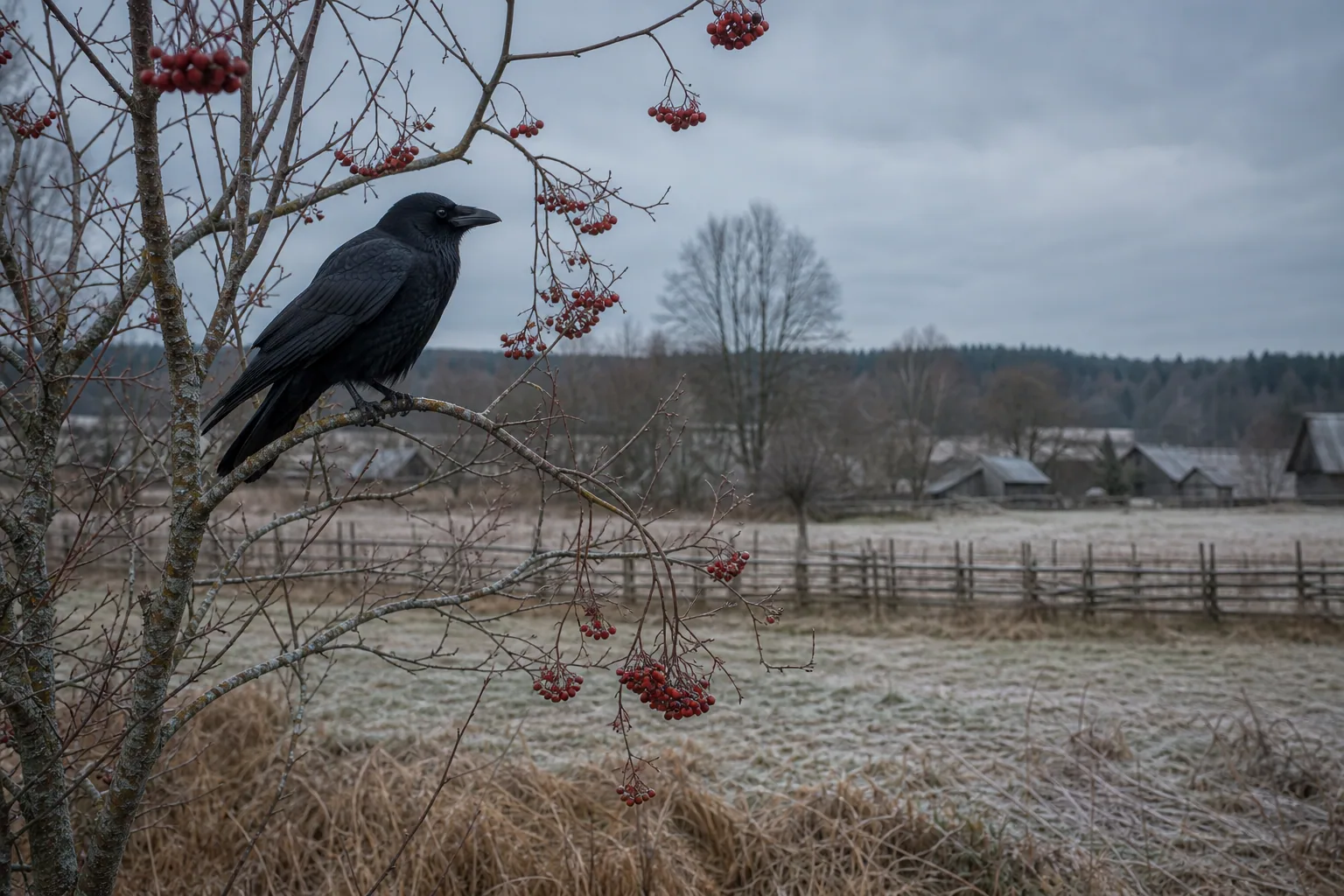
This role as a herald of fate places the crow in the same group as the owl and other night or forest birds whose voices people tried to interpret. The difference is that the crow and raven prophesy not only at night but also by day, in open fields, so their signs touch the whole community.
This prophetic quality is closely tied to the fact that the birds are seen where death is present: on battlefields, near dead livestock, and near graves. For the community they became a living reminder of death's nearness and fate's inevitability.
Juodvarnis: a form of the devil
One of the raven's most important roles in Lithuanian legends is as a form of the devil. Norbertas Vėlius notes that among all birds the juodvarnis, raven or crow, is the form most characteristic of the devil, so in legends the devil often appears as a black bird.
Vėlius describes the juodvarnis as a black carrion-eating bird that in many mythologies was imagined as a mediator between beasts and birds, between the worlds of the living and the dead, between earth and underworld. This mediating role explains why the devil, a chthonic being connected with the realm of the dead, most readily appears as a raven.
The raven in Lithuanian mythology is therefore not simply a frightening animal, but a boundary marker. Where it appears, this world and the other world touch. This layer links the raven with the devil, vėlės, and cemetery imagery.
The brothers as black ravens: the transformation motif
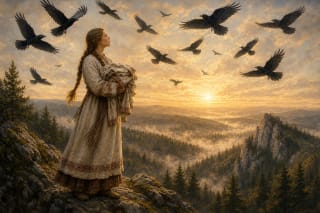
The raven's power of transformation appears most vividly in wonder tales, especially the tale of twelve brothers turned into juodvarniai. In it enchanted brothers lose human form and become black birds, and only their sister's silence, patience, and sacrifice can free them.
In this tale the raven is not a sign of death but the form of a human being under a curse. Transformation into a bird means a temporary fall out of the human world, while return to human form means redemption and the restoration of the family.
This motif shows that bird form in folklore was understood as an intermediate and unstable state between human life and another world. It again connects the raven with boundary, transformation, and fate.
The raven in wonder tales
Alongside danger, the raven in tales can also be a knowing helper. In wonder tales it is often a bird that brings the hero what the hero cannot reach alone: a distant message or magical object.
In such tales a bird connected with the otherworld can cross boundaries a human cannot. The raven becomes a mediator between the hero and the mysterious world from which help or a life-restoring object comes.
This role does not contradict the raven as a bird of death; it complements it. The same bird that knows death may also know the road out of it, so in the world of tales it remains powerful and ambivalent.
How should the crow or raven be read today?
Today the raven is often seen only as a gloomy, mystical bird, but in Lithuanian folklore its meaning is richer. It is a herald of fate and death, a form of the devil, a sign of transformation, and also a knowing helper in tales.
The raven is best explained together with the owl, cemeteries, the devil, and the world of vėlės. Then it becomes clear that it marks a boundary, not simply evil. The juodvarnis reminds us that death and fate are part of the world, and the bird that foretells them can also mediate between worlds.
Distinguishing raven from crow and from a general dark-bird image gives a more precise folklore picture: this is not a universal fear symbol, but a concrete figure in Lithuanian legends and tales rooted in death, fate, and transformation.