- Category
- Night and Fate Birds
- Domain
- Night, death, fate, prophecy, hooting, fire, wisdom, otherworldly knowledge, eagle-owl
- Source status
- folkloric
owl, eagle-owl, pūcė, yvas, night bird
What does the owl mean?
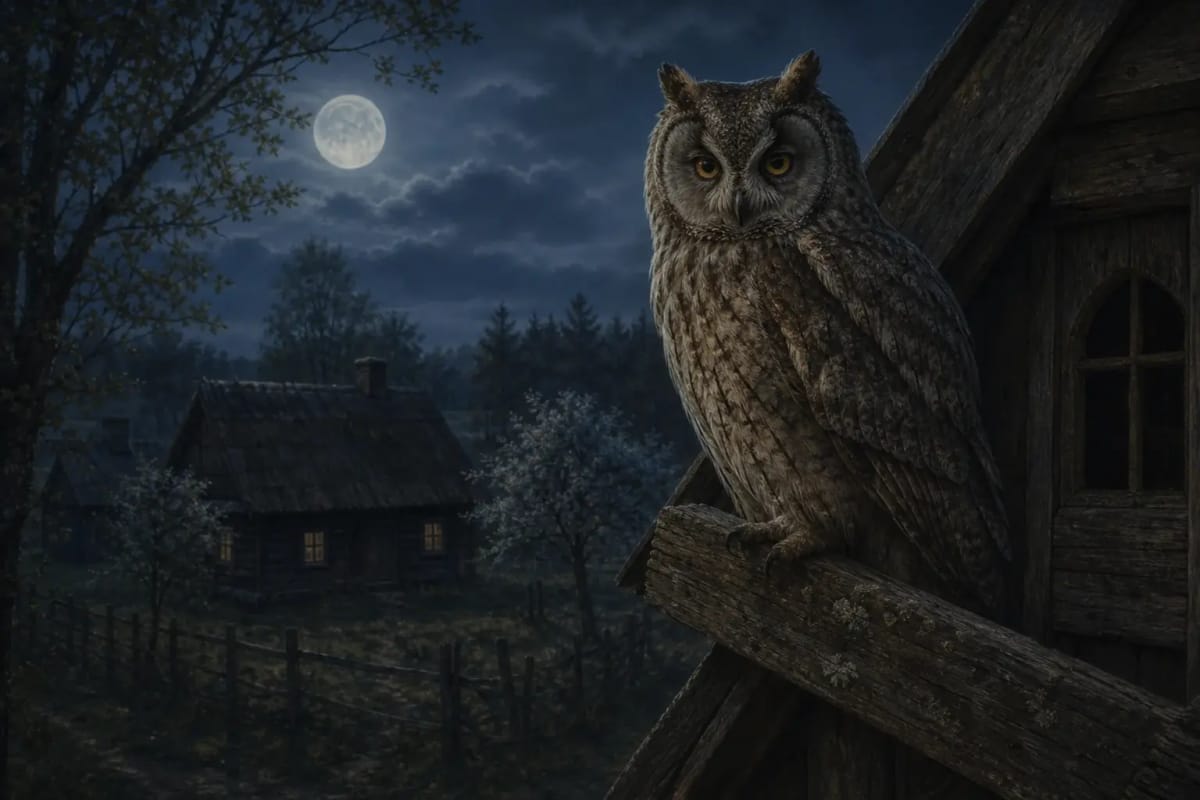
In Lithuanian and Prussian folklore the owl is a bird of night and fate. Because of its nocturnal life, large eyes, and oppressive hooting, it stood on the boundary between day and darkness, life and death, so its voice was usually read as a sign.
Its most important role is as an omen of death. An owl hooting or moaning near the house was believed to foretell death or illness, and its appearance caused anxiety. At the same time it was not treated as pure evil, because a night bird circling close to a human dwelling could be understood as warning and knowing.
The owl image is ambivalent: it announces death and sometimes new life, sees in the dark, and seems to know what is hidden. In folklore it therefore stands between threat and mysterious wisdom.
Omen of death
The clearest feature of the owl in folklore is its connection with death. It was believed that if an owl hoots or moans near a house, someone there will fall ill or die, and if it moans in the fields, a bad and unhappy time will come.
This belief is very old. In the sixteenth century Lucas David described a Prussian superstition that if a large owl called an apuokas hooted for three nights while sitting on a house, someone there would die. Similarly, hearing an owl moan at midnight meant death was near.
Because of this link with death, the owl belongs to the same group of fate birds as the raven. The difference is that the owl is nocturnal, so its prophecy is especially tied to darkness, sleep, and what happens unseen by people.
Testimonies of Lucas David and Matthäus Prätorius
Much about the owl is known from old writings of Lithuania Minor and Prussia, later summarized by researchers. Matthäus Prätorius wrote that the Nadruvians did not touch owls and even put food out for them. This shows that the bird was respected and considered to have special power.
Prätorius also recorded stories in which an owl speaks and warns people. In one, while a fine linden was being cut, an owl in a nearby tree cried 'Run, run!' four times to a man; he hid and avoided the overseers who would have caught him. In another story, people returned a captured owlet out of pity, and the old owl loudly thanked them with 'Thank you, thank you'.
These testimonies show that the owl was understood not only as a herald of death, but also as a speaking, warning bird that intervenes in human life. This knowing role adds to its ominous image.
Signs of fire, loss, and new life
In folklore the owl foretells more than death. It was also considered an omen of loss and fire, so its hooting could be connected with various household and farm misfortunes, not only with human death.
Yet in some beliefs the owl's voice meant the opposite: new life. A belief was recorded that if a pūcė, an owl, croaks or cries near the dwelling, there will be a christening there. Thus the same bird could foretell both death and birth.
This duality is typical of liminal folklore birds. The owl stands at a crossing between states, so it can announce both departure from the world and arrival into it. Its sign always needed interpretation: where and when the bird appeared mattered.
Night, sight, and wisdom
The owl differs from many birds because it keeps watch at night and sees in darkness. It was therefore linked with what is hidden from people and with otherworldly knowledge, a bird that notices what others do not see.
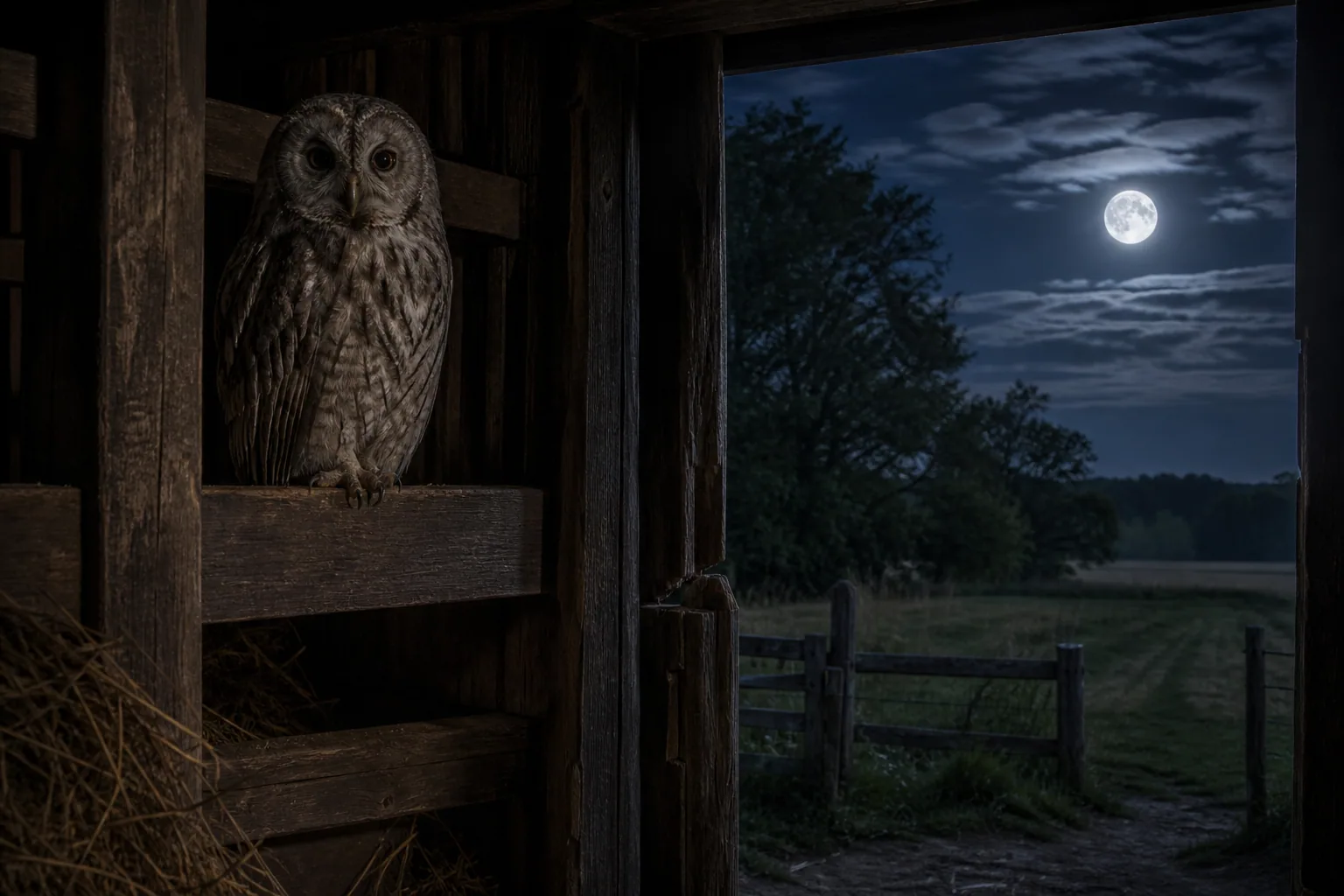
This trait gives the owl a shade of wisdom and vigilance. Night vision was understood in folklore as a special ability, so the owl could mean not only threat but also knowledge, warning, and watchful alertness.
Still, in Lithuanian tradition the owl's wisdom is not separated from death. It knows what is dark, so its knowledge is closely bound to fate, night, and the otherworld rather than to light and learning.
The owl and the devil
The owl also belongs to the chthonic layer of mythology. Norbertas Vėlius, describing forms of the devil, lists the owl among birds, beside raven and cuckoo, into which the devil may turn. The night bird was therefore linked with forces of the dark side.
On the other hand, the owl was also used as protection. In legends and beliefs, to stop devils from riding and tormenting horses, a dead owl was hung on the stable door, as were a magpie or small hawk. The night bird thus became a protective sign against the very night forces it resembled.
This duality, the bird as both a form of the devil and protection against him, shows that the owl is a boundary being in Lithuanian mythology. It acts where night and day, living and dead, household order and wild darkness meet.
How should the owl be read today?
Today the owl is most often seen as a symbol of wisdom, a meaning that comes through wider Western tradition. In Lithuanian folklore the older and more complex image should remain visible: here it is first of all a night bird and omen of death, and only then a knowing, warning being.
The owl is best explained together with the raven, night, the devil, and signs of death. Then its hooting is seen not as an ordinary sound but as a message about illness, death, loss, or even birth, which people tried to read correctly.
It is also worth distinguishing the folklore owl from unrelated uses of the word: in general reference works Pelėda may even name an emigrant humor magazine, so folklore meanings should be grounded in ethnological research and old sources.