- Genre
- Chronicle myth of the divine smith
- Source status
- late written source
- Motifs
- Kalvelis, Teliavelis, Sun, smithing, fire, heavenly body
Teliavelis and the Sun, Kalvelis, The forged Sun, Divine smith
The myth
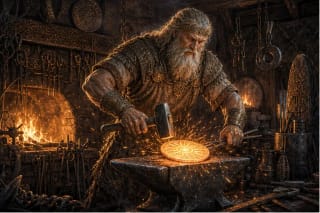
The myth of Kalvelis, or Teliavelis, tells of a divine smith who forges the Sun. The image is short but powerful: the heavenly light does not simply appear, but is made through smithing.
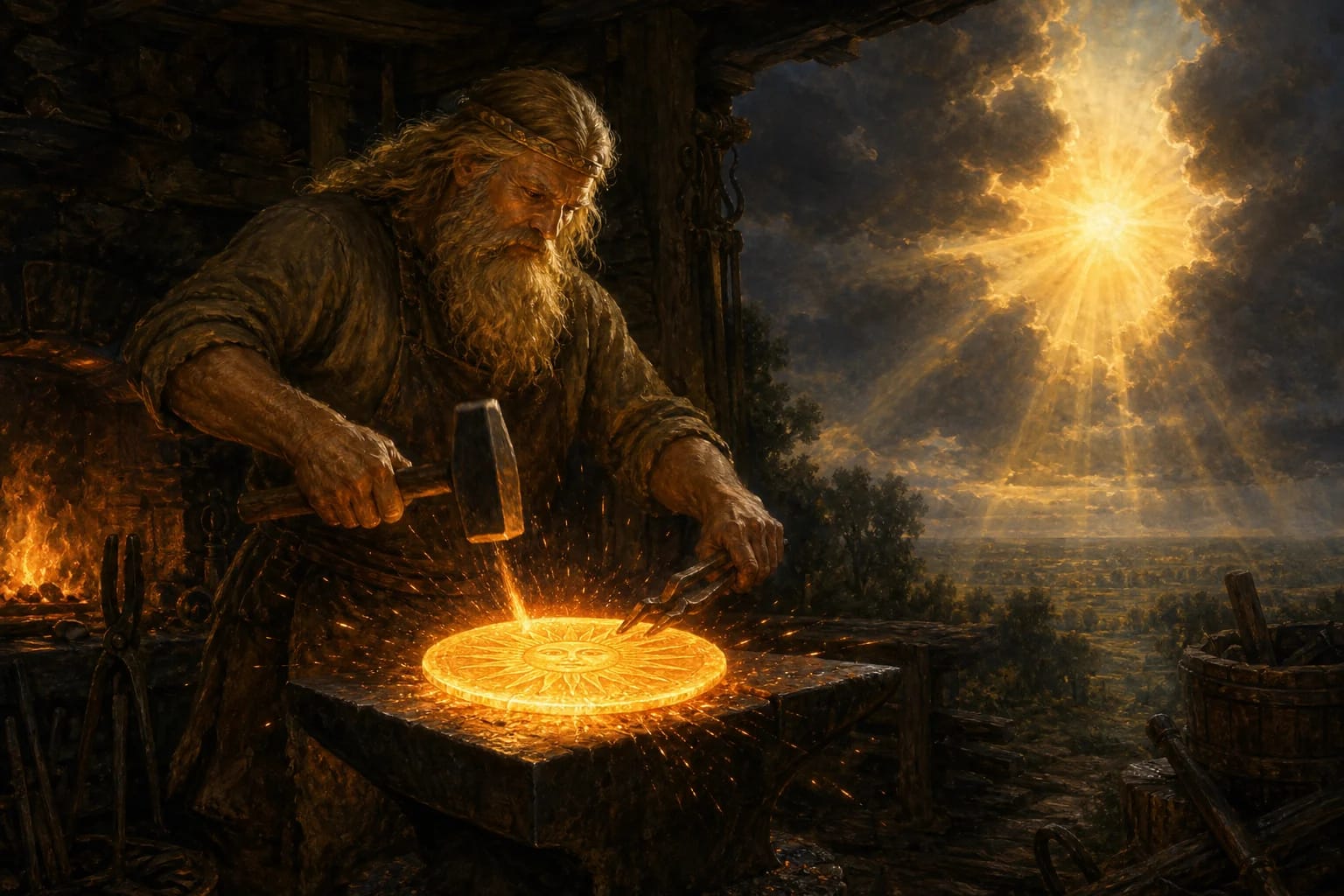
The smith works with fire, metal, and blows. In this myth the Sun becomes not only a heavenly body but a crafted object, a disk of light raised or thrown from the smithy into the sky.
The story is known from late written sources and scholarly interpretation, so it should be read as a brief mythological fragment rather than a long folk tale.
Interpretation: what does the forged Sun mean?
The myth imagines the Sun as created light. Smithing explains how light gains form: it becomes a disk shaped by fire and craft.
Kalvelis joins craft and cosmos. In an ordinary smithy people forge tools; in a mythic smithy the smith can forge a heavenly body. Human craft is lifted to the scale of world-ordering creation.
Fire works in two registers here: the heat of the smithy and the light of the Sun. The myth is therefore a strong example of material work being read through cosmic order.
Another, earthier reading is possible. Some scholars, as VLE notes, connect Teliavelis with the devil of Lithuanian folklore, because folk narratives sometimes say devils first invented smithing and humans learned it from them. In that view, the forged-Sun motif moves from a high divine smith into a chthonic field of smithing and underworld powers.
The motif must be kept distinct from other layers: Saulė as a goddess, Teliavelis/Kalvelis as a smith figure, and the brief forged-Sun episode that connects them.
History and source status
VLE presents Teliavelis as an ancient Lithuanian god. In the Hypatian Chronicle he is mentioned second after Nunadievis, without a stated function. The specific forged-Sun motif appears in the 1261 interpolation in the Slavic translation of John Malalas' chronicle, where Teliavelis is called the smith who forged the Sun and cast it into the sky.
The name Teliavelis has been interpreted differently: Aleksander Brückner read it as a road god, Norbertas Vėlius as an earth god, and Vladimir Toporov as a borrowing from Scandinavian mythology. That uncertainty is why statements about the deity's identity should stay cautious.
The brevity of the sources is both a problem and a value. A problem, because we cannot reconstruct the whole myth. A value, because even a short fragment shows a very ancient bond between the smith, fire, and heavenly light.
Why this myth matters
The forged Sun motif shows Lithuanian mythology not only as a list of divine names but as an action: someone makes light and sets it in the sky.
It also connects mythology with craft. Smithing is not only practical work but a place where fire, iron, and light take on mythic meaning.