- Category
- Yard and Dawn Birds
- Domain
- Dawn, fire, night and its end, protection from night beings, foundation sacrifice, homestead boundary
- Source status
- folkloric
little rooster, red rooster, bird of dawn, weather vane
What does the rooster mean?
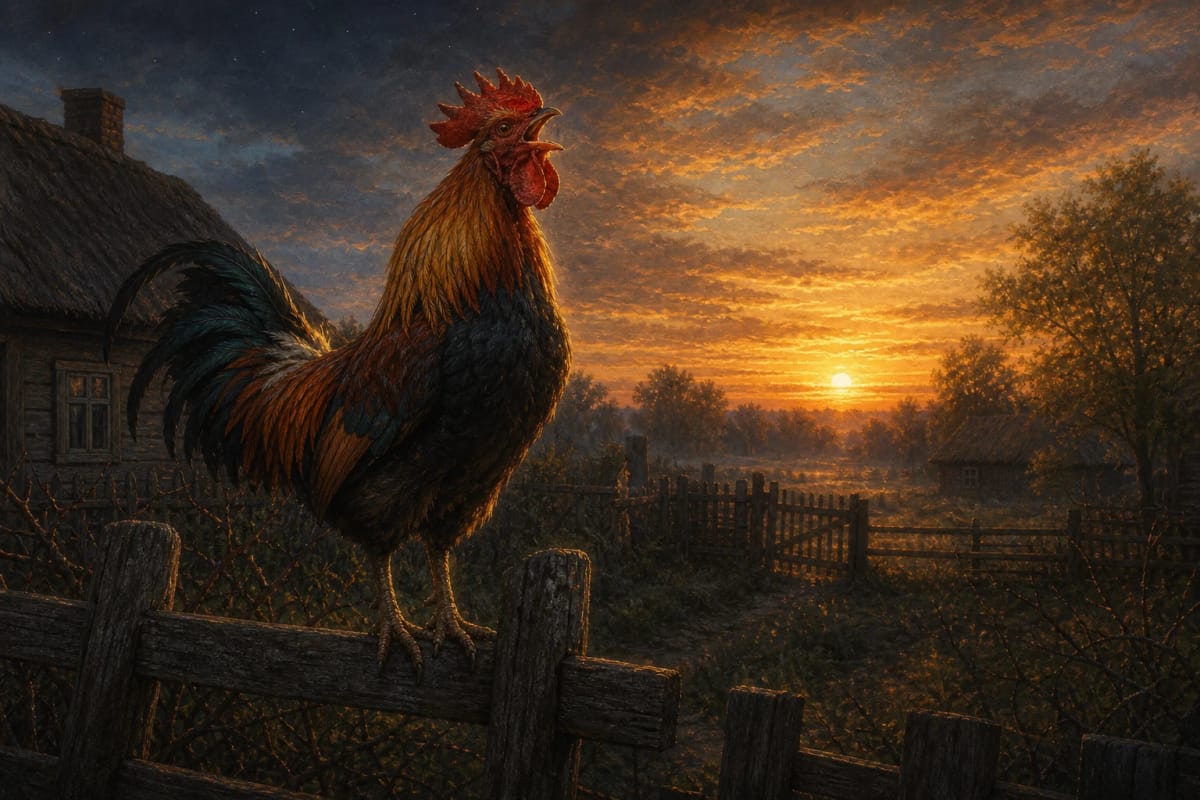
In Lithuanian folklore the rooster is a bird of dawn and fire. Its crowing announces morning, ends the night, and drives away the forces of night, so the rooster was understood as an ally of daylight and human order.
The rooster is also linked with fire and protection. Its red comb recalls a flame, and its crowing marks dawn's victory over darkness. It is therefore both a guardian and a herald of time.
The rooster and dawn
In folklore the rooster's crow marks the end of night. The first rooster call was understood as the boundary between night, when supernatural beings are active, and day, when the world again belongs to human beings.
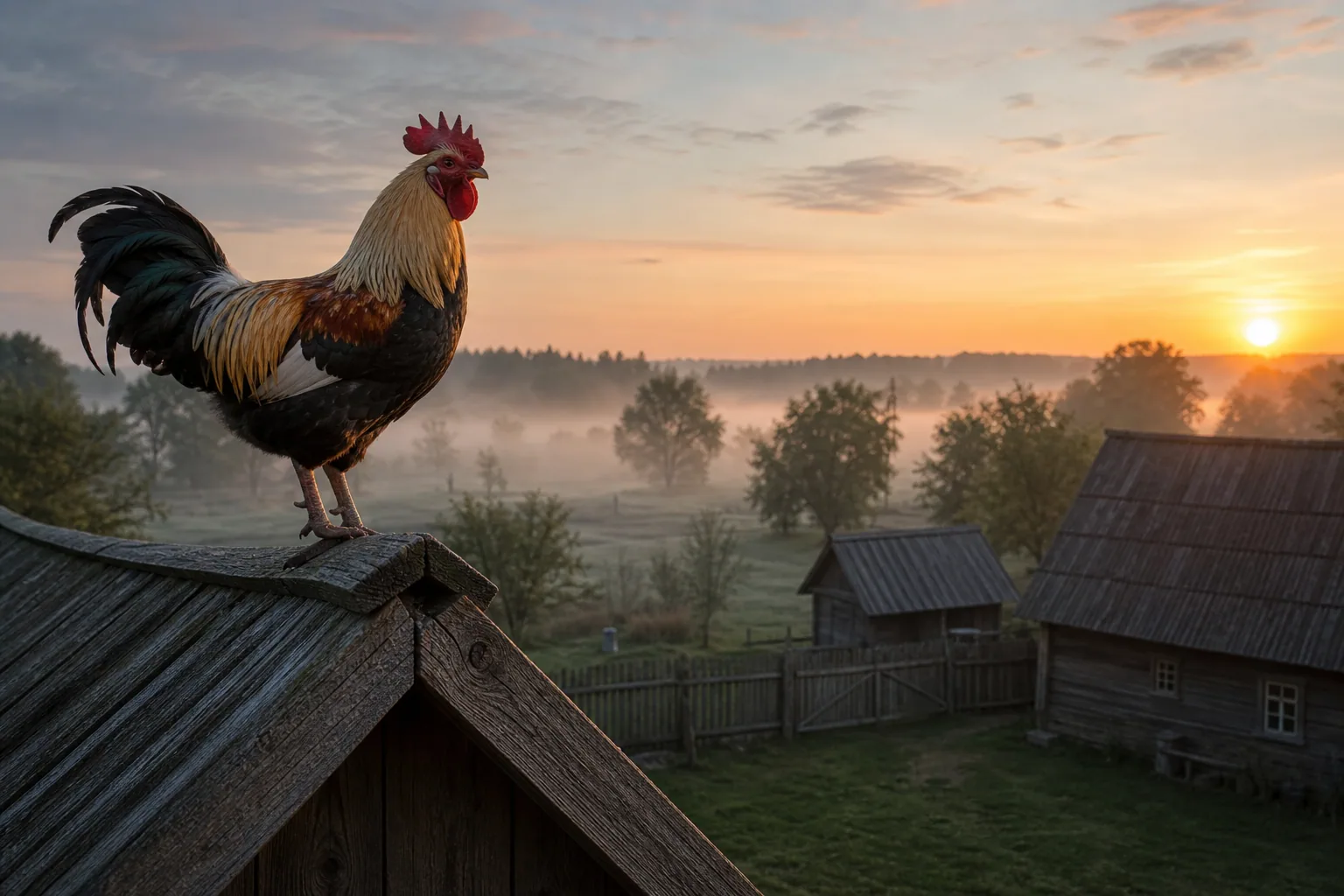
Because of this link with dawn, the rooster became a measure of time in the village. Parts of the night were counted by rooster crowing, and people rose for work by it. Thus the bird joined the daily rhythm of the household with the mythic relation between light and darkness.
When the rooster crows, night beings disappear
One of the rooster's most important roles is to drive away night beings. It was believed that devils, ghosts, and especially laumės can act only in darkness, and that at the first rooster crow they must disappear or abandon their unfinished work.
This is clear in laumė legends: a laumė working at night, building a bridge or dam across a river, has to leave everything unfinished when the rooster crows. Such works remain forever incomplete in folk narratives because the rooster cuts short the power of night forces.
The red rooster and fire
The rooster is closely tied to fire. Its red comb and bright feathers made it a fire bird, and the Lithuanian expression 'red rooster' means a fire or arson: to 'release the red rooster' means to set something on fire.
This connection with fire is double. On one hand the rooster was linked with the hearth and protective fire of the home; on the other, with dangerous, destroying flame. The image therefore joins protection and threat.
The rooster in foundation sacrifice
When a new building was raised, there was a custom of sacrificing a rooster, killing or burying it near the foundations so the structure would stand firmly and bring good fortune. This is the so-called foundation or cornerstone sacrifice.
Such a sacrifice shows the rooster as a bearer of life and luck, offered in exchange for settling in a new place. The bird's life is given to the foundation so the house may become safe and vital.
The rooster on the roof
The rooster figure is common on roofs and towers as a weather vane, a turning wind indicator in rooster form. Such a roof rooster shows wind direction, but it also preserves an older protective meaning.
The roof rooster continues the bird's role as a sign of dawn and protection: it keeps watch over the house, looks into the distance, and guards the homestead. Practical wind direction and deep folklore imagery are joined in one object.
How should the rooster be read today?
Today the rooster is often seen only as a yard bird or a symbol of early rising. In Lithuanian folklore it has a deeper layer: it is the bird of dawn, fire, and protection from night forces.
The rooster is best explained together with laumės, night beings, fire, and the homestead boundary. Then its crowing becomes not only a morning sound, but a mythic sign of light's victory over darkness.