
Love Pledge lyrics and meaning
Ateik, mergyte,
Pavasarėly,
Kai dyvai žydės
Močiutės darže:
Aplink lysates
Žalės rūtatės,
O viduryje
Vis lelijatės.
Aš tada skysiu
Margą kvietkatę
Ir nusiųsdysiu
Savo bernačiui.
Ne pati nešiu,
Nei kitai duosiu,
Šiaurių vėjačiu
Aš nupūsdysiu.
Ateik, bernyti,
Pavasarėly,
Kai dyvai žydės
Tėvo daržely:
Aplink sodatį
Žali čiepačiai,
O viduryje
Vis obelatės.
Aš nusiskysiu
Du obuolaičiu
Ir nusiųsdysiu
Savo mergatei.
Ne patsai nešiu,
Nei kitam duosiu,
Pietų vėjačiu
Aš nupūsdysiu.
View illustration
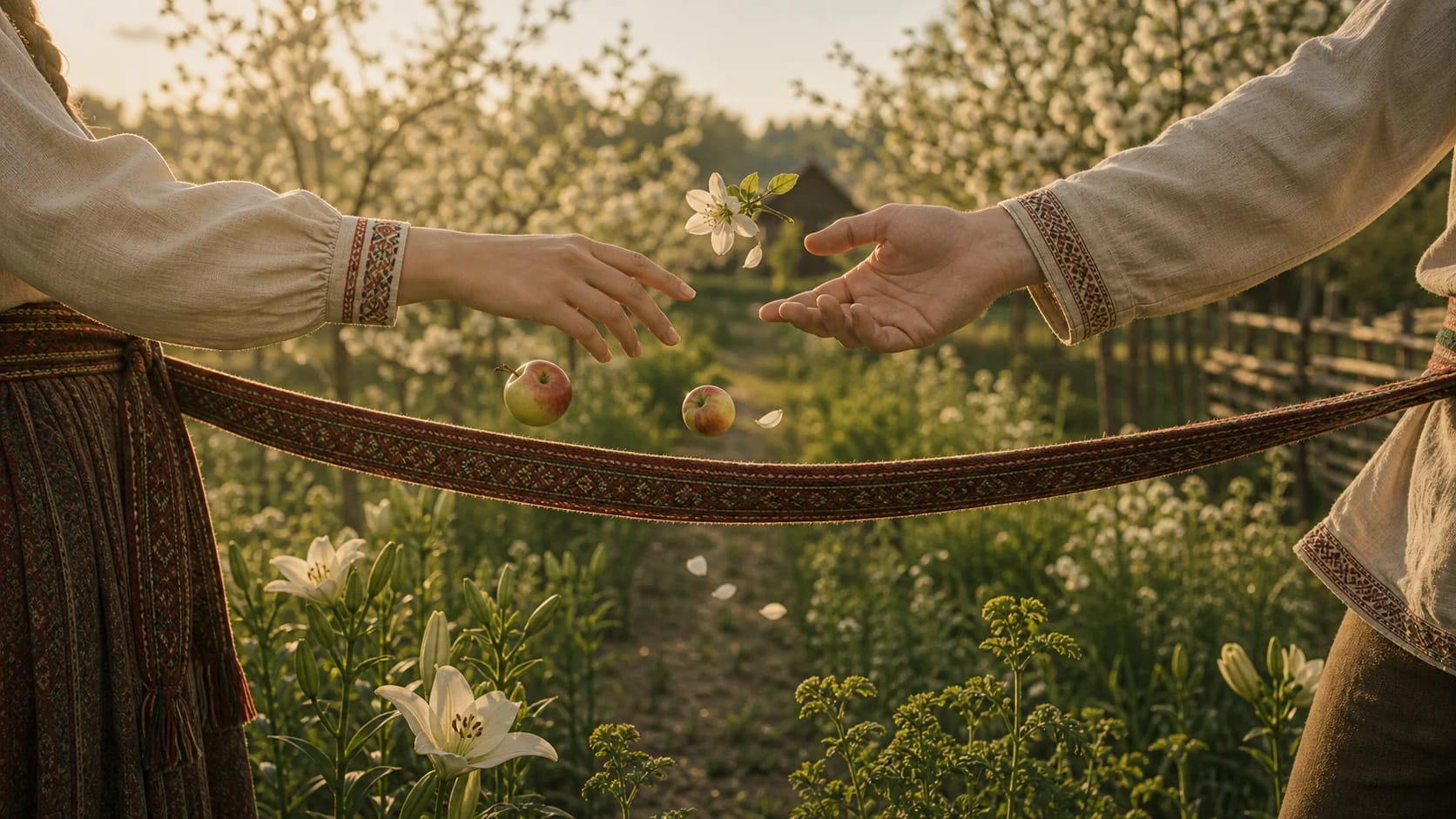
Love Pledge: song interpretation
Spring is the season of the pledge in this song. Rue, lilies, and apple trees bloom in the gardens, and the lovers speak to each other through plants and winds. It is a subtle language of love, in which the gift matters because of the path by which it reaches the other.
The north and south winds create directions between the young woman and the young man. They carry not only gifts, but trust: the pledge must cross distance without being placed into someone else's hands.
Love Pledge: symbols and phrases
- Pledge
- A promise of love, expressed in the song through flowers and fruit.
- Rue and lilies
- Plants of the young woman's garden, linked with beauty, purity, and youth.
- Apples
- The young man's answering gift. They suggest reciprocity, fruitfulness, and a mutual bond.
- Winds
- Carriers of the pledge. They let the love signs travel without human intermediaries.
Love Pledge: song history
"Love Pledge" appears in Liudvikas Rėza's collection as a spring song of promise. Although the exact title is not especially prominent in modern catalogues, Rėza's text clearly preserves a dialogue structure: the young woman and the young man each promise to send signs to one another.
The song is distinctive because the pledge is not handed over directly. The young woman sends a variegated flower on the north wind, while the young man sends apples on the south wind. In this way the promise becomes part of nature's movement.
Love Pledge: sources
Love Pledge: frequently asked questions
What does the pledge mean in this song?
It is a promise or given word. In the song, the promise is a love pledge expressed through symbolic gifts sent by wind.
Why does the song take place in spring?
Spring is a season of blooming, renewal, and the beginning of love. It naturally fits a pledge scene built around gardens, flowers, and fruit trees.
Why are the gifts sent by wind?
The wind lets the promise travel directly, without being handed to someone else. It is a poetic way to cross distance while preserving trust.
How are the young woman's and young man's gifts different?
The young woman sends a flower from her garden, while the young man sends apples from his father's orchard. Both signs come from their own home space.
Is this a dialogue song?
Yes. The first part calls to the young woman and gives her answer; the second part calls to the young man and gives his answer.
Why is the source trail mostly connected with Rėza?
The exact title is not common in modern catalogues, so Liudvikas Rėza's publication is the most reliable textual base for this page.