- Field
- Lithuanian straw-star and solar-ornament decorations
- Type
- folk art
- Heritage status
- living tradition
- Context
- Straw stars, straw sunbursts, snowflakes, radial ornaments, Christmas-tree toppers, window decorations, straw segments, thread, symmetry
Straw stars, Straw sunbursts, Straw snowflakes, Straw star ornaments, Straw Christmas-tree toppers
Straw Stars forms and objects
Flat radial star: A straw ornament arranged in one plane, with rays, star points, and the impression of a sunburst or snowflake.
Spatial straw star: A three-dimensional star or Christmas-tree topper made of several straw modules and attractive from more than one side.
Snowflake-type ornament: A smaller form, often with hexagonal or many-rayed symmetry, hung in a window, on a tree, or in a garland.
Sunburst-type ornament: A circular or radiating straw decoration in which a center and rays create an impression of light, a wheel, or the sun.
What Are Straw Stars?
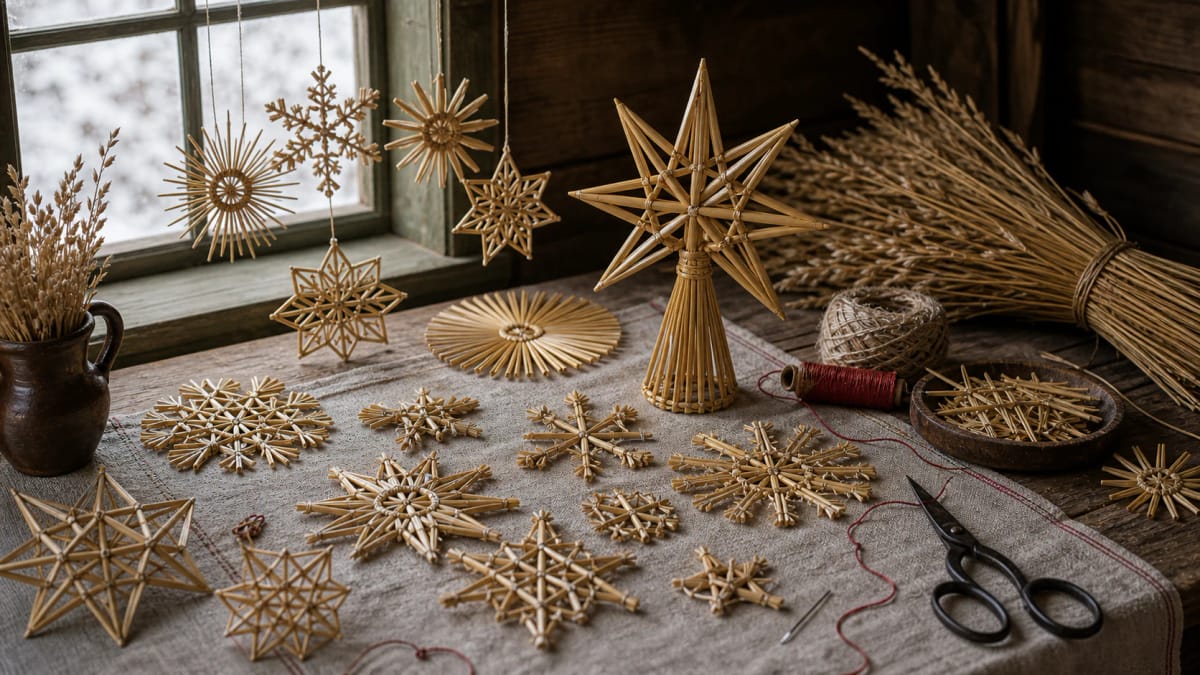
Straw stars are radial ornaments made from straw segments: stars, sunbursts, snowflakes, Christmas-tree toppers, and window decorations. They may be flat or spatial, small or larger, very simple or quite complex.
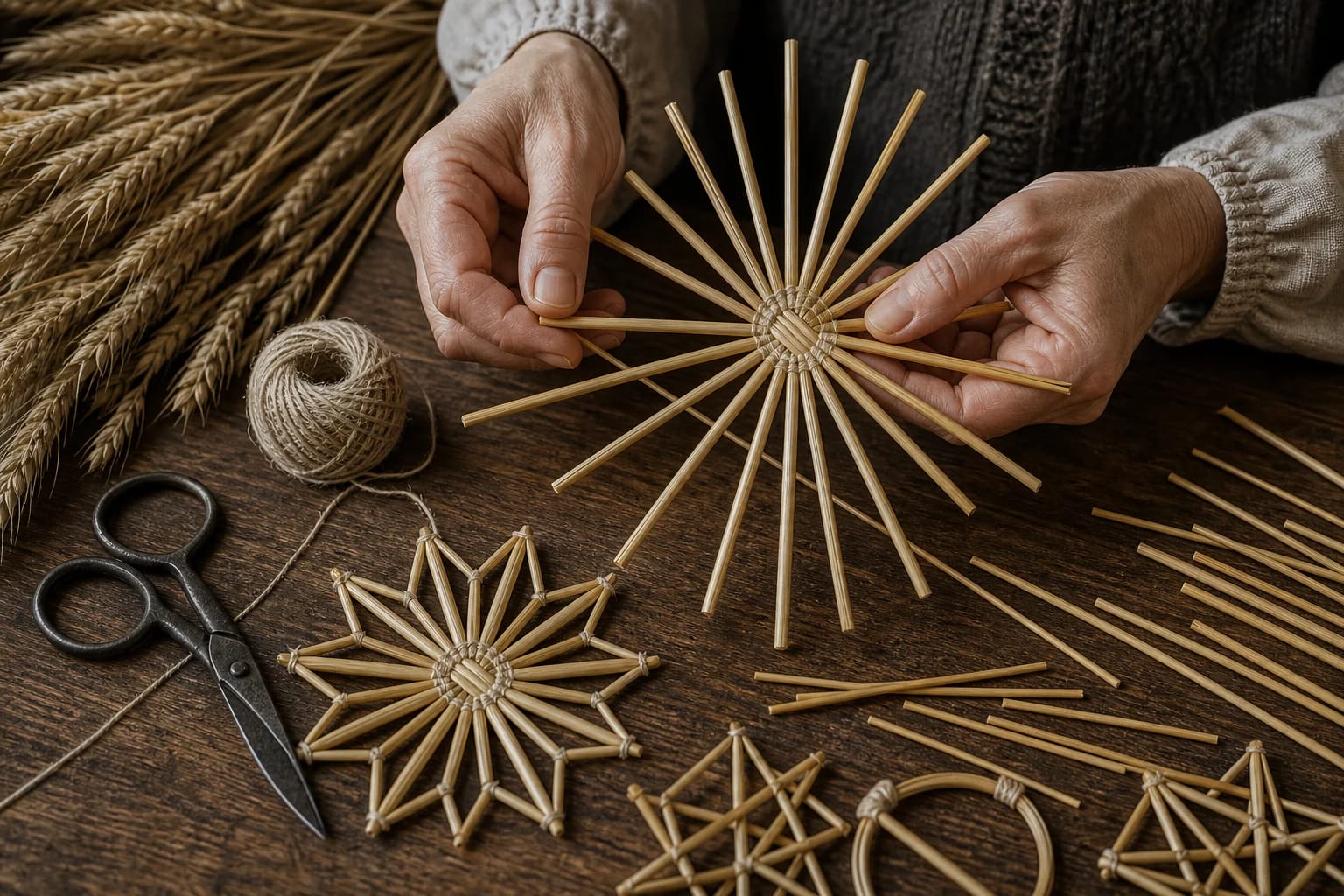
They belong to the same field of straw decoration as sodai and straw ornaments, but their form has a narrower principle: rays, a center, symmetry, and an impression of light.
A straw star looks light, but its order is strict. If the segments differ in length, the center is inaccurate, or the thread is too loose, the ornament quickly loses its geometry.
Flat and Spatial Forms
Flat stars are made in one plane. They suit windows, Christmas-tree branches, walls, table decoration, or garlands. In such forms, a clear outline is important: six, eight, twelve, or more rays.
Spatial stars extend in several directions and look good from the side. They may be used as a Christmas-tree topper, a hanging window ornament, or a small object recalling the geometry of sodai.
A flat form requires precision; a spatial form also requires balance. When hung, the star should stay straight rather than tilt to one side.
Material and Preparation
Straight, clean, unbroken rye, wheat, or oat straw is suitable for stars. The stems should be similar in thickness because uneven segments change the rhythm and weight of the ornament.
The straw is cut into equal segments. Some stars need very short pieces, while others need long rays. If the straw is hard, it may be soaked briefly so it breaks less easily.
Thread, a needle, scissors, and patience are needed. The thread must hold the form without squeezing so hard that the straw cracks. Every knot is part of the structure.
How Is a Radial Star Formed?
A radial star begins at the center. Around it, rays are arranged at equal lengths and equal intervals. Sometimes the center is made from a ring, knot, or small straw wheel.
The outer contour is then created: rays are joined with shorter segments, and points, branches, or snowflake-like offshoots are added. Every added layer should remain symmetrical.
Finally the star is hung and checked. Hanging immediately shows whether the structure is balanced. If it leans, knots or ray weight need adjustment.
Sunburst, Star, or Snowflake?
The same straw principles can create different impressions. When there is a circular center and many straight rays, the ornament reads as a sunburst. When the rays make an angular contour, it reads as a star. When the branches are fine and symmetrical, it resembles a snowflake.
The boundaries between these names are not mathematical. Makers and families may call the same form by different names depending on use, appearance, or local habit.
The important thing is not to force one meaning onto the form, but to describe it: center, rays, branches, flat or spatial construction, and where it is hung.
Symbolism: Light, Winter, and Caution
Straw stars naturally invite associations with light, winter holidays, the sun, heavenly bodies, and the image of snow or a snowflake. Still, not every star should be explained as a single ancient cosmological sign.
Official sources for straw gardens emphasize geometric, ritual, and communal tradition. Small stars are often a contemporary or living offshoot of decoration using the same material.
The best explanation keeps several layers together: grain straw, light and winter decoration, geometric order, family handwork, and Christmas or room decoration.
Use: Window, Tree, Table
Straw stars are hung in windows, on Christmas trees, above tables, in festive decoration, or in small garlands. In a window they are attractive because straw has a natural sheen and casts a light shadow.
On a tree they often work better than heavy ornaments because they are light. A spatial star may become a tree topper, while flat stars can decorate the branches.
In contemporary homes they fit well with linen, wood, clay, and natural spruce decoration. Excess glitter or plastic often overwhelms the straw itself.
Care and Storage
Straw stars are fragile. They should be stored in a dry box, separated with paper or light cloth, not compressed, and protected from rodents, insects, and moisture.
If an ornament becomes distorted, thread tension can sometimes be corrected carefully, but a broken segment often means that part must be threaded again.
An old or maker-made ornament should be documented. Recording who made it, when, and by what technique can be as important as preserving the fragile straw itself.