- Field
- Lithuanian straw ornaments, Christmas-tree decorations, and small festive decoration
- Type
- folk art
- Heritage status
- living tradition
- Context
- Straw ornaments, šiaudinukai, Christmas-tree ornaments, birds, horses, angels, bells, sunbursts, snowflakes, reketukai, small liktoriai, straw threading, straw tying
Šiaudinukai, Straw toys, Straw Christmas-tree ornaments, Straw ornaments, Small straw decorations
Straw Ornaments forms and objects
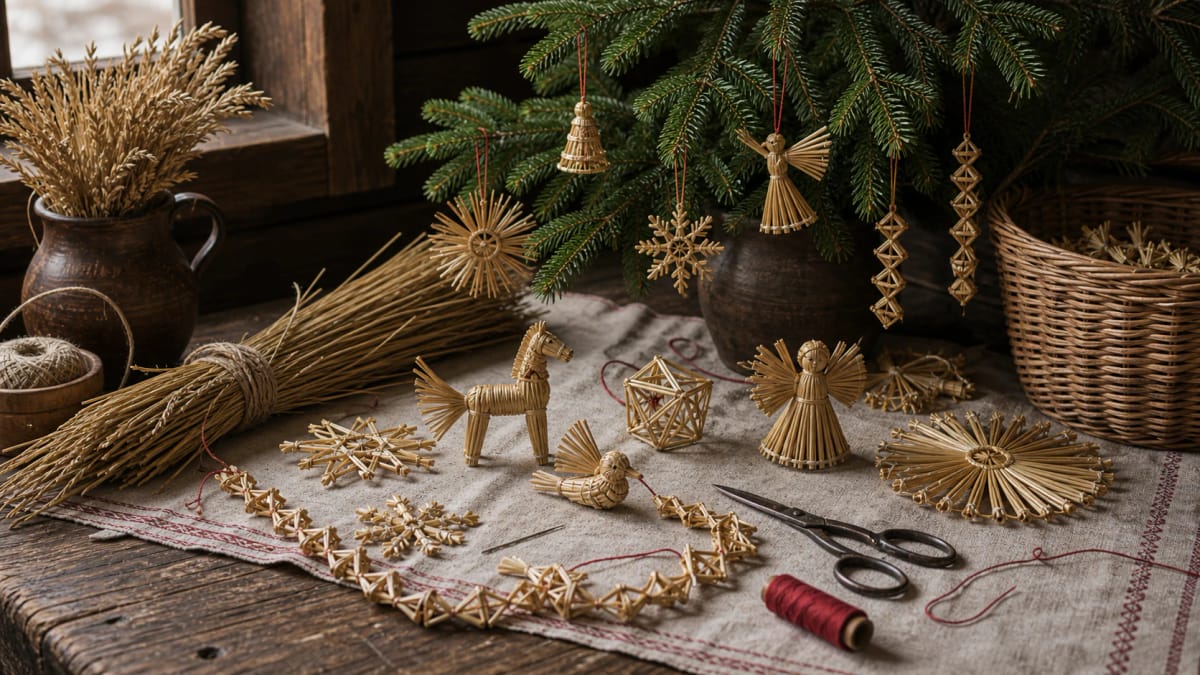
Figurative ornaments: Birds, horses, angels, small human figures, bells, and other recognizable forms tied from straw bundles and short segments.
Geometric ornaments: Reketukai, cubes, small diamonds, snowflakes, sunbursts, and small spatial forms close to the geometry of sodai but on a smaller scale.
Christmas-tree ornaments: Small hanging decorations now often used on Christmas trees, although Christmas-tree decoration itself is a later tradition in Lithuania.
Garland modules: Small straw forms threaded into chains for windows, Christmas trees, table edges, or room decoration.
What Are Straw Ornaments?
Straw ornaments are small ornaments threaded, tied, or folded from straw. They include birds, horses, angels, bells, sunbursts, snowflakes, reketukai, cubes, small human figures, garland modules, and other hanging decorations.
They are close to Lithuanian straw gardens, but they are not the same. A sodas is a larger, often spatial and symbolically dense construction hung indoors. An ornament is smaller and easier to hang on a tree branch, in a window, on a wall, or in a decorative room chain.
The Lithuanian word žaisliukas, literally toy or little plaything, does not mean only a children's toy here. It denotes a small decorative and festive object that can be made in children's workshops, family craft sessions, or by experienced makers.
Material: Which Straw Works?
Rye, wheat, or oat straw is most often used for these ornaments. It should be dry, clean, unbroken, fairly straight, and similar in thickness. The material determines whether the ornament will be light and orderly.
The straw is sorted, cut into segments, and sometimes soaked so it becomes more flexible. Figurative ornaments may require not only tubes but also flatter, pressed, or opened straw parts.
Thread, needle, and scissors are the main tools. Some ornaments rely on tying rather than threading alone. The most important thing is that the straw should not break and the form should keep its balance.
Birds, Horses, and Angels
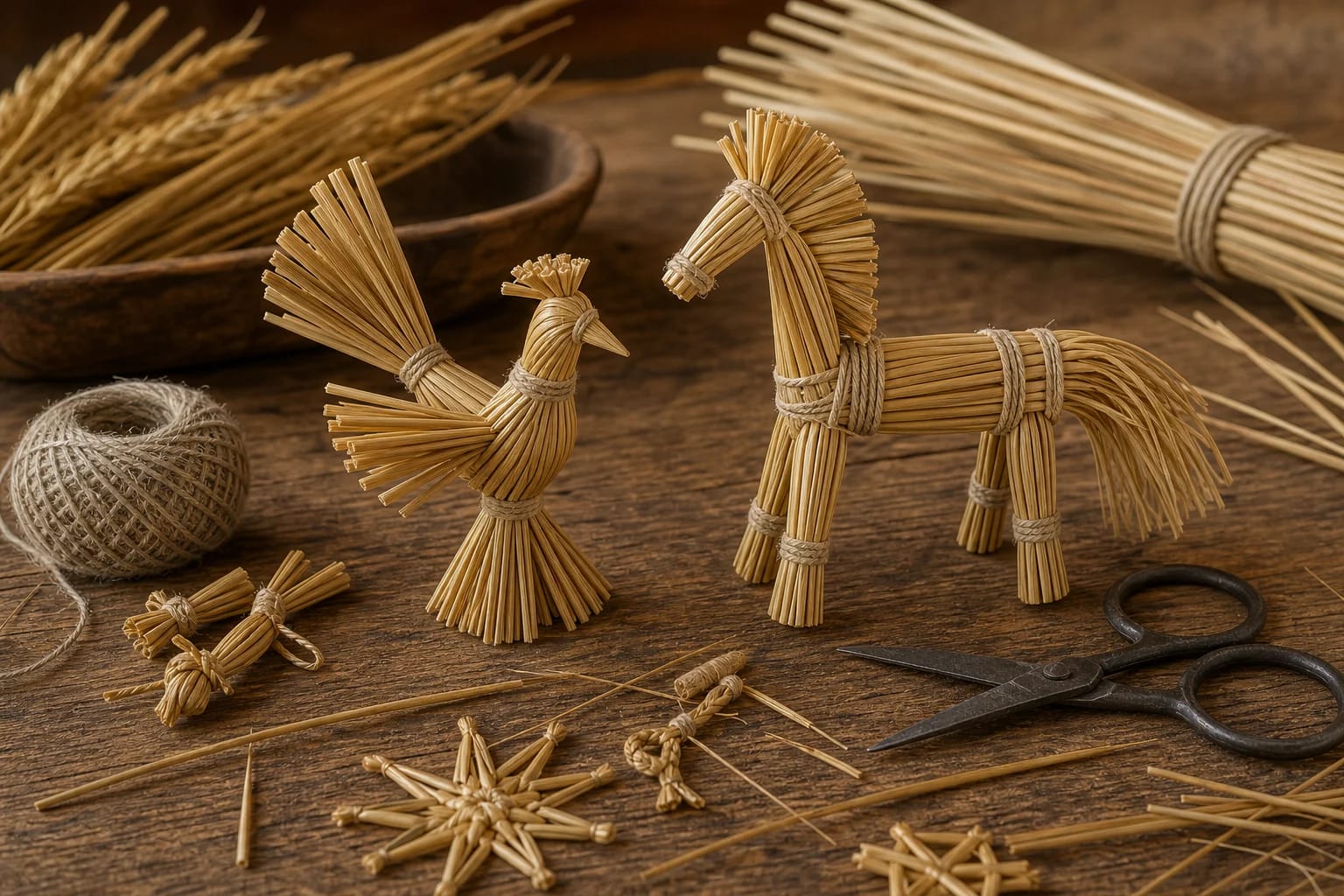
Figurative ornaments often show birds, horses, angels, little people, or bells. They are made from tied straw bundles, short segments, opened wings, or small geometric knots.
A bird in straw decoration may suggest sky, home, life, or simply a beautiful form. The horse connects with the rural world and children's imagination. The angel belongs more clearly to Christian and Christmas decoration.
Such ornaments often allow more playfulness than sodai: recognition of the figure, family creativity, and expressive silhouette matter more than strict geometric precision.
Geometric Ornaments
Geometric ornaments such as reketukai, cubes, small diamonds, snowflakes, sunbursts, and small stars are close to the constructions of straw gardens. Straw segments are threaded onto string and joined into rhythmic forms.
Small ornaments suit a Christmas-tree branch, window, table decoration, or garland. They may be made from only a few segments or from a more complex spatial figure.
In these ornaments, accurate straw cutting is crucial. If the segments are unequal, the geometry quickly distorts and the ornament loses balance.
Christmas Trees and Chronological Caution
Today straw ornaments are often associated with Christmas trees, but the custom of decorating Christmas trees in Lithuania is later than many other winter customs. It would therefore be inaccurate to say that all straw Christmas-tree ornaments are a very old, uninterrupted tree tradition.
It is more precise to present them as a living continuation of traditional material and festive decoration. Straw, winter holidays, home decoration, and sodai-making skills met the later culture of the Christmas tree.
This does not diminish their value. On the contrary, it shows how tradition adapts: old material and technique find a new place on the tree, in the window, or in contemporary homes.
How Is a Simple Ornament Made?
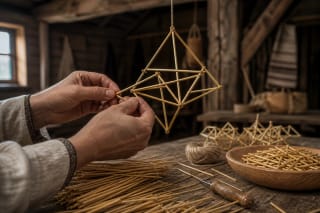
A simple geometric ornament begins with straw segments cut to equal lengths. They are threaded onto string, joined into triangles, squares, diamonds, or small spatial modules, then the thread is tightened and the knot hidden.
A figurative ornament often requires tying bundles of straw: shaping a body, wings, head, legs, or tail. Here the key is not mathematical precision but a recognizable silhouette and proportion.
A good ornament should be light, balanced, and hang straight. If one side has too much material, it will lean, so even a small ornament requires attention to balance.
Children, Workshops, and Family Crafting
Straw ornaments are especially suitable for workshops because they are smaller and quicker to finish than a large sodas. Children can learn to sort straw, thread, tie, count segments, and understand how a fragile material behaves.
Still, straw is not just a disposable craft material. It has cultural context: grain, harvest, home decoration, holidays, sodai making, thread, and careful hands. A workshop should show this connection.
A contemporary family workshop can continue the tradition if it does not overload the ornaments with plastic, glitter, or random decoration. Natural straw already has enough light of its own.
Care and Storage
Straw ornaments are very fragile. They should be protected from moisture, pressure, direct breaking, rodents, and insects. The best storage is a box where the ornaments are not compressed.
After the holidays, remove them carefully by holding the thread or a stronger joint rather than the thin end of a straw. If a straw breaks, repair is sometimes possible, but often the whole module must be remade.
An old or maker-made ornament should be documented: who made it, when, in what form, and from what material. Small ornaments disappear easily, so information is part of the heritage.