- Category
- Cosmos and household-order symbols
- Domain
- Home, festivals, weddings, Christmas, cosmic order, handwork, straw
- Source status
- well attested
sodas, straw garden, reketukas, straw sodas, sodai tying
What are straw gardens?
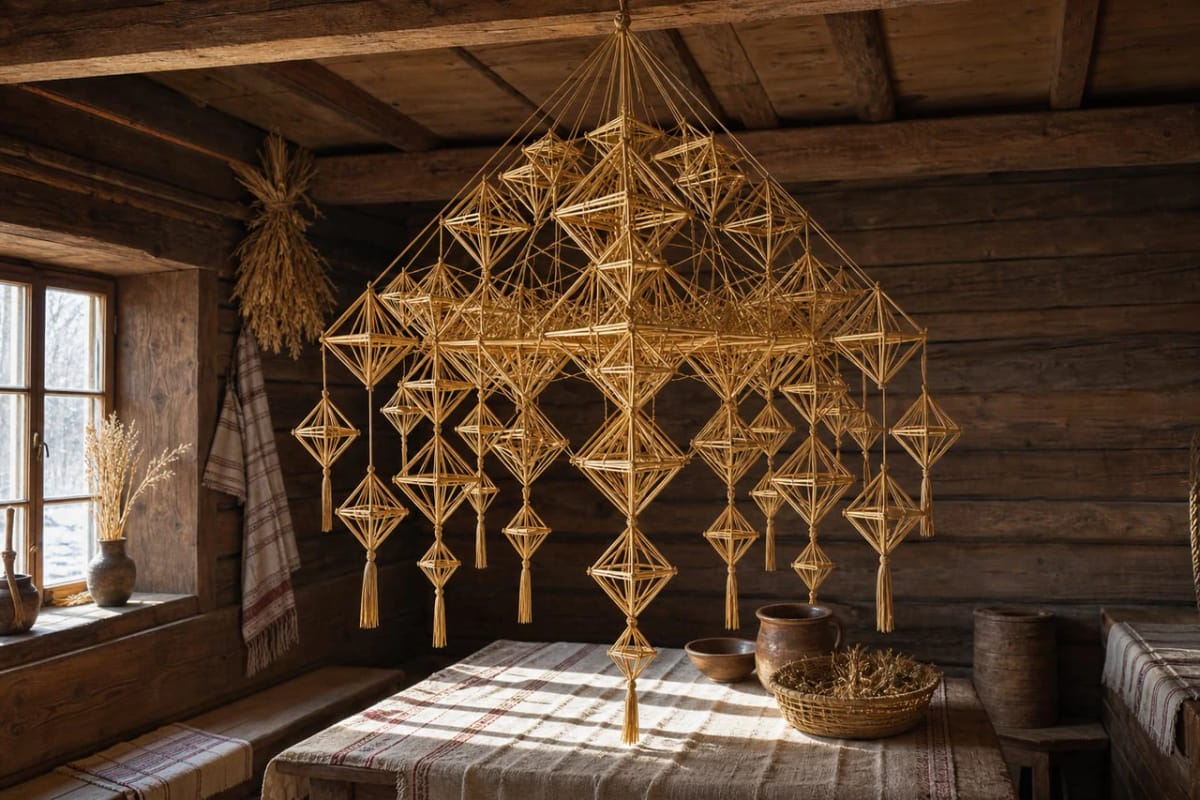
Straw gardens, or sodai, are spatial constructions tied from straw and hung in homes during festivals, weddings, or other important occasions. Their beauty comes from very simple materials: straw, thread, hand, and patience.
UNESCO recognition shows that sodai tying is a living Lithuanian intangible-heritage tradition. In a mythological context, the sodas matters as a symbol of order, harmony, and a model of the world.
The sodas as a small world
The form of a sodas is often made of repeated geometric parts. Rhombuses, top, bottom, center, and suspended space allow it to be understood as a small cosmos in which chaos is ordered into a clear structure.

This explanation is symbolic rather than dogmatic. A sodas is not a written text of old religion, but its use in festive spaces allows us to speak about the ordering of the household world.
Straw, harvest, and the festive household center
Straw keeps the link with grain, rye, and harvest. It is the material left after grain cutting, but in a sodas it becomes not waste, but sacred decoration. This is a beautiful Lithuanian cultural principle: what is simple can become meaningful.
Hung above the table or in the center of a room, the sodas marks space. It creates a festive center around which family, guests, and ritual time gather.
How to read sodai today
Today straw gardens are often used in interiors, education, and heritage events. To keep them from becoming only design objects, it is important to show their connection with straw, harvest, festival, and household harmony.
The tradition of making sodai, hanging straw ornaments, combines UNESCO-recognized heritage with handcraft. Their geometric structure is also interpreted as a symbolic image of cosmic order.