- Field
- Lithuanian fish preservation by smoke, especially in Pamarys and the Curonian Lagoon
- Type
- traditional food craft
- Heritage status
- living tradition
- Context
- Fish, smokehouse, smoke, salt, smelt, bream, vimba, lamprey, Curonian Lagoon, Pamarys, nets, reeds
Smoked fish, Pamarys fish smoking, Curonian Lagoon fish smoking, Preserving fish with smoke
Fish Smoking forms and objects
Hot-Smoked Fish: Fish smoked at a higher temperature and cooked at the same time, usually eaten fairly soon.
Cold-Smoked Fish: Fish smoked longer at lower temperature, requiring precise salting, drying, and safe storage.
Pamarys Smokehouse Fish: Fish-smoking products from the Curonian Lagoon, Neringa, Rusnė, Šilutė, and other lagoon-side places.
Festival or Market Smoked Fish: Smoked fish sold at fairs, fish festivals, seaside and lagoon settlements, while still subject to food-safety rules.
What Is Fish Smoking?
Fish smoking is a way to preserve fish and shape its flavor: the fish is salted, dried or lightly cured, and then held in smoke in a smokehouse. In Lithuania it is especially vivid in Pamarys, the Curonian Lagoon, the Curonian Spit, and coastal fishing settings.
It is not simply cooking over smoke. Smoking requires knowledge of fish species, salt, moisture, temperature, smoke, and time. Cold smoking may take 2-5 days at about 20-40 °C, while hot smoking may last 6-12 hours at about 80-170 °C. Hard deciduous woods are used, with alder common and juniper sometimes added for aroma.
Fish smoking should be read together with fishing traditions, local regulations, seasons, and food safety. Smoked fish is a heritage food, but also a sensitive product.
Pamarys and the Curonian Lagoon
In Pamarys, smoked fish is more than a tourist snack. It is tied to Curonian Lagoon fishing, local boats, nets, fish species, fish soups, markets, and daily fishers’ work.
Nida, Juodkrantė, Preila, Pervalka, Rusnė, Kintai, Šilutė, Ventės Ragas, and other places have their own fishing and fish-preparation memory. The Lithuania Minor layer is important because lagoon food culture is not only general Lithuanian food culture.
Curonian Lagoon fishing is regulated today. Smoked fish should not be separated from legal catch, quotas, fishing rules, and sustainability.
Which Fish Are Smoked?
Many fish are smoked: bream, vimba, smelt, pike-perch, carp, flounder, perch, eel, lamprey, and other legally caught local species. The specific fish depends on water, season, and local tradition.
Smelt carries a strong seaside and lagoon festival image; vimba is linked with rivers and spring cycles; bream belongs to the lagoon fishing and smoking table. Lamprey is a separate heritage layer connected with the Šventoji River.
Species should not be flattened into one category. Smoking time, salt, texture, and storage change according to the fish.
Salting and Surface Drying
Before smoking, fish is salted. Salt gives flavor, draws out some moisture, and prepares the surface for smoke. Too little salt is risky; too much overwhelms the fish.
Surface drying is important so the fish receives smoke rather than steams in its own moisture. This is one difference between smoking and simple cooking.
A traditional maker reads fish size, fatness, skin, and moisture. One rule does not fit every fish.
Hot and Cold Smoking
Hot smoking happens at higher temperature, so the fish is smoked and cooked at the same time. Such fish is often eaten quickly, is softer, and keeps for a shorter time.
Cold smoking happens at lower temperature and for longer. Salting, drying, and hygiene are especially important because the fish is not rapidly cooked as in hot smoking.
Ethnographic description should not be treated as a safety manual. Fish smoking has serious food-safety requirements.
Smokehouse and Smoke
A smokehouse may be wooden, masonry, or another construction, but its purpose is to control smoke, temperature, and fish placement. Fish are hung or arranged so smoke reaches the surface evenly.
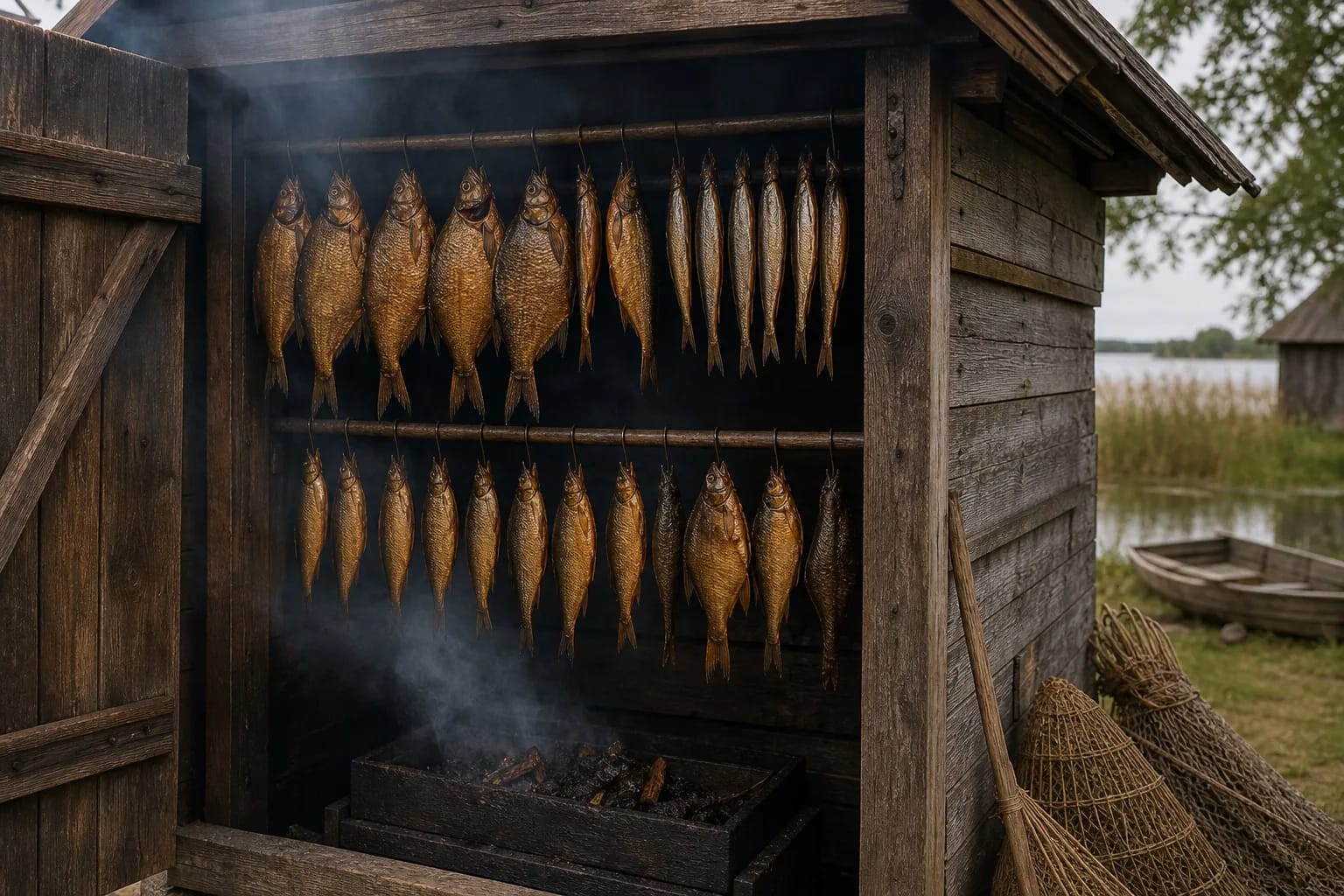
Smoke often comes from suitable deciduous wood such as alder or other local woods. Unsuitable wood, chemically treated boards, or overly harsh smoke can spoil the product and make it unsafe.
A good smokehouse is not decoration. It is a tool that has to draw properly, smoke evenly, and avoid burning the fish.
Smoked Fish and Local Festivals
Smoked fish is now visible in Neringa, Pamarys, fish festivals, markets, and local tourism. Such events can support the tradition if they keep the product tied to fishing and local memory.
Smelt festivals, fish soup cooking, smokehouse demonstrations, and fishers’ stories show that fish is not only a dish but a regional social sign.
Commercial popularity has risks: the tradition can shrink to a sales stall. A stronger cultural story connects catch, smokehouse, people, rules, and landscape.
Safety, Legality, and Sustainability
Fish smoking requires care. Poorly salted, insufficiently cooked, or badly stored fish can be dangerous. Smoked fish sold to the public must meet food-safety rules.
The fish must also be legally caught. Protected species, seasons, quotas, and fishing gear rules are not details. Heritage cannot justify illegal fishing.
A sustainable tradition means preserving flavor while also preserving waters, fish stocks, and the local community’s right to live from its region.