- Field
- Curonian Lagoon fishing-boat signs and folk art of Mažoji Lietuva
- Type
- folk art
- Heritage status
- living tradition
- Context
- kurėnas and sailing-boat weathervanes, fishing-village signs, 1844 fishing control, Beerbohm, Neringa, openwork carving, color codes, and lagoon identity
Kurėnas weathervanes, Curonian fishing-boat weathervanes, Sailing-boat weathervanes, Fishermen's weathervanes
Curonian Lagoon Weathervanes forms and objects
Early fishing signs: Practical signs introduced in 1844 to identify the village or fishing district from which a sailing boat came.
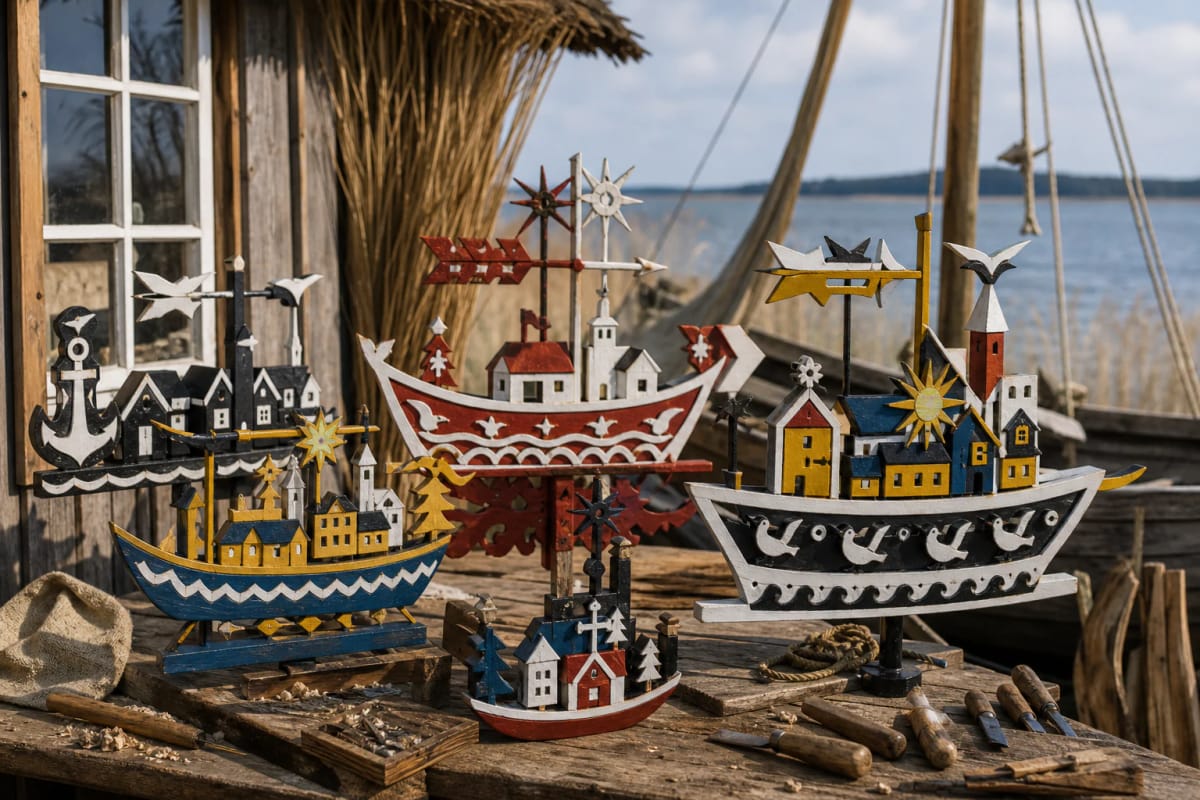
Ornamented kurėnas weathervanes: Later versions decorated with openwork carving, colors, houses, boats, lighthouses, birds, churches, and other motifs.
Village-sign weathervanes: Weathervanes in which colors and forms help indicate the fisherman's village, shore, or part of the lagoon basin.
Contemporary decorative weathervanes: Weathervanes used in Neringa, museums, workshops, and souvenir culture, carrying an older visual language into a new context.
What is a Curonian Lagoon weathervane?
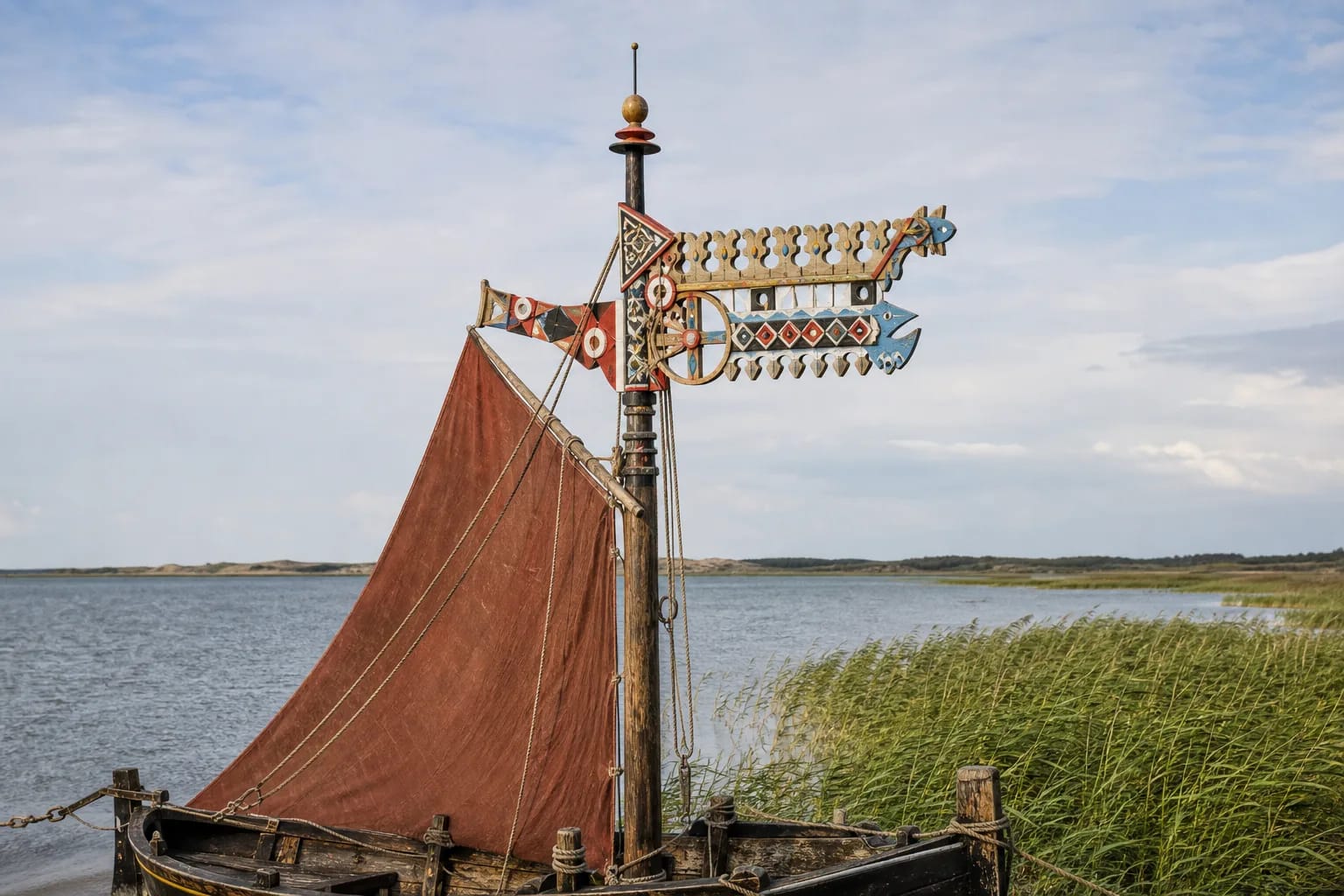
A Curonian Lagoon weathervane is a wooden, painted, openwork sign fixed to the mast of a kurėnas or other sailing boat. Today it looks like a colorful miniature of folk art, but its origin was very practical.
In 1844 the Prussian fishing administration introduced boat-identification signs so fishing areas could be controlled and it would be possible to tell which village or shore fishermen came from. This decision is associated with Ernst Wilhelm Beerbohm, who lived at Muižė Manor near Ventė Cape.
Later fishermen began to decorate the signs. A practical identification mark became a distinct form of Curonian Lagoon folk art, with little houses, churches, lighthouses, birds, suns, waves, hearts, anchors, and boat silhouettes.
A practical sign, not an ancient flag
It is important to say clearly that Curonian Lagoon weathervanes are not a vague ancient pagan symbol. Their known history begins with a nineteenth-century administrative decision: to identify sailing boats and regulate fishing.
This practical origin is exactly what makes them interesting. Within several decades a fishing-control sign became an artistic object in which a fisherman could show village, family, faith, home, dreams, humor, or signs of prosperity.
The weathervane can therefore be called a wooden passport of a lagoon fisherman. It does not show an abstract national emblem, but concrete belonging: whose boat it is, where it sailed from, and what place it has in the world of the Curonian Lagoon.
Beerbohm and the 1844 order
Ernst Wilhelm Beerbohm is often mentioned as an important figure in the origin story of the weathervanes. He was connected with the administration of Curonian Lagoon fishing and with the system of fishermen's signs intended to help manage fishing districts.
The signs were not first intended as beautiful representation. They had to be visible, clear, and understandable. Only later, especially in the late nineteenth century, did fishermen develop them into ornate openwork objects.
This shift from official sign to folk art is rare and valuable. It shows how a community can take over an imposed rule and turn it into a language of its own imagination and identity.
Colors and village signs
The colors of the weathervanes helped identify parts of the Curonian Lagoon basin. The northern part of the Curonian Spit is associated with black and white, the eastern lagoon shore with red and white, the southern shore with yellow and blue, and the Vistula Lagoon with blue and red.
Color here is not merely decoration. It functioned as a local code, so the weathervane could be read from a distance. Beside colors appeared village signs and motifs of boats and homes, later becoming part of more complex compositions.
In contemporary souvenirs colors are sometimes used more freely, so it is worth asking whether a weathervane is based on a concrete historical sign or is a decorative interpretation. Both can be beautiful, but their accuracy differs.
How to read a weathervane
First, look at the colors and the overall silhouette. They may indicate a shore or village connection. Then the upper part can be read, where a lighthouse, church, house, cross, boat, sun, or birds often appear.
The lower part often shows water, waves, or the boat hull. Birds and fish connect the weathervane with lagoon fauna, the anchor with the boat, the house with the fisherman's yard, the church with the community, and the sun and stars with images of the sky and route.
Not every element should be explained as having one fixed meaning. A weathervane is both a sign and a fisherman's creation. It brings together an administrative code, local image, family memory, aesthetics, and representation that grew stronger in the age of tourism.
Making and materials
Traditional weathervanes were made of wood. Stronger woods such as oak or ash could be used for the frame, while easier-to-cut linden, alder, willow, or other woods suited openwork and small details.
Parts of the weathervane were sawn, carved, drilled, joined, painted, and fixed so that the sign was visible on the mast. Later ornamented weathervanes could reach about a meter in length and several dozen centimeters in height, making them visible from afar.
The craftsmanship lies not only in color. The maker has to maintain proportions, allow the wind to act on the construction, avoid breaking small openwork details, and still create a clear, recognizable composition.
The Curonian Spit and Neringa identity
Today weathervanes are especially associated with Neringa. They appear in the visual language of Nida, Juodkrantė, Preila, and Pervalka, in museums, information signs, souvenirs, and the story of municipal identity.
In Neringa's coat of arms and public spaces, weathervane signs remind us that Curonian Spit culture is not only dunes and pinewoods. It is also fishing villages, kurėnai, the lagoon, wind, wooden boats, and the memory of Lietuvininkai and Kuršininkai.
At the same time, it should not be forgotten that the history of the weathervanes includes not only present-day Lithuanian Neringa, but the wider Curonian Lagoon and Vistula Lagoon basin. Historical borders, villages, and shore communities were more complex than the modern tourist image.
From fishing sign to souvenir
After the First World War the practical identification function of weathervanes weakened. Sailing boats changed, fishing control took other forms, and weathervanes increasingly became objects of memory, museums, tourism, and decorative art.
That does not mean the end of the tradition. Weathervane making is included in Lithuania's Intangible Cultural Heritage Inventory, and makers and museums today preserve knowledge about forms, colors, signs, and woodwork.
Still, it is worth distinguishing a historical kurėnas weathervane from a decorative souvenir. A good contemporary souvenir can be excellent if it does not tell a false history and is based on the real logic of Curonian Lagoon signs.
Where to see weathervanes
Weathervanes are worth seeing in Neringa museum exhibitions, Curonian Spit museum and cultural routes, ethnographic homesteads, and exhibitions about navigation and fishing. Nida and Juodkrantė are natural starting points for learning this tradition.
In a museum it is possible to understand the difference between a real fishing-sign structure and a later decorative interpretation. Beside the lagoon itself, the weathervane is best understood through wind, a boat mast, the horizon, and shore colors.
When buying a weathervane, it is worth asking whether it is based on a historical village sign or is an artist's interpretation. That question helps preserve not only a beautiful form, but also its fishing memory.