- Field
- Lithuanian woven containers for gathering, carrying, sowing, and household storage
- Type
- traditional craft
- Heritage status
- well attested
- Context
- baskets, carriers, kraitelės, kašelės, karbijos, bamblės, seed baskets, mushroom baskets, berry baskets, market baskets, travel baskets
Baskets, Carriers, Kraitelės, Kašelės, Karbijos, Bamblės
Baskets and Carriers forms and objects
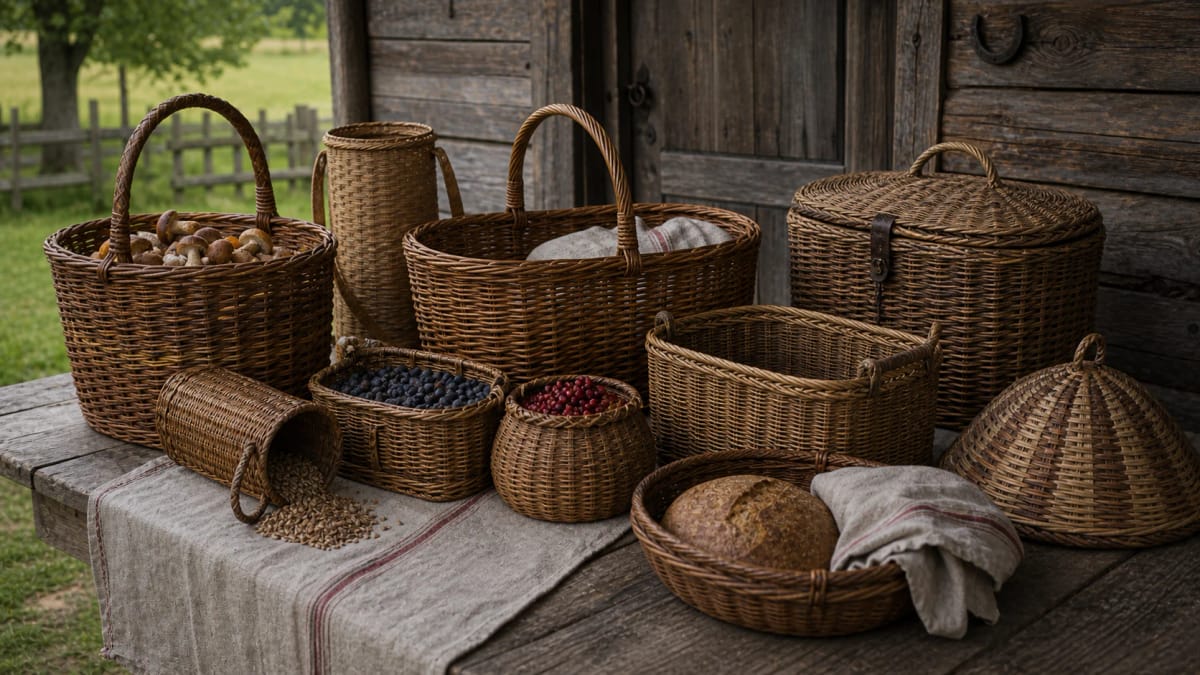
Mushroom and berry baskets: Light baskets with comfortable handles for forest gathering, berries, mushrooms, and short everyday carrying.
Market and travel baskets: Stronger, larger carriers or baskets with handles and sometimes lids, used for food, clothing, purchases, or travel goods.
Seed baskets and grain containers: Woven containers for scattering seed, carrying grain, flour, or other dry materials.
Bamblės, karbijos, and kraitelės: Local names for woven containers, showing variety of form, purpose, region, and local speech.
What are baskets and carriers?
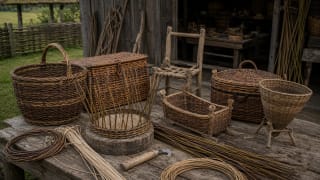
Baskets and carriers are traditional woven containers for carrying, storing, sorting, and displaying objects. VLE notes that Lithuanian folk woven objects, including baskets, kraitelės, seed baskets, and furniture, were long woven in spiral and cross techniques from hazel and willow rods, splints, spruce and pine roots, pine splinters, and bundles of rye straw.
This topic is narrower than all willow weaving. Here the main question is not the technique in general, but object type: what the basket is for, what size it needs, and whether it needs a lid, handle, dense base, ventilation, or strong rim.
In Lithuanian daily life a basket was as practical as a wooden bucket, chest, or spoon. It was not always ornate, but almost always precisely fitted to its work.
Variety of names
Sources mention pintinės, krepšiai, kraitelės, kašelės, karbijos, bamblės, sėtuvės, doklai, kretilai, and other local names. They show not only form, but also region, purpose, and local speech.
In one place kraitelė may mean a smaller basket; elsewhere a similar container is called kašelė or krepšys. It is therefore best to describe the concrete object by form: open or closed, with or without a handle, high or low, dense or open, with or without a lid.
The variety of names is part of heritage. It helps show that woven containers were everyday and local, not standardized factory products.
Mushroom and berry baskets
Mushrooms and berries need a light, breathing container. The basket must be strong enough to hold the contents, but not too heavy, because it is carried in forest or fields. The handle must be comfortable and the base stable.
A mushroom basket is often higher and more open so mushrooms are not crushed. Smaller kraitelės or bowl-shaped containers suit berries because the contents are easy to see and carry without damage.
Although today the mushroom basket has become an almost romantic forest image, traditionally it was a practical object for food and the family household.
Market, travel, and household baskets
A market basket has to be roomy, strong, and comfortable to carry. It may have a tall handle, reinforced rim, and sometimes a lid or fastening. Such a form protects food and makes walking easier.
Travel baskets or lidded baskets protected food, clothes, textiles, or small objects from dust and falling out. A lid changes the purpose of the container: it becomes not only an open carrier but a storage box.
Household baskets could hold laundry, yarn, bread, vegetables, small firewood, or other objects. Their beauty often lies in exact function.
Seed baskets and grain containers
A seed basket is a special container for scattering seed. It must be comfortable to hold against the body, open enough for the hand, but not so shallow that seed spills while walking. Its form therefore differs from a simple basket.
Containers for grain, flour, or dry products must be more densely woven so smaller material does not fall out. Lids, cloths, or inner layers could sometimes be used.
Such objects show that the basket is not only a forest carrier. It belongs to the agricultural cycle: sowing, harvest storage, the road to bread, and everyday food order.
Bread, laundry, and household baskets
Woven forms for bread, leavening, dough, or baked goods could be used together with cloth. Bread-tub covers, baskets, or lids protected food from dust and helped maintain order.
Laundry or textile baskets had to be larger, lighter, and ventilated. Textiles should not become damp and stale, so woven material works well here. Strong handles make it possible to move a full container.
Household baskets are often less showy than exhibition pieces, but their form reveals the true purpose of the craft: the object must work every day, not only look beautiful.
What makes a good basket?
A good basket begins with suitable material. Rods should be similar in thickness, properly soaked, and flexible enough. Different parts, base, sides, rim, handle, may require different thicknesses.
The base must hold weight, the rim must not unravel, and the handle must not cut the hand or break. Density depends on purpose: grain needs denser weaving, mushrooms can be looser, and laundry needs ventilation.
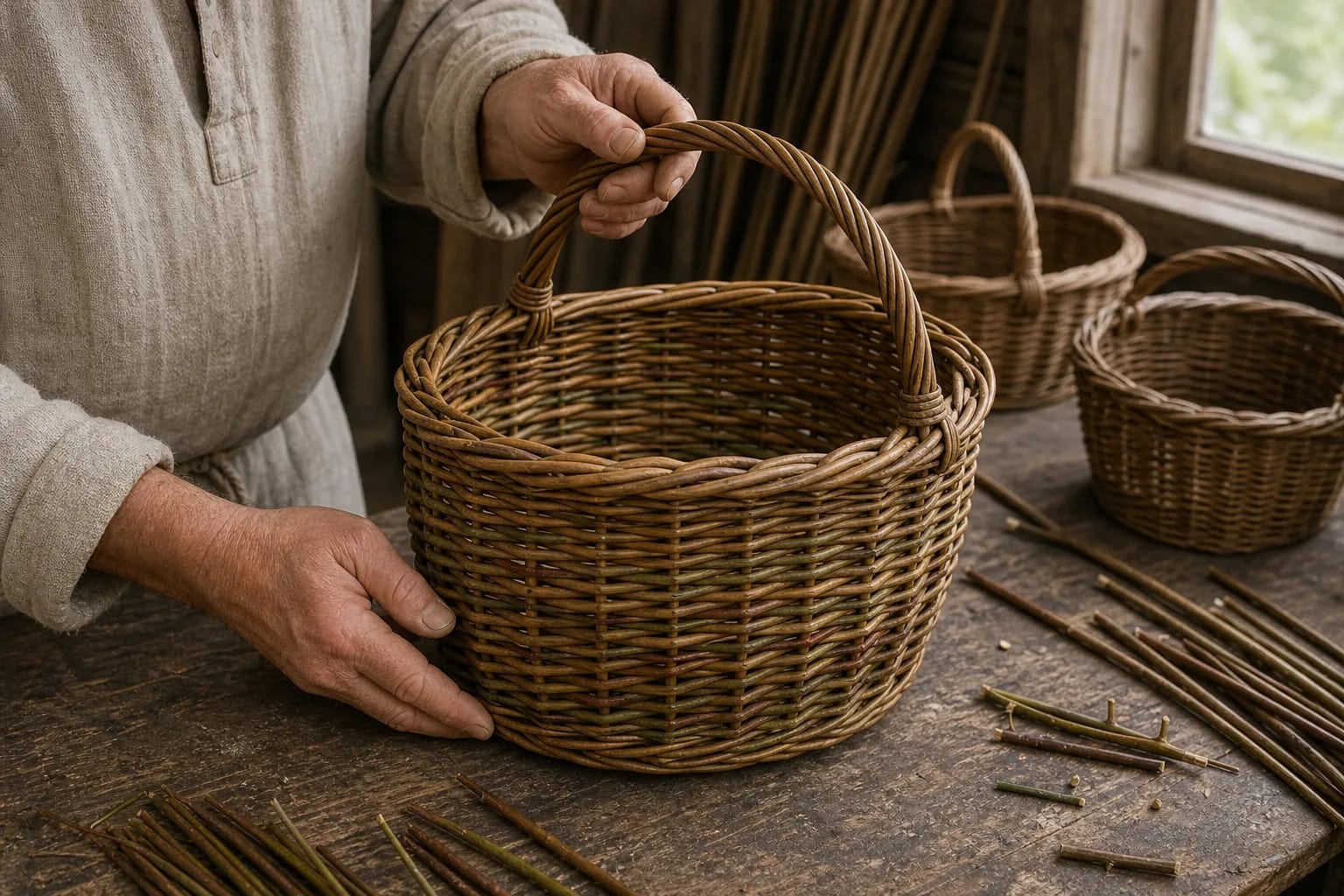
Decoration is secondary if the object does not work. Real skill appears when a basket is light, strong, comfortable, and clearly made for its task.
Baskets today
Today baskets and carriers live through folk-art fairs, certified makers, education, interior use, and practical mushroom or market baskets. Some forms are very close to old ones, while others are adapted to modern life.
Natural baskets should be distinguished from synthetic imitations. Plastic or synthetic rattan may look similar, but it does not have the same material, repairability, local plants, or craft history.
A valuable contemporary basket does not have to be an old copy. It can be new if it preserves material logic, strong construction, and a clear connection with traditional function.
Care
Baskets should be protected from long-term moisture, mold, and excessive drying. After mushroom or berry gathering, they are best dried in a ventilated place, not directly on a hot radiator or in strong sun.
If a basket is dirty, it can be gently cleaned with a dry brush or barely damp cloth, but the whole object should not be soaked unnecessarily. Moisture can deform the weave.
A broken handle or rim should be repaired with similar plant material. Wire, plastic, or adhesive tape may help briefly, but over time they damage the object and change its heritage value.