- Field
- Openwork textile decoration made with crochet, pinikai, edgings, and handmade lace
- Type
- textiles
- Heritage status
- well attested
- Context
- Lace, crochet, pinikai, openwork, edgings, bonnets, towels, tablecloths, pillowcases, bedspreads, shelf and window decoration, folk textiles
Crochet, Pinikai, Edgings, Openwork lace, Linen lace
Lacework forms and objects
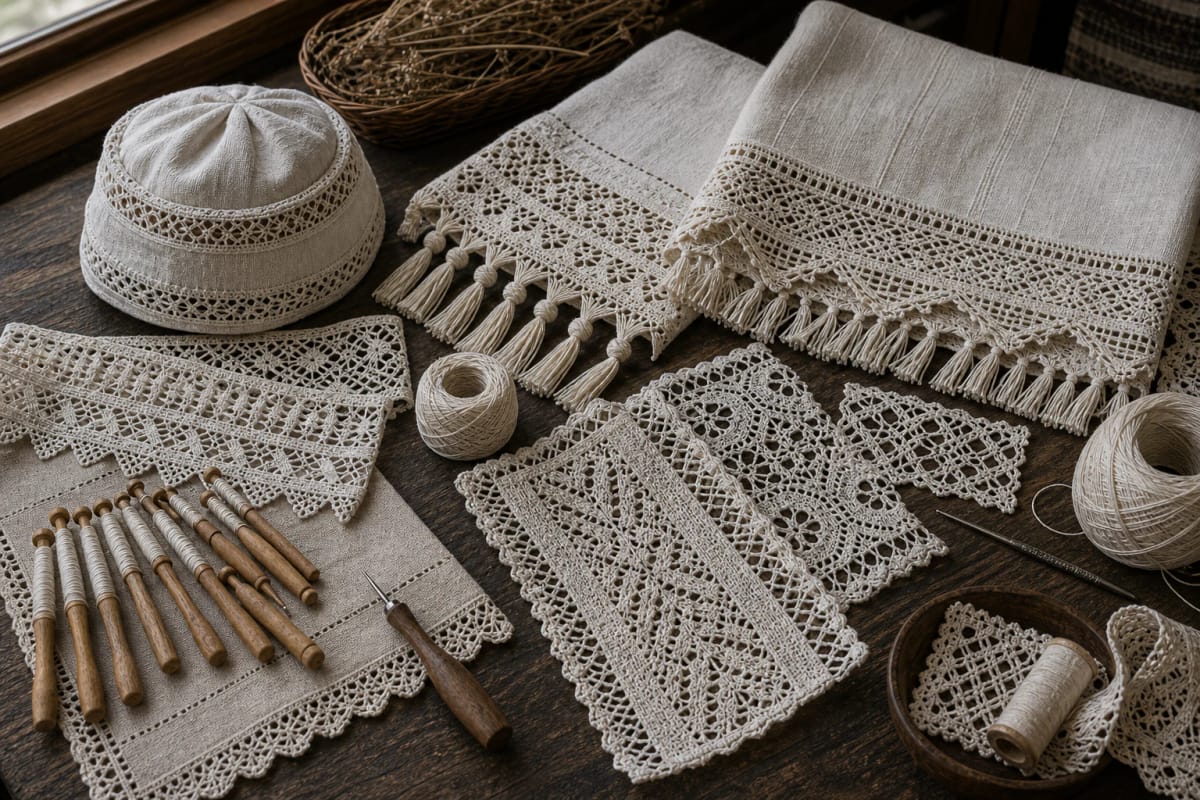
Crocheted edgings: Looped and openwork decoration on the edges of tablecloths, towels, pillowcases, scarves, or shelf textiles.
Pinikai: Openwork edges and joins made by knotting, braiding, or connecting threads, often used to finish borders or join woven panels.
Lace for head coverings: Fine, often white decoration on the edges and surfaces of kykai, scarves, nuometai, and other head coverings.
Industrial and purchased lace: A later layer, increasingly visible from the late nineteenth century, when cheaper purchased lace began to supplement home textiles.
What Is Lacework?
Lacework is openwork textile decoration made with loops, knots, braiding, crochet, or related techniques. In Lithuanian folk textiles it most often appears as edgings, towel ends, joins between woven panels, and decoration for caps and head coverings.
Lace differs from embroidery: embroidery places stitches on or into a ground fabric, while lace is often built as an independent openwork structure or as a continuation of the fabric edge.
Its value lies less in strong color contrast than in light, openings, rhythm, and the fineness of handwork. White lace on white linen can look restrained while being technically demanding.
Pinikai
Pinikai are one of the most important techniques for Lithuanian textile edges and joins. They may be braided, tied, or worked so that they connect two woven panels or finish a border.
In towels, tablecloths, pillowcases, and head coverings, pinikai often appear where the fabric ends or where separate pieces need to be joined. They are both structure and decoration.
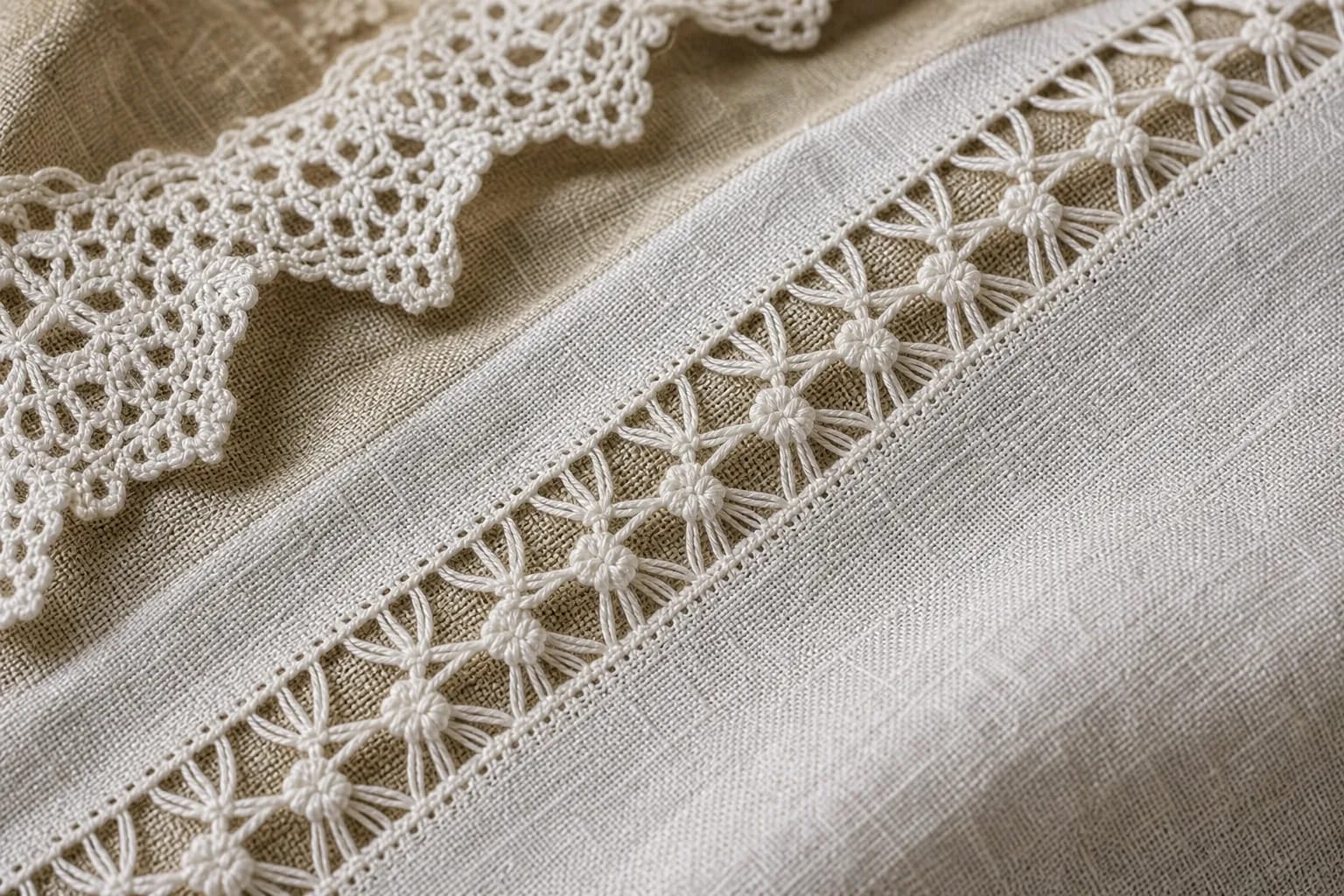
Pinikai should not be understood as a merely decorative strip. Good pinikai must hold the fabric, remain usable, and keep their rhythm after washing.
Crochet
Crochet makes it possible to build looped structures: edgings, bands, nets, flowers, stars, shell-like forms, teeth, and broader openwork fields. It became especially convenient for finishing textile borders.
Crocheted edges are common on towels, tablecloths, bedspreads, pillowcases, scarves, kykai, and later home textiles. They may be simple or complex. The fashion for lace reached Lithuania in the sixteenth century through ornate Western dress: expensive imported lace and work by local lace-makers in estates and monasteries are recorded in sixteenth- to eighteenth-century manor inventories, including the 1665 Gelgaudiškis manor inventory. A lace manufactory briefly operated in Gardinas at the end of the eighteenth century, and in folk dress crocheted caps, skirt edges, and shirt borders became widespread.
The quality of a crocheted pattern depends on thread thickness, hook size, hand tension, and the fabric to which the lace is attached. Even a beautiful pattern looks poor if the edge ripples or pulls the ground fabric.
Where Lace Was Used
The most important places were edges: towel ends, tablecloth borders, joins between fabric panels, pillowcase corners, scarf edges, the rims of kykai, and the finishing of bedspreads and sheets.
In some textiles lace is only a small accent; in others it forms an entire decorative system. In a tablecloth, for example, lace may join panels through the middle, while on a towel it may be the main visible end.
In the home interior, lace also appeared as decoration for shelves, windows, or festive surfaces, but paper cutwork and textile lace need to be distinguished.
Kykai and Head Coverings
Kykai, scarves, nuometai, and other head coverings often had fine lace, pinikai, edgings, or openwork elements. The head was highly visible, so subtle white decoration there carried strong meaning.
A married woman's head covering had social significance, and lace could emphasize its festiveness, orderliness, and quality of handwork.
Lace on head coverings should be evaluated together with the way the covering was tied. A detached edging does not show how it appeared when worn.
Lace and Table Textiles
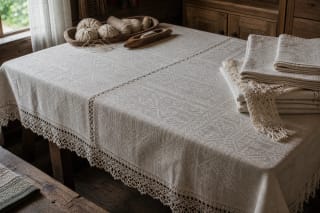
On tablecloths, lace may appear along the edges, at the corners, or between panels. Because older tablecloths were often sewn from several woven pieces, an openwork join could be both a necessity and an ornament.
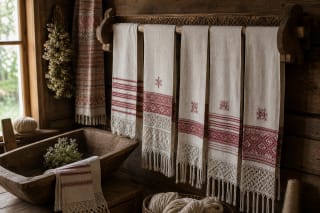
On towels, lace was often placed at the ends, the most visible parts when the towel hung on a rankšluostinė, a wooden towel rack. In this way lace created a vertical textile composition.
On sheets, pillowcases, and bedspreads, lace transformed everyday cloth into festive textile. It shows that fabric was meant not only for use but also for the dignity of the home.
Industrial Lace
In the late nineteenth and twentieth centuries, cheaper purchased lace increasingly affected home textiles. It could replace time-consuming handwork or be combined with home-woven linen.
That does not mean industrial lace is valueless. It records changes in trade, urban fashion, and rural household life. On a traditional craft page, however, it is important to separate purchased lace from handmade crochet or pinikai.
In museum objects this distinction helps identify the period: handmade lace, machine-made tape, and a later sewn-on border tell different stories.
Lace, Embroidery, and Paper Cutwork
Lace is often confused with embroidery and paper cutwork because all three can create openwork or edge decoration. Embroidery relies on stitches, lace on loops, knots, or braiding, and paper cutwork on cutting paper.
In a traditional home these techniques could stand side by side: a tablecloth with lace on the table, a towel with pinikai on a towel rack, and a paper cut curtain in the window.
Understanding the differences is essential for a good page and a good reconstruction. The word “openwork” alone is not a sufficient description.
How to Recognize Good Lacework
Good lace has even tension, a clear rhythm of pattern, a firm join to the fabric, and an edge that neither ripples nor pulls the ground. Poor technical execution becomes visible quickly, even in a beautiful pattern.
When evaluating an old object, it is important to ask whether the lace is original or was sewn on later. New lace added to old linen may be attractive, but it changes the object's history.
Contemporary lace can be a strong living tradition when the technique, material, and purpose are clearly stated. Quality of handwork matters more here than the complexity of a diagram alone.