- Field
- Winter lake fishing for smelt and vendace using the rotating boba device
- Type
- traditional fishing
- Heritage status
- regional tradition
- Context
- Smelt, vendace, boba, ice hole, ice, net, seine, Lake Lūšiai, Mindūnai, Baltieji Lakajai, sledges, winter
Smelt fishing under ice, Fishing by rotating bobos, Catching smelt with bobos, Old smelt and vendace fishing
Smelt Fishing Under Ice forms and objects
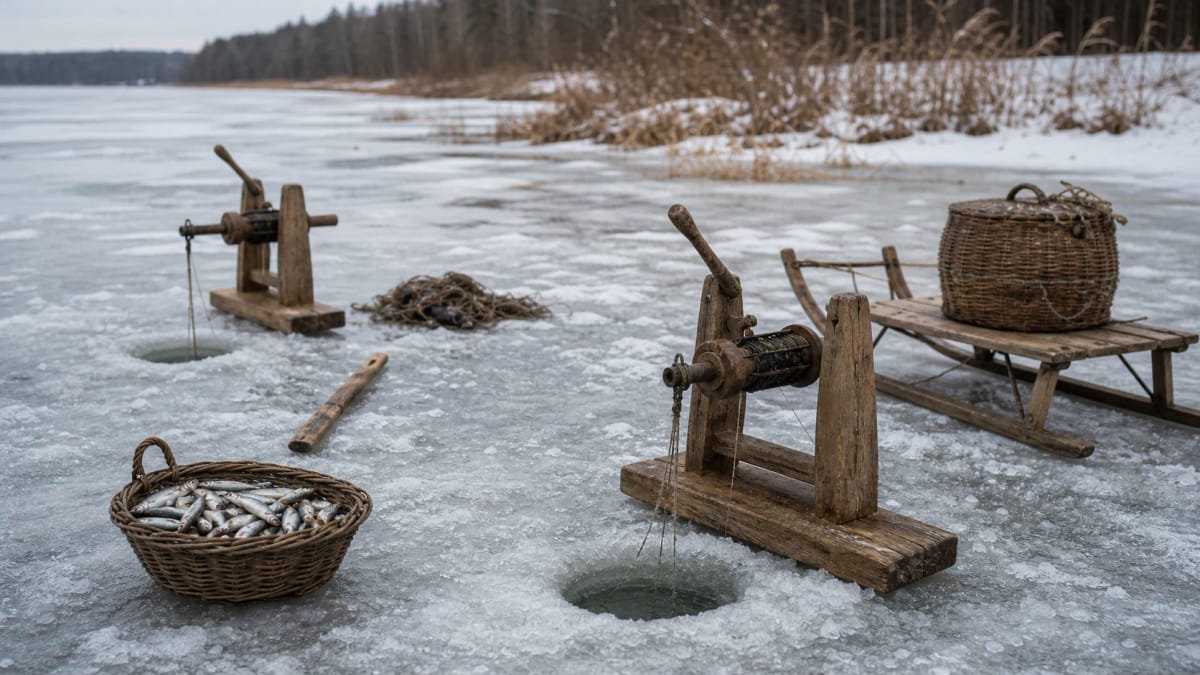
Boba: A wooden winding device used to pull ropes and nets under lake ice.
Entry and Exit Ice Holes: Working holes or points through which the net is fed under the ice and drawn back out.
Draw Net: A net worked under the ice for catching stintelės or vendace during a short winter season.
Stintelės Catch: Small lake smelt, valued for seasonality, distinctive aroma, and local food traditions.
What Is Ice Fishing for Stintelės by Turning Bobos?
Fishing for stintelės by turning bobos is a lake ice-fishing method in which a net is pulled beneath the ice through ice holes, while its ropes are wound with wooden devices called bobos. It is not solitary hook-and-line fishing but a coordinated mechanism of net, ice, rope, and people.
The tradition is tied to eastern Aukštaitija lakes: Lake Lūšiai near Palūšė and Mindūnai village by Lake Baltieji Lakajai. Two closely related but place-specific traditions are listed in Lithuania’s intangible cultural heritage inventory.
Its defining feature is that the fishing happens under ice. Fish knowledge, net technique, and safe ice are equally important.
What Is a Boba?
In this context a boba is a wooden winding device, similar to a hand winch. It winds ropes that pull the net under the ice from one hole to another.
The boba must be strong, stable on the ice, and able to control rope tension. If the rope catches, the net can tangle and the work stops.
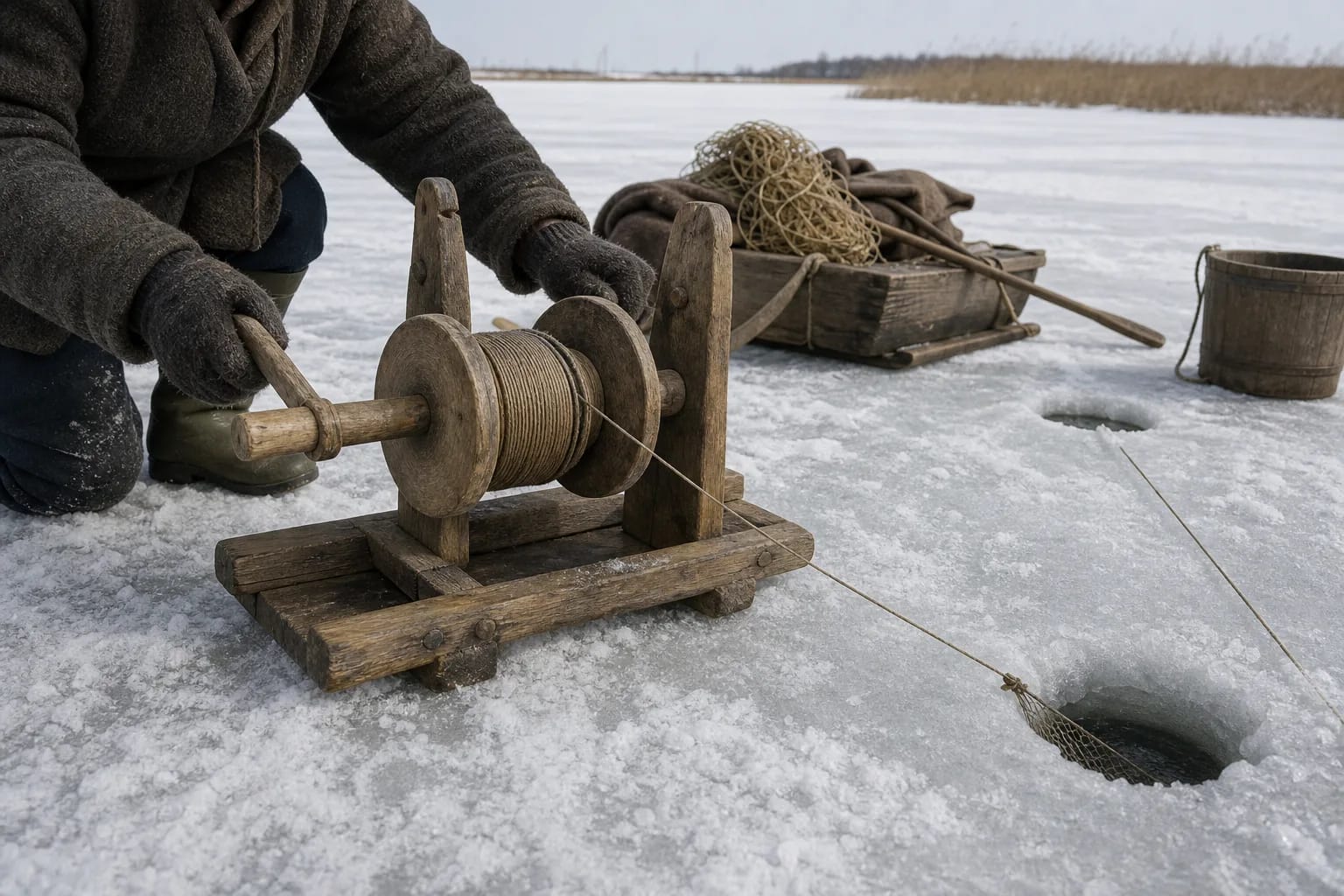
The tool explains the name of the tradition: the main movement is not casting a hook but rhythmically turning a device to draw the net.
Ice Holes, Entry, and Exit
Under-ice net fishing needs a working system of ice holes. Through one point the rope or net is sent under the ice; through another it is drawn out, creating an under-ice path between them.
Terms for entry and exit points show that these are not random holes. Each has a purpose, distance, direction, and relation to the net’s movement.
The technique requires knowledge of lake depth, bottom, fish-holding places, and ice condition.
Stintelė and Seliava
Stintelė is the lake form of smelt, a small fish related to larger smelt. Smelt (Osmerus eperlanus) belongs to the smelt family; its smaller form, which stays in fresh water, is precisely what is called the stintelė. It is valued for seasonality, scent, and local food use. Seliava, or vendace, is another important northeastern lake fish and belongs to the Mindūnai tradition.
Both fish require the right season and legal permission. A traditional name does not mean fishing can be done at any time or by any method.
Stintelės fishing carries a strong winter feeling: a short season, ice, cold, and community gathering.
Lake Lūšiai
The under-ice stintelės fishing tradition on Lake Lūšiai is one of the values officially listed in Lithuania’s intangible cultural heritage inventory. It is tied to Palūšė and the surroundings of Aukštaitija National Park.
Here the catch is not the only point. Demonstrations, education, festivals, and fishers’ stories make the tradition visible as a sign of regional identity.
The Lūšiai example shows that the lake itself is a heritage space: ice, shores, community, and rules form one system.
Mindūnai and Lake Baltieji Lakajai
Mindūnai village and Lake Baltieji Lakajai have their own old winter practice of catching stintelės and vendace by turning bobos. It is also included in the national inventory.
The Mindūnai fishing museum, local festivals, and community work help present the tradition to visitors. It is not only a recorded memory but a demonstrated and taught practice.
Lūšiai and Baltieji Lakajai should be named separately because they show concrete lakes and communities, not one abstract technique.
Difference from Curonian Lagoon Fishing
Fishing for stintelės by turning bobos is not Curonian Lagoon fishing and not sea smelt fishing. It is a lake-based under-ice net tradition with its own tools, ice conditions, and places.
Curonian Lagoon fishing centers on kurėnai boats, fyke nets, lagoon winds, and brackish waters. Stintelės fishing centers on bobos, ice holes, a draw net, and safe lake ice.
Keeping this distinction prevents two strong water-heritage traditions from collapsing into one vague story.
Ice Safety and Permits
Ice fishing is dangerous when the ice is too thin or uneven. Heritage and park events often emphasize that the tradition is demonstrated only under safe conditions.
Modern fishing also depends on permits, rules, season, and protected-area requirements. A heritage description is not permission to set nets under ice independently.
The safest way to learn the tradition is through official education, festivals, and demonstrations by local fishers, not through untrained risk-taking.