- Field
- Tradition of grain milling, millstones, water and windmills, millers, and flour preparation
- Type
- traditional craft
- Heritage status
- well attested
- Context
- milling, mill, miller, millstones, hand querns, saddle querns, millstone half, flour, groats, bran, grain, rye, wheat, barley, malt, hopper, vertical shaft, gear, water wheel, windmill, watermill
Grain grinding, Mill craft, Millstone grinding, Flour milling
Grain Milling forms and objects
Millstones: A pair of stones between which grain is crushed; they can be hand-operated or part of a mill mechanism.
Hand querns: Small household millstones turned by human hands and used for smaller everyday milling.
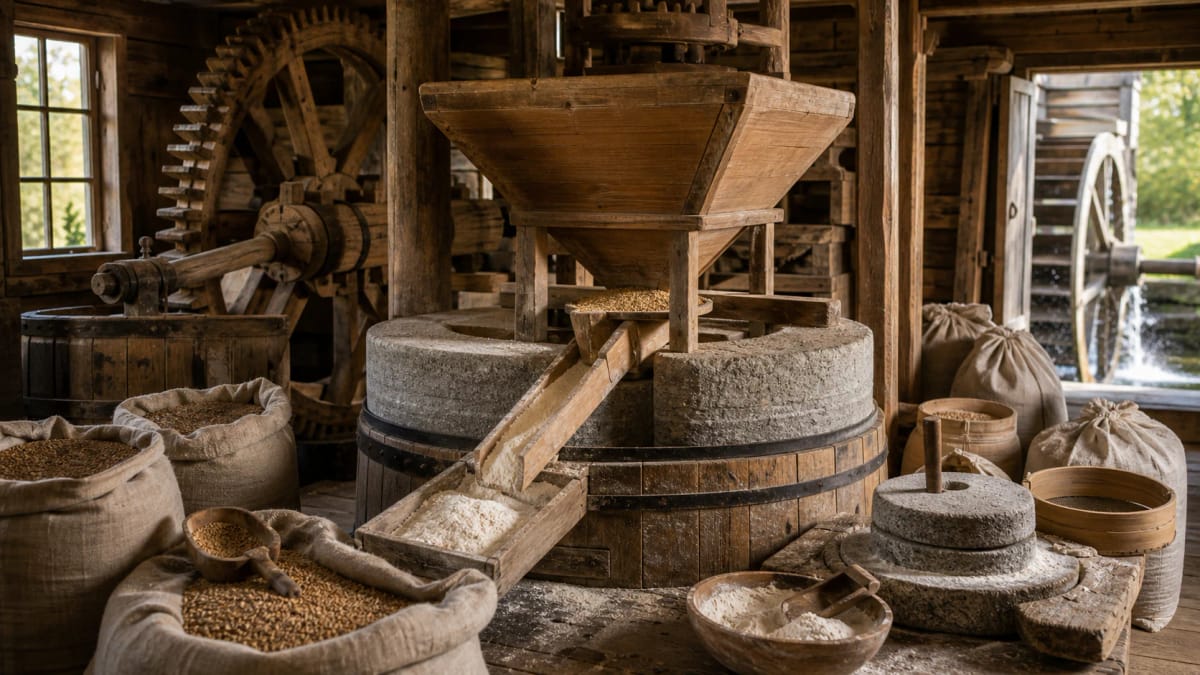
Watermill: A mill whose mechanism is turned by a water wheel or turbine using the energy of a stream or dam.
Windmill: A mill whose sails catch the wind and transmit motion to the millstones through wooden mechanics.
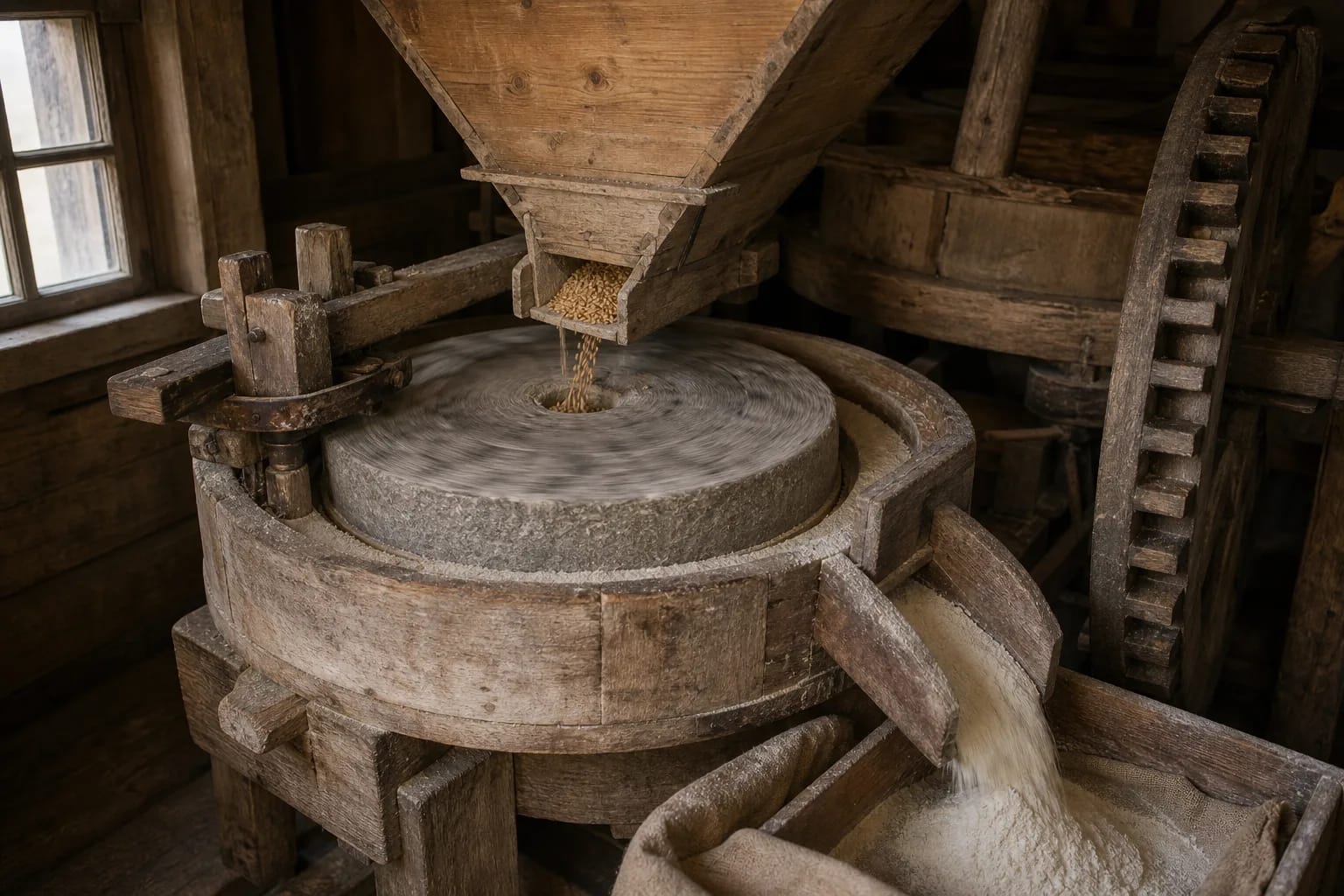
Hopper: A container above the millstones from which grain gradually falls into the grinding area.
What is milling?
Milling is the crushing of grain to obtain flour, groats, meal, or other products needed for food and the household. In traditional culture it connects the field, harvest, millstones, mill, bread, and everyday food.
VLE describes milling as a process of crushing materials, and in agricultural heritage its most important form is grain milling. Rye, wheat, barley, oats, and buckwheat behave differently in millstones and give different products.
Milling is not only a technical action. For a village person it meant stores of flour, the possibility of baking bread, payment to the mill, the road to the mill, and the miller's reputation.
From household querns to the mill
The oldest and closest household level is the hand quern. It consists of two stone halves between which grain is poured and crushed by turning into meal or flour. VLE notes that hand saddle querns were used in Lithuania already in the Neolithic, while rotary hand querns spread in the fourth-third centuries BCE; millstones were usually made from field stones such as granite, basalt, sandstone, or flint, and from the second half of the nineteenth century they began to be cast.
Hand querns allowed a household to grind a small amount of grain, but the work was hard and slow. When watermills and windmills appeared, larger quantities could be milled professionally using natural energy.
The history of milling is therefore a shift from family hand work to community technology. The mill served villages, manors, and small towns and became a local economic point.
Millstones
Millstones are the heart of milling. Their stone, surface roughness, gap, and speed determine whether grain is only cracked or ground into finer flour.
Millstone halves had to be maintained. A surface that became too smooth ground poorly, so stones were sharpened, grooved, or otherwise dressed. This required separate knowledge of stone and mechanics.
The Lithuanian word girnos is often used symbolically today, but in traditional technology it was a concrete, heavy, precisely working device.
Watermills
A watermill uses moving water. A river, stream, dam, or pond turns a wheel or other mechanism, which transmits motion through shafts and gears to the millstones.
In Lithuania watermills were important where terrain and water flow made it possible to collect or use energy. According to VLE, mills powered by water and animals appeared in the thirteenth century, windmills in the fourteenth; the first watermill was mentioned in 1256. A village watermill had one to three water wheels; the most efficient were overshot wheels, with efficiency of about 85 percent, and the least efficient undershot wheels, up to 35 percent. Such mills often became economic centers of manors, towns, and villages.
The example of the Kretinga Manor watermill shows that a mill can be an object of technology, architecture, and local history. It is not only one pair of millstones, but a building, water system, and social memory.
Windmills
Windmills use wind. Their sails turn a shaft, and the mechanics transmit motion to the millstones. VLE notes that windmills are mentioned in Lithuania from the fourteenth century; four-sailed mills were most common, with sails 8-12 m long, and post mills, whose whole body turns, are distinguished from cap mills, where only the upper cap turns. The latter reached up to 20 m in height. Such mills need open landscape, wind directions, and suitable construction.
In Lithuania windmills became vivid landscape signs, but it is a mistake to think all mills were windmills. Watermills, horse mills, and other milling systems were also important.
Windmill heritage is visible in sails, cap, wooden mechanics, millstones, and the miller's work. A handsome outer silhouette alone does not explain milling.
The miller
The miller was a craftsperson, machine keeper, and participant in the local economy. He received grain, regulated milling, watched the stones, maintained the mechanics, and settled accounts with people.
A good miller had to understand grain moisture, the gap between stones, flour coarseness, the sound of the mechanism, and wind or water conditions. If the mill worked badly, bread and trust suffered.
In folklore and stories the miller often has a special status: he works beside a loud, powerful machine through which the food of the whole village passes.
Flour, groats, and bran
Milling does not always mean only white flour. Grain can yield coarser flour, groats, dunstas, bran, or malt products. The product depends on the grain, the stones, and sifting.
Sifting separates finer parts from coarser ones. Bran consists of grain husks and other separated parts, which also had household value.
Bread baking, porridges, animal feed, beer, and everyday meals needed different milling. A mill therefore had not only to grind, but to prepare the right product.
Milling and bread
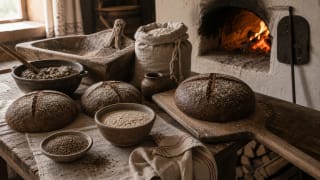
Rye bread begins not in the oven but in the field and in the millstones. Rye has to be grown, threshed, cleaned, ground, and only then can flour become sourdough and dough.
Milling is therefore a necessary part of bread culture. Without querns or a mill there are no everyday stores of bread flour, and without good flour the taste and structure of bread change.
This connection lets milling be presented not as a separate technical museum corner, but as one of the main stages of food heritage.
Mills as heritage
Surviving mills today are heritage of technology, architecture, and landscape. It is important to preserve not only building walls, but also mechanism, millstones, water system, sails, floors, hoppers, and work stories.
Lithuanian mill heritage initiatives emphasize that a mill is a complex machine and a place of community memory. If only a pretty facade remains, most of the craft meaning is lost.
A good milling page therefore has to show movement: grain enters the hopper, the millstones crush it, the mechanics work, and flour falls from the chute.