- Field
- Lithuanian tošininkystė, birch bark objects, and plant-material household crafts
- Type
- traditional craft
- Heritage status
- living tradition
- Context
- Birch bark, tošininkystė, birch-bark vessels, birch-bark boxes, baskets, footwear, vyžos, tošelė, tar, food storage, birch bark, Samogitia, Mažeikiai
Tošininkystė, Birch bark objects, Birch bark craft, Tošis craft, Birch bark boxes
Birch Bark Crafts forms and objects
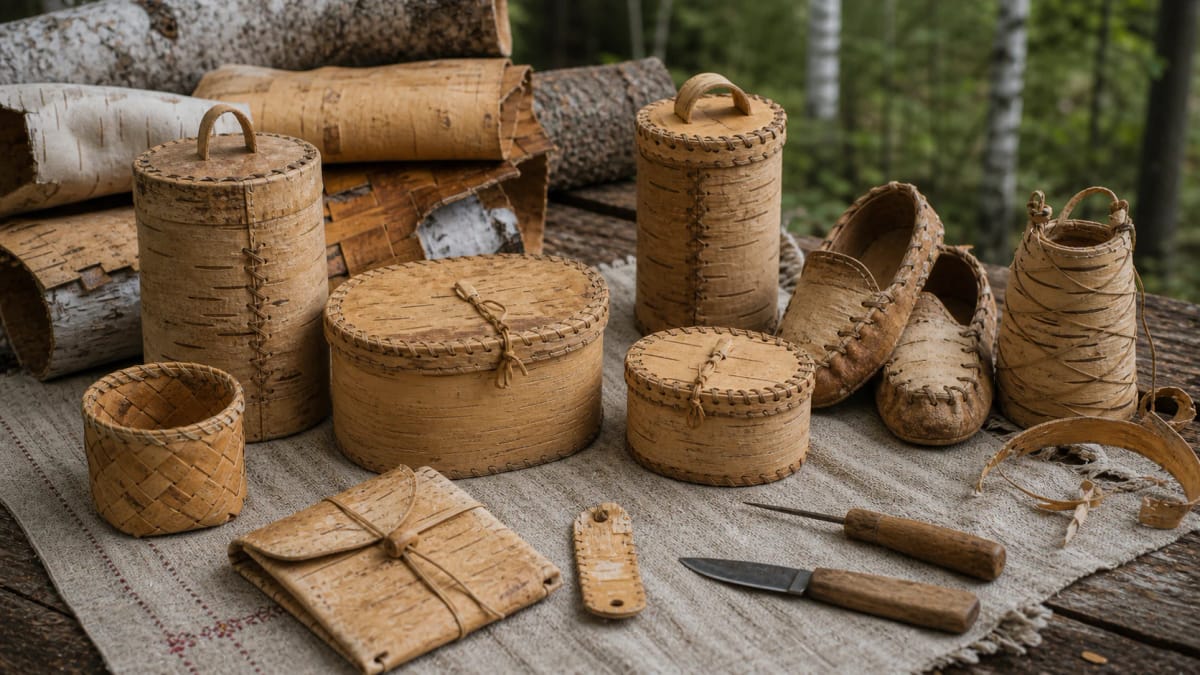
Birch-bark vessels and boxes: Cylindrical, oval, or rectangular containers for food, small objects, tools, or household use, often with sewn seams and lids.
Baskets: Containers woven from birch-bark strips or folded from sheets, related to basket traditions but with a distinctive smooth, layered surface.
Footwear and protective objects: Birch bark can be used for light footwear, inserts, protective cases, or temporary household constructions when lightness and flexibility matter.
Small sheet-made objects: Plates, writing or marking bases, toys, scrubbers, massagers, and educational pieces where the main point is learning the material's layers.
What are birch bark crafts?
Birch bark crafts are household objects made from the outer layer of birch bark: vessels, boxes, baskets, bags, cases, parts of footwear, small tools, and educational pieces. The craft is based not on carving wood but on bending, sewing, weaving, and shaping a sheet-like, layered bark.
Tošis is the corky tissue of birch bark. It is layered, smooth, white, yellowish, or reddish, and its layers can separate from one another. Because of this, birch bark behaves like a natural sheet: it can be bent, cut, joined, rolled, or woven into a container.
In Lithuania today, tošininkystė is not a mass craft. It is more visible as a rare revived tradition kept alive by masters, museum education, and the folk-art field. The page should be read as a living but very niche heritage.
Material: layers, flexibility, and scent
The value of birch bark lies in its layers. A thinner layer suits small work, folding, or tošelė-type plates; a thicker one suits boxes, vessels, and baskets. The master must feel where a layer wants to separate and where it must stay whole.
Birch bark contains resinous substances, including betulin. In traditional household use this helped people see it as fragrant, natural, and fairly resistant, though today its protective or medicinal properties should not be overstated. For the craft, the practical behavior of the material matters most. VLE also reminds us of broader uses: tar was obtained from birch bark, leavens and baskets were made, and in old times people even wrote on birch bark, producing birch-bark writings.
Birch bark is light, but not indestructible. It can crack if bent too sharply, deform from moisture, split when overdried, and lose form if the joints are inaccurate.
When and how is birch bark gathered?
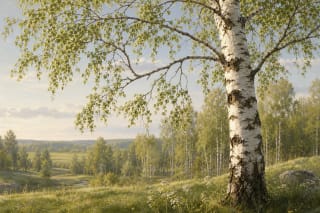
Birch bark must be gathered very carefully. The best material is usually associated with the right season and trees whose bark separates evenly. Bark must not be stripped recklessly from a living tree, because that damages or kills it.
In responsible contemporary practice, birch bark is taken from logging sites, already felled birches, or places where collecting material does not harm a living tree and does not violate forest rules. This matters because the craft needs a good sheet, not random torn pieces.
Gathered bark is sorted, cleaned, dried, or stored so it will not mold and lose flexibility. Before work it may be moistened or warmed so it yields more easily to shaping.
Vessels, boxes, and baskets
The most visible birch-bark objects are vessels and boxes. A cylindrical or oval form is made by rolling a sheet, joining it with a seam, and adding a bottom and lid. The edges are reinforced so the vessel does not open out and keeps its shape.
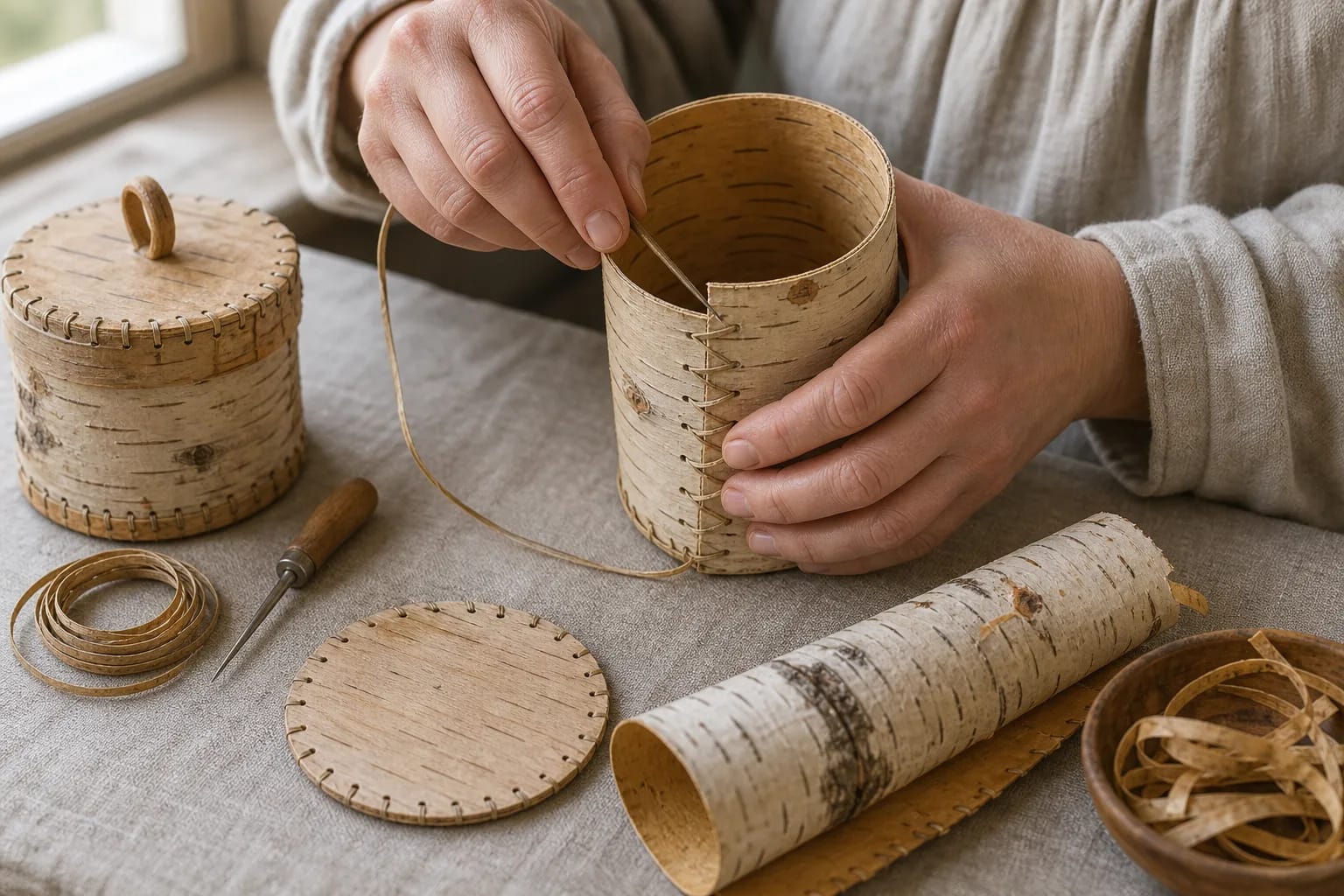
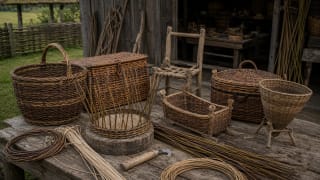
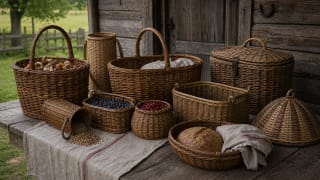
Baskets may be woven from narrower strips of bark or constructed from wider sheets. Such objects look close to willow basketry, but their surface is different: bark gives a smooth plane, a bright birch pattern, and a clear graphic seam.
Birch-bark vessels are traditionally associated with storing food, grain, small objects, or tools. Today they often also become folk-art, interior, or educational objects, but a good piece should still remain functional.
Footwear, cases, and other household objects
Birch bark can also be used for footwear examples, cases, handbags, and parts of backpacks or bags. These objects show that bark is not only material for small boxes; it can become a folded, sewn, and wearable construction.
Footwear and large carried objects require especially careful material selection. Where the foot moves or a handle carries weight, a weak spot quickly tears. Practical use therefore needs stronger joints and clear form.
Contemporary bark workers sometimes create new objects: scrubbers, massagers, decorative cases, and educational pieces. Such forms can be new if they do not hide the material and its traditional logic.
Tošelė and the link with sound
Birch bark matters not only for household objects. The tošelė is a Lithuanian folk musical instrument, a small free-reed aerophone using a birch-bark plate or membrane. It produces a clear sound shaped by the mouth cavity and blowing.
This does not mean that all bark objects are musical instruments, but it shows the material's versatility. The same birch layer may become a box, basket, plate, lure, or sound source.
Mentioning the tošelė places birch bark in a wider cultural field: from forest material and household use to music, imitation of bird sounds, and village ensemble repertory.
Lithuania and the wider northern area
Birch bark objects are not only Lithuanian. Birch bark crafts are widespread in other northern and eastern European cultures where birch forests grow and people had access to suitable bark. The material or technology should not be claimed as exclusively Lithuanian.
The Lithuanian focus lies elsewhere: local terminology, references to tošis, museum education, living practice among Mažeikiai and Samogitian masters, the Lithuanian folk-art field, and links with other plant-material crafts.
This approach is more honest and stronger. It allows a Lithuanian layer to be shown without forgetting that birch bark belongs to a broader forest culture.
How to recognize a good birch-bark object
A good birch-bark object has a clear form, clean edges, a strong seam, and bending appropriate to the material. The seam should not tear the sheet, the edges should not crumble, and the lid should fit the body without forced pressure.
The direction of the material also matters. If the sheet is turned incorrectly, it may split where it should hold. If decoration overwhelms construction, the object becomes superficial. In tošininkystė, ornament must obey the layers of the material.
When evaluating an old or museum object, it is important to document not only form but also place, maker, purpose, name, method of use, and material source. Rare crafts disappear not only physically but also by losing their names.
Care and use today
Birch-bark objects should be kept dry, but not overdried near a radiator or direct sun. Sudden changes of moisture and heat can distort form, stretch seams, or split edges.
Cleaning is best done dry or with a barely damp cloth, without aggressive chemicals. If an object is meant for food, it must be clear whether it was made for that purpose or only decorative. Contemporary food-safety requirements differ from older household practice.
If a birch-bark vessel cracks, it should be repaired with similar material and a structural method. Glue, tape, or metal clamps can damage not only the appearance but the material itself.