- Category
- Learning traditional music
- Reading time
- 5 min
- Sources
- Source-based explanation; editorial exercises identified separately
Original learning exercise · synthesized sound
D–E–F–G–A: five reference notes
Digital D4–A4 example, A4 = 440 Hz. The source supplies the pitch names d–e–f–g–a; this example’s octave and note durations are editorial choices. Follow the maker’s specification for the register and string tension of a real instrument.
Ready to play
The selected parts follow a two-beat count-in. This is synthesized demonstration sound, not a recording of a traditional performer.
Notes and durations in text
Digital example D4–A4: D4 (2 quarter-note beats) · E4 (2 quarter-note beats) · F4 (2 quarter-note beats) · G4 (2 quarter-note beats) · A4 (2 quarter-note beats)
Which kanklės this example concerns
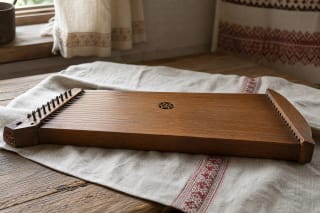
This guide concerns traditional five-string kanklės associated with northeastern Aukštaitija. Do not use this layout to tune concert kanklės or a different regional model. Identify the maker, string set and intended register first.
On printed page 265 of his 2011 article, Romualdas Apanavičius cites Juozas Žilevičius’s d–e–f–g–a example and notes variation in tuning. It is historical evidence for one example, not a universal Lithuanian tuning.
Understand the five reference notes
Ascending from the lowest note, the sequence is D, E, F, G, A: re, mi, fa, sol, la. Its semitone gaps are 2, 1, 2, 2. This is a five-note diatonic segment; five strings alone do not make music pentatonic.
The player gives D4, E4, F4, G4 and A4 at A4 = 440 Hz: approximately 293.66, 329.63, 349.23, 392.00 and 440.00 Hz. This octave and equal temperament are choices for the digital comparison. The historical source does not prescribe your instrument’s register.
Check the string before turning a peg
Place the instrument securely and trace each string to its own tuning peg. Listen first. Pluck one string gently while damping the others; read both the note letter and octave number on the tuner.
Adjust only towards target notes supplied by the maker, using small peg movements. Pluck again after each movement and allow the reading to settle. The tightening direction depends on how the string is wound, so do not assume a universal turning direction.
Check all five strings systematically
On a worksheet, list the five strings from their intended lowest pitch to highest. Record the maker-confirmed note with its octave and the present tuner reading for each. Match one string before moving to the next.
Recheck all five afterwards and play them individually upwards and downwards. If the display jumps, try a gentler pluck and better damping of adjacent strings. If you do not know the correct octave, or a string will not hold pitch, consult the maker instead of continuing by guesswork.
What the reference does not teach
Five successive reference notes are not a traditional kanklės melody. They help separate note name, octave and interval. Learn the playing technique and a particular sutartinė separately; a tuning cannot by itself reproduce a performance style.
For further study, explore the old Lithuanian instrument demonstrations and the emokykla.lt lesson “Penkiastygės kanklės ir kanklininkai.” This editorial guide is neither a maker’s instrument manual nor a maker-reviewed instruction.