- Instrument family
- String instruments
- Type
- Plucked chordophone, Baltic psaltery, sutartinės, cult of the dead, national symbol
- Source status
- well attested
kanklelės
What are kanklės?
Kanklės are a traditional Lithuanian plucked string instrument, a chordophone in the Baltic and Baltic Sea psaltery family. Related instruments include Latvian kuokle or kokle, Estonian and Finnish kantele, and northern Russian gusli; they differ in form, string number, and playing method but share an archaic string-music background.
Sound is made by plucking open strings with the fingers of one hand while the fingers of the other hand hold, or mute, strings that should not sound. Kanklės were most often played solo but also fitted into bands with a melody-leading fiddle, bass strings, and percussion. In Lithuanian culture they became one of the strongest signs of national recognition.
Construction and sound
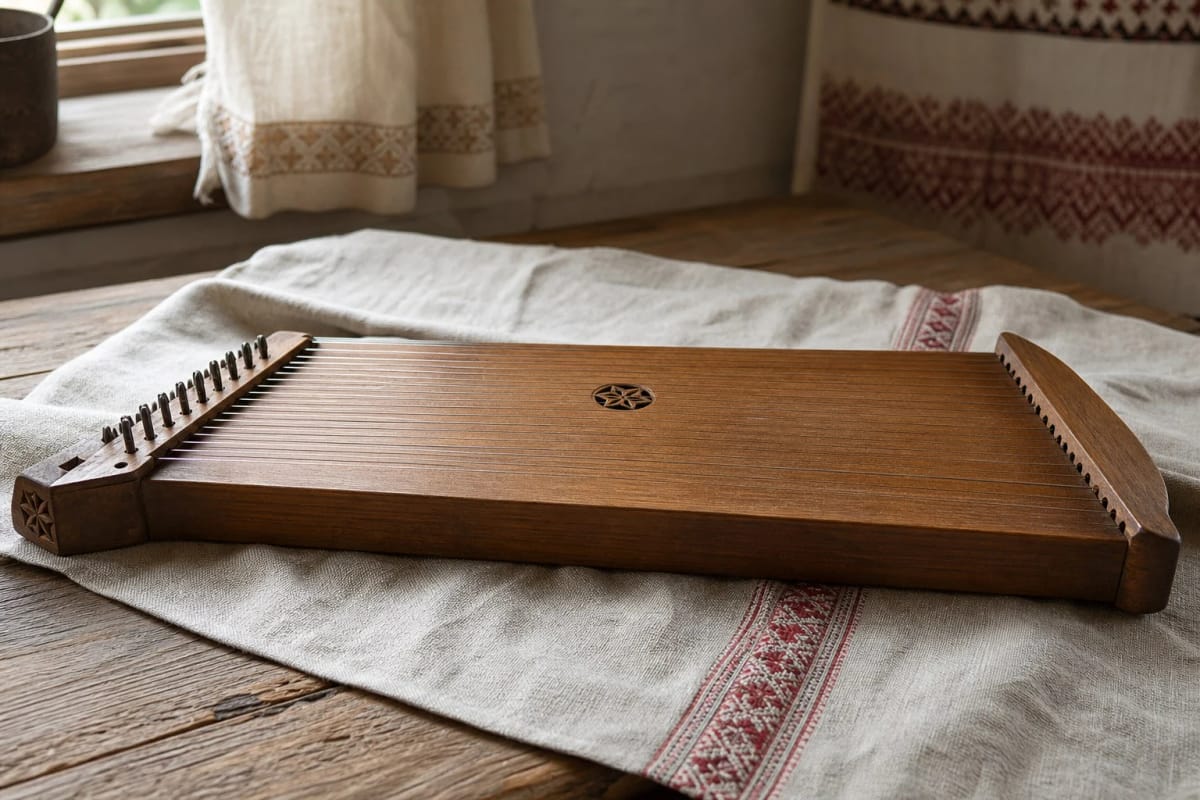
The traditional body is hollowed from a single piece of wood, trapezoid, with a star-shaped or circular sound hole. Along the body are stretched 5-12 strings. The oldest museum examples have 5-12 strings, and regional types differ in both shape and string number.
The sound is clear, calm, and resonant. Northeastern Aukštaitians played melodic kankliavimas, drawing melody with the fingernail, while western Aukštaitians, Žemaitians, and Suvalkians played chordal kankliavimas with nail and plectrum, sometimes fingers, muting unnecessary strings with one hand. This makes the instrument suitable for both solo melody and harmonic filling.
Regional kanklės types
Northeastern Aukštaitian kanklės are shaped like a small boat or coffin, usually hexagonal, with a slightly slanted thick end higher than the thin end; they have 5-7 strings and were used for sutartinės. Western Aukštaitian and Žemaitian kanklės are flat, with a slanted thick end and 9-12, sometimes more, strings; in northwestern Žemaitija some have a rounded or spiral thick end.
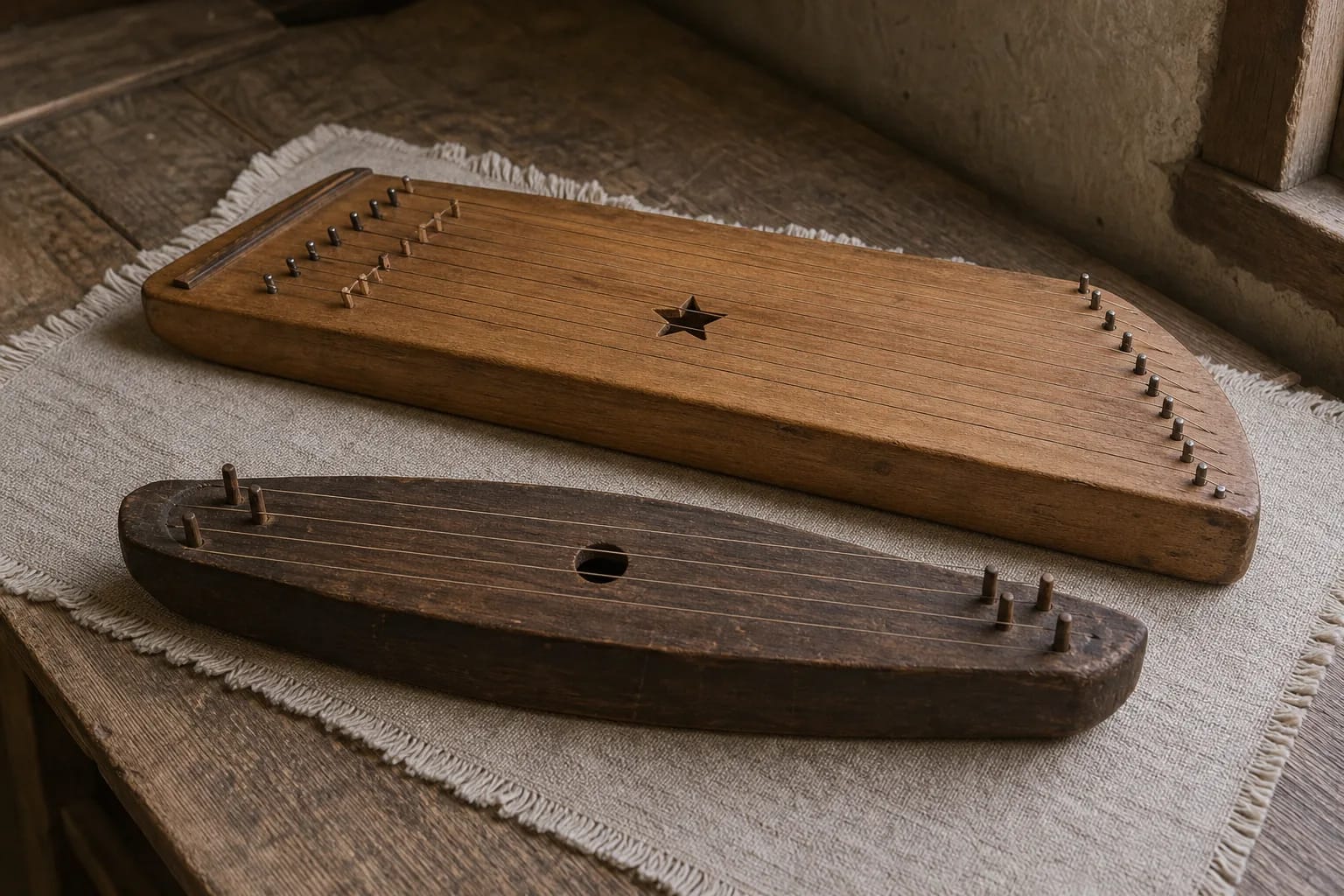
Suvalkija, or Užnemunė, kanklės have a very wide rounded thin end and 9-12, sometimes 13, strings. Historical sources also mention Lithuania Minor kanklės with 7-9 strings. The oldest Aukštaitian and Žemaitian kanklės were painted black; newer Suvalkian ones were black and brown. These differences show several local schools inside one Lithuanian instrument.
History, beliefs, and tradition
Kanklės were widespread mainly in the Narva culture area: northern and western Lithuania, in the lands of the Selonians, Semigallians, Žemaitians, and Curonians. They may have reached Užnemunė through Žemaitians in the fifteenth-eighteenth centuries. They were absent in Dzūkija and some other regions. Kanklės were first mentioned in the manuscript of Jonas Bretkūnas's Bible translation in 1579-1590.
Their origin and use are linked with old beliefs. Making customs preserve relics of the cult of the dead, such as cutting the tree and making kanklės after a family member died. The shape and color recall a dugout boat and coffin; string counts match magical numbers 5, 7, 9, and 12; and ornamentation includes sun and light symbols. Northeastern Aukštaitians played sutartinės at dawn or dusk, a sacred transition from darkness to light. In A. Juška's wedding description Svotbinė rėda, kanklės playing is mentioned together with singing.
From traditional to concert kanklės
The kanklės tradition began to decline as bellows instruments became dominant, so in the early twentieth century kanklės were consciously cultivated as a national symbol. In 1906 Pranas Puskunigis founded the kanklės ensemble Kanklės in Skriaudžiai; from 1901, Suvalkian kanklės were improved by J. Astrauskas, J. Garalevičius, Pranas Puišys (1879-1958), J. Strimaitis, and others.
In 1964, based on a design by Pranas Stepulis and Dalia Mataitienė, Pranas Kupčikas built modified concert kanklės: high kanklės with 29 strings and range c-c4, bass with 20 strings and range C-a1, and contrabass with 15 strings and range G1-A. Kanklės have been taught at the Lithuanian Academy of Music and Theatre since 1945 and in conservatories and music schools since 1953. Folklore ensembles and folk-instrument orchestras use them, while reconstructed traditional kanklės have brought back the older sound.