- Category
- Everyday life and the calendar
- Reading time
- 6 min.
- Sources
- Local ethnographic studies and LMTA’s Metų ratas resource
Words and examples
Showing: 8
Spring
Preparing soil and sowing
The Kaišiadorys account distinguishes ploughing, manuring and sowing.
Source · pp. 150–151: ploughing, manuring, sowing
#Spring
Turning livestock out
Beliefs about turning livestock out mention blessed juniper branches.
Source · p. 4: first grazing, references [24, 31]
#Summer
Haymaking
Mowing, drying and bringing hay in were separate stages.
Source · pp. 157–163: haymaking
#Summer
Rye harvest and completion
Daily work and the completed harvest had different song contexts.
Source · Passages on the daily song cycle and the harvest wreath
#Summer and autumn
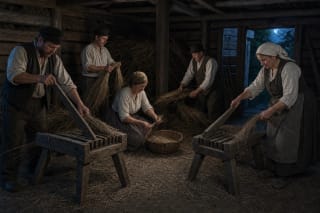
From pulling flax to breaking stems
Harvesting flax and preparing fibre formed a chain of operations.
Source · Passages on flax pulling, seed removal and breaking
#Autumn
Threshing and work parties
The Vaiguva study shows how reciprocity and machinery shaped work parties.
Source · pp. 1–2: organising communal work
#Winter
Spinning evenings
A Žalvarniai account places spinning between December and March.
Source · p. 186, note 743; Kazė Leščinskienė
#Winter
Evening work restrictions between Christmas and Epiphany
Pilviškiai memories describe restrictions on some work during evenings between Christmas and Epiphany.
Source · p. 2: evenings between Christmas and Epiphany (tarpušvenčiai), references [30, 36]
#No entries match this search.
Read the year as a sequence of work
This calendar maps relationships between tasks. Each stage points to a particular account, not a starting date prescribed for all Lithuania. Several tasks overlapped: livestock needed care during sowing, while food preparation continued through both celebrations and communal work.
Every account of a working year is selective. This guide concentrates on farming households. Fishing, town crafts and the lives of landless labourers would require different emphases; they cannot be absorbed into one supposedly universal village timetable.
Separate spring work from its ritual markers
Preparing land, sowing and turning livestock out are distinct processes. Associated holidays and beliefs illuminate their cultural meaning, but the mention of a custom does not prove that every household performed the same work on the same day.
The Pilviškiai study is useful partly because its author explains the limits of the evidence: local memories collected at different times cannot reconstruct every part of a complete calendar equally well. A documented gap is preferable to an invented rule.
Summer work involves more than a starting date
Distinguish mowing from drying and bringing hay in. For rye, separate the rhythm of a working day from the celebration completing the harvest. A wreath by itself cannot explain all the labour that preceded it.
Describe museum demonstrations in similar stages: what visitors saw, which tool was demonstrated, and whether a song accompanied work or formed part of a later concert programme. That gives contemporary education a clear setting rather than treating it as an unchanged scene from the past.
Autumn work parties: agreements and equipment
Jonas Mardosa’s Vaiguva study presents communal work as something organised: who helped, how help was returned and what labour the available machinery required. Working together does not automatically imply equal status or identical obligations.
In the flax cycle, distinguish harvesting the plant from preparing its fibre. Compressing everything into one “flax festival” obscures the duration of the process and the tools needed at each stage. Our separate flax-breaking page explains that operation in detail.
Winter did not mean that work stopped
The Žalvarniai account places spinning between December and March. This is a local memory rather than a rule for every Lithuanian farm. Sources record both the rhythm of work and restrictions associated with festive time.
To build a calendar for a particular place, record its locality, historical period, work stage and witness. Also distinguish memories of daily life from a present-day demonstration or a researcher’s synthesis. These questions help preserve the differences that make a local account useful.