- Category
- Lost settlement histories
- Reading time
- 3 min.
- Sources
- Local history interpreted from cited sources
1744–1909: a community before the reservoir
The Kaunas Regional State Archives account identifies Kampiškės in a 1744 list of settlements in the Vilnius diocese. It belonged to Rumšiškės parish in 1782; a chapel was built in 1883 and an independent parish established in 1909. The flooded place held a long history of community life, not simply a cluster of houses.
A written mention, an administrative affiliation and a building date describe different events. They should not be collapsed into one vague measure of the village's age.
1956–1959: residents are relocated
The archival account dates the relocation of residents to 1956–1959 and records the damming of the Nemunas on 19 July 1959. The formation of Kaunas Reservoir altered both the village landscape and people's connections with neighbouring places.
A family's departure and the arrival of the water need not have occurred on the same date. Research into an individual home requires its relocation record or family testimony; the general period cannot substitute for either.
1958: the church's history continues in another form
Šlienava church was consecrated in 1958. The archive distinguishes the dismantling of the old Kampiškės church from moving a building intact: its logs were used to complete the church at Šlienava.
Saying only that the church was moved can conceal residents' resistance, destruction of the building and continuity through reused material. The continued dedication is also not proof that the whole building survived.
1990–1995: a new memorial
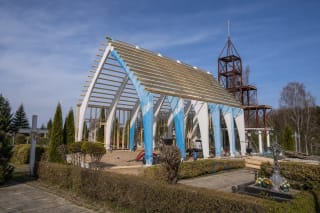
The account describes community efforts between 1990 and 1995 to build a chapel beside Viršužiglis cemetery. Completed in 1995, St Anne's Chapel remembers the lost village in a later landscape.
The memorial chapel, Šlienava church and flooded village site have separate locations and histories. A map should connect them rather than replace them with one misleading pin.
Reading an archival photograph
Look for the place, date and archival reference. This publication includes later photographs of Šlienava: they document continuity, not Kampiškės before flooding. Availability online does not by itself grant permission to reproduce a photograph.