- Category
- Food heritage
- Reading time
- 5 min.
- Sources
- A food heritage learning guide based on the cited sources
Two words, two questions
Kafija can be explored as a drink, and palaunagė as an occasion for meeting. The Lithuanian National Culture Centre's inventory places kafija culture in Lithuania Minor and describes palaunagė as afternoon sociability over a cup. This pairing helps readers approach family memories and event descriptions more precisely. When someone recalls going for kafija, ask about more than the contents of the cup. Who invited whom, where did people sit and what did they talk about? Those questions preserve experience that an ingredient list cannot capture.
Kafija does not mean acorn coffee alone
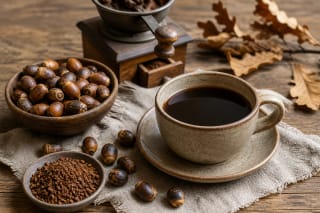
The inventory mentions coffee beans and local materials including acorns, chicory and cereals. The name therefore does not identify one fixed mixture. Ask which ingredients went into the particular cup being described and why they were chosen. If a narrator remembers a blend, record it as a blend; do not supply missing proportions. A drink demonstrated by a present-day educator and a version preserved in family memory can be valuable in different ways. Neither needs to become the supposed universal recipe of all Lietuvininkai.
Notice how the meeting is made
At a demonstration, listen to how the hosts introduce their practice: through family memory, regional research or an event they are shaping today. Record their vocabulary and the order of serving, while resisting the temptation to turn one occasion into a regional rule. Ask which detail they most want to pass on. Sometimes the most valuable result is a better understanding of a person's story, rather than an arrangement of cups you can reproduce. Agree how photographs or voice recordings will be used before making them.
Remembered practice and present-day revival
The inventory entry itself emphasises revival. A public presentation can therefore be understood both as heritage and as the work of people living now. Ask which accounts participants learned from, who helped record them and what decisions shaped the demonstration. A different vessel or meeting place does not, on its own, settle whether a tradition has continued. Describe what you actually encounter: a particular community's chosen form at a particular time. This makes continuity discussable without implying that every detail has remained unchanged for centuries.
Keep a family memory of palaunagė
Start with one account, recording the narrator, locality, remembered decade and conversation date. Note the drink, food, participants and occasion separately. If the person used a different name, preserve it; an explanatory label can be added later. Caption a family photograph with what is confidently identified and what remains uncertain. The resulting record may be small, but others will be able to revisit it. This guide provides no tested drink proportions: its purpose is to make the social setting and the voices describing it easier to understand. Keep the participants’ own name for the occasion alongside their account.