- Place
- Klaipėda District Municipality
- Region
- Klaipėda Region
- Type
- privately operated educational and leisure park themed around the Indigenous cultures of North America
- Address
- 63 Šlikių St, Šlikiai, Klaipėda District
- Coordinates
- 55.85208, 21.21078
Vinetu Native American Village, Vinetu Kaimas, Living Native American History Museum
What Vinetu Village actually is
Vinetu Village is not a surviving historic settlement or a cultural institution run by a particular Indigenous nation. It is a privately operated themed homestead and educational park created by a Lithuanian family in Šlikiai, developing this concept since 2006. The venue calls itself a living-history open-air museum, but visitors will understand it more accurately as an immersive interpretation.
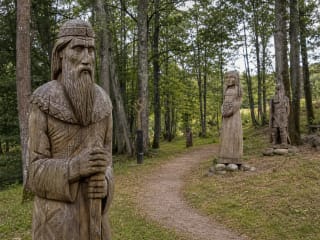
White tipis, tall carved poles, log benches, spaces used for stories and rituals, timber buildings, and animal enclosures shape the visual experience. The green Dangė-Akmena valley provides a genuine rural setting, but it is neither a North American prairie nor a reconstruction of one documented historic community.
The Lithuanian brand and programme names deliberately use the familiar local word indėnai, meaning Indians. This guide uses Indigenous peoples of North America and the names of individual nations when known, because those communities do not share one culture, language, or history.
What general admission includes
A self-guided ticket lets visitors explore the grounds, see the tipis and carvings, follow the maze and obstacle areas, use a family activity booklet, and enter the museum display. It is independent exploration rather than a narrated tour at a fixed time.
Horses, sheep, goats, domestic birds, and other animals live on the property. Approach only where permitted, feed them solely with food approved or supplied by staff, and supervise children: an admission ticket does not turn every enclosure into an unrestricted petting zoo.
Weather and private events affect obstacle courses, mazes, and outdoor areas. Check age or height instructions before a child starts, and treat archery, spear or tomahawk throwing, horse riding, and other supervised activities as separate services unless your chosen programme explicitly includes them.
The private collection: questions worth asking
The venue says its collection has been assembled for more than fifteen years. It includes art and jewellery, weapons, musical instruments, trophies, clothing and decorative details, old photographs, paintings, and other objects. With a guide, it offers a useful opportunity to compare materials, functions, and imagery.
The official visitor page does not provide a public object-by-object catalogue recording provenance, date, maker, or nation. Treat authentic as the venue's description rather than automatic museum attribution for every item, and ask where an object came from and how its purpose was established.
The best questions are specific: is an item associated with Lakota, Dakota, Nakota, Haida, Apache, or another people; is it historic, made by a contemporary Indigenous artist, produced for visitors, or created as part of the Lithuanian venue? This avoids the false impression that all Indigenous peoples of North America shared identical homes, dress, and ceremonies.
A booked tour is different from a walk-in visit
The booked 1.5-2-hour programme combines the guide's account of history, present-day life, traditions, and values with a museum visit, an activity inside a tipi, archery, and spear throwing. It is participatory and theatrical, best for groups willing to join in rather than simply read labels.
The official 2026 page lists the guided programme at EUR 15 for an adult, EUR 12 for a child, senior, or disabled visitor, and EUR 45 for two adults and two children. It must be booked, while meals, other workshops, and additional activities cost extra; confirm the current contents and price before paying.
A 2025 Ministry of Culture decision admitted three Vinetu Village programmes to Lithuania's Cultural Passport catalogue: a drumming and song circle, a moccasin-themed programme, and a programme on Indigenous lifestyles and traditions. That confirms the inclusion of particular services in the funding scheme, not state-museum status for the entire venue or exclusive authority over Indigenous history.
Tipis, totem poles, and the value of being specific
The Smithsonian's National Museum of the American Indian stresses that there is no single American Indian culture or language and that the most accurate name is the one a community uses for itself. Vinetu Village combines symbols associated with different regions in one space, so read it as a thematic synthesis.
The conical tipi is associated above all with peoples of the Great Plains and mobile lifeways, while monumental carved poles embodying ancestry, kin groups, and stories developed among Northwest Coast cultures. Placing both together does not mean that the combination formed one historical village.
Children should also hear that Indigenous nations live and create today, govern communities, maintain languages, and address contemporary issues. Use the visit as a starting point, then seek museums, artists, and educational resources produced by specific nations themselves.
2026 hours, tickets, and practical planning
The official 2026 page lists walk-in summer-season admission from Tuesday to Saturday, 11:00-18:00, at EUR 8 per adult and EUR 6 per child, with free entry for children under five. From October through May, visits are by arrangement or during events. Because May overlaps the venue's seasonal wording, confirm the schedule particularly carefully that month.
Individual summer visitors normally do not need to book, but the entire property sometimes closes for private events. Check the official page or call +370 602 50008 before travelling, especially on Sunday, Monday, in May, outside the summer season, or when planning a tour, meal, or overnight stay.
Much of the visit is outdoors on grass or natural ground, so waterproof footwear helps after rain, while a sunny day calls for water and a hat. A discounted tour price for disabled visitors does not itself confirm full physical access; discuss wheelchairs, toilets, paths, animals, dogs, and individual sensory needs with the venue in advance.