- Place
- Vilnius City Municipality
- Region
- Vilnius
- Type
- historic Vilnius cemetery in Užupis
- Address
- Žvirgždyno g. 3, Vilnius
- Coordinates
- 54.67970, 25.30860
Bernardine Cemetery
Bernardine Cemetery in Užupis, on the Vilnia bank
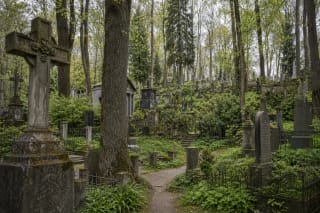
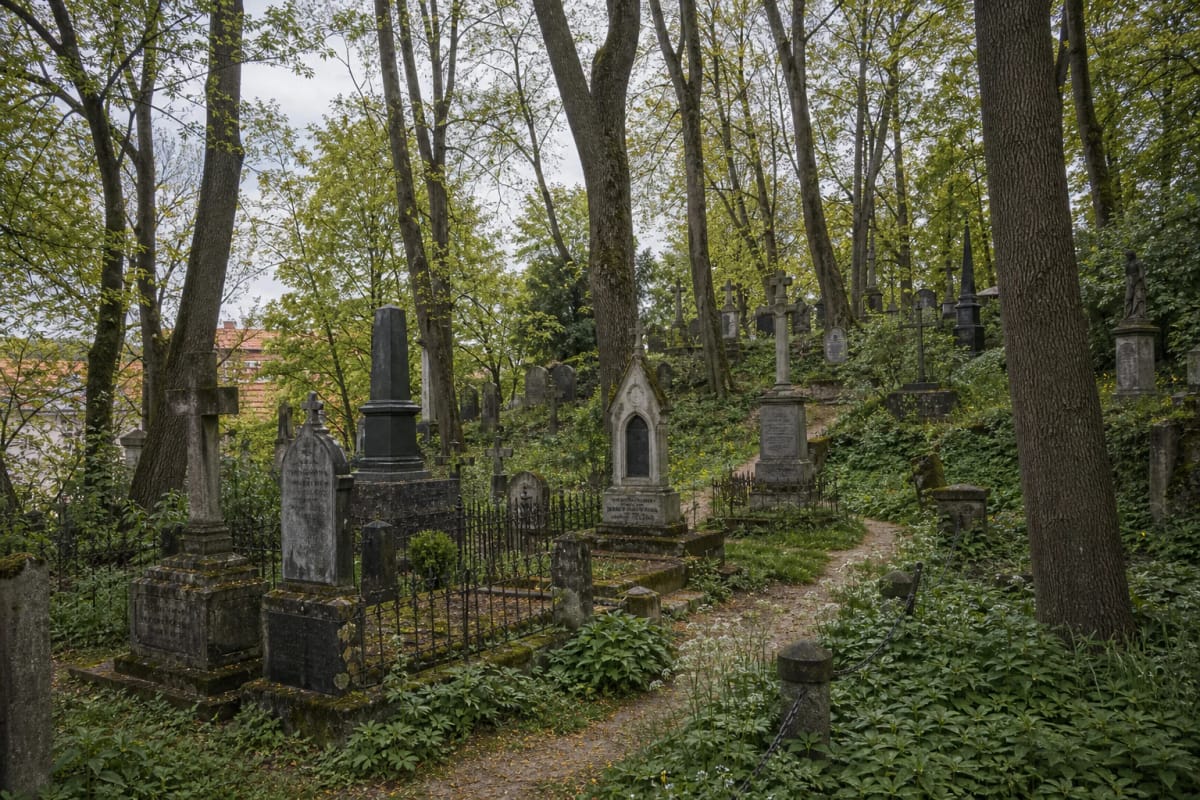
Bernardine Cemetery is one of the most sensitive places in Užupis: a 3.6 ha hilly, dense cemetery landscape on the right bank of the Vilnia, where paths, old trees, and layers of monuments create a slow experience of city memory. The gravestones here are mostly stone.
The cemetery stands around Žvirgždyno Street, close to the old town and Užupis, so it is easy to include in a walking route. Still, it is worth coming deliberately rather than merely passing through. Unlike the more monumental Rasos Cemetery, the experience here is smaller in scale and more intimate.
Founded in 1810 and shaped by nineteenth-century building
The cemetery was established in 1810, when the Vilnius Duma, at the request of the Bernardine Monastery's St Martin German Roman Catholic congregation, allocated a 2.6 ha plot. Burials began on October 2, 1810. On October 26 of the same year, a small masonry Classical founding chapel built in the centre of the cemetery was consecrated, with a memorial plaque and a wooden sculpture of the Crucified Christ.
Columbaria were built in 1810-1812, a masonry wall with a red-tile gabled roof enclosed the cemetery in 1812, and around 1825 construction began on the chapel, consecrated in 1827; burials in its underground crypts began in 1829. In 1860 the cemetery was expanded by another 1.21 ha. These precise dates show that this is a documented nineteenth-century heritage ensemble, not simply an atmospheric backdrop.
Known Vilnius residents and heritage objects
Bernardine Cemetery is important as a memory site for Vilnius townspeople, clergy, and cultural figures. Artists Kanutas Ruseckas and Boleslovas Ruseckas, Aleksandras and Witold Slendziński, Vytautas Kairiūkštis, photographer Stanisław Filibert Fleury, writer Antanas Ramonas, and several Vilnius University professors are buried here. Multilingual inscriptions remind visitors that Vilnius was long a multicultural city.
Among the art monuments are nineteenth- and early-twentieth-century gravestones by sculptors, as well as three mausoleum chapels. After 1945 the columbaria were demolished, and in 1948 remains were buried in pits near the chapel. Since 1967, burials here have almost ceased. Today the cemetery is therefore more a historic memory site than an active burial place.
How to visit respectfully
Move along marked paths, do not touch fragile monuments, do not step on graves, and photograph with restraint. This matters especially around Vėlinės, when relatives come to tend graves and the cemetery becomes a living place of family memory.
There is no ticket for the cemetery, but there is a responsibility to behave as in a memorial space. If visiting with children or a group, explain in advance that this is not a park for noisy walking.