- Place
- Troškūnai, Anykščiai District Municipality
- Region
- Aukštaitija
- Type
- late Baroque church and former Bernardine monastery
- Address
- Nepriklausomybės a. 13, Troškūnai, Anykščiai District
- Coordinates
- 55.58710, 24.87080
Troškūnai Church of the Holy Trinity, Troškūnai church and Bernardine monastery building complex
Troškūnai church and monastery
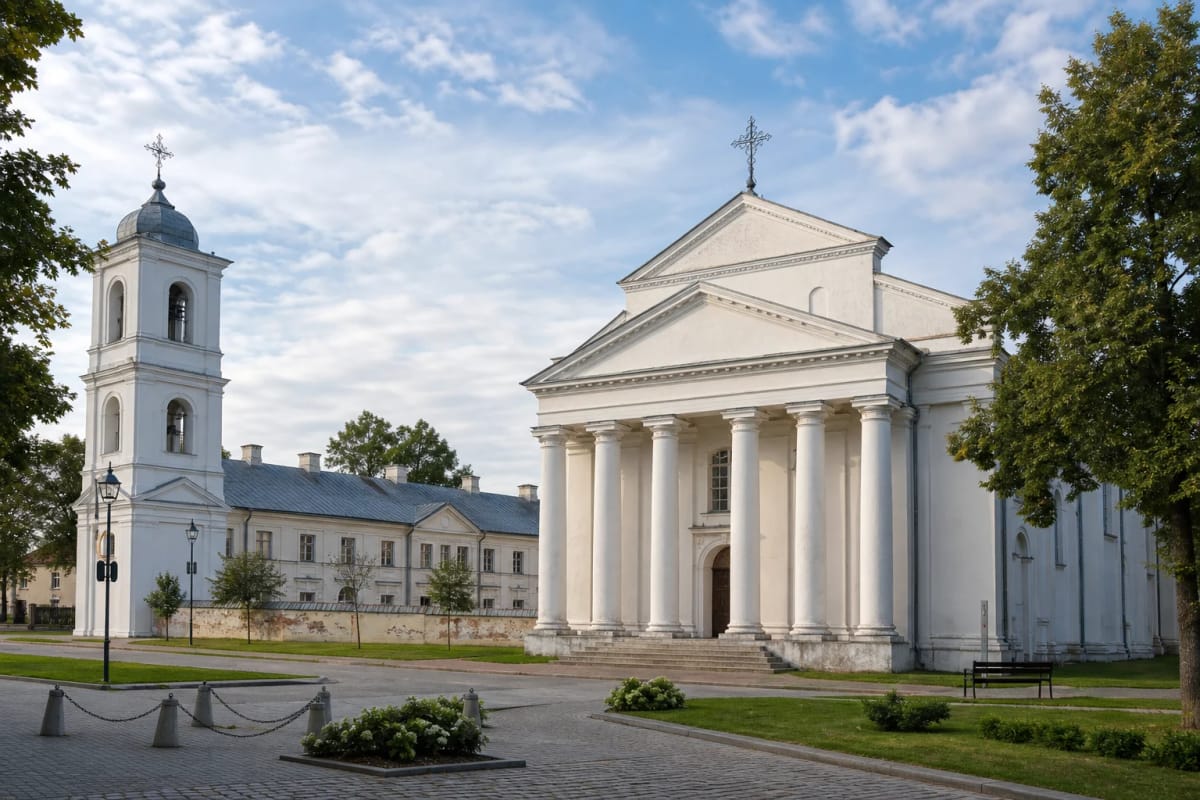
Troškūnai Church of the Holy Trinity and the former Bernardine monastery stand in the town of Troškūnai, Anykščiai District, about 16 km north-west of Anykščiai. They form a coherent late Baroque ensemble with Classical features, clearly dominating the town square.
The church has a Latin-cross plan, no towers, and a facade with a colossal-order column portico. Nearby stands the one-storey U-shaped monastery building and a separate Classical bell tower, together forming a building complex listed in the Register of Cultural Property.
Bernardines, Knakfusas, and the bell tower
In 1696 the owner of Troškūnai Manor, Vladislovas Sakalauskas, invited the Bernardines and built a monastery, and in 1698 a wooden church rose here. Wooden churches burned several times, so the present brick church was built in 1774-1787. VLE names Martynas Knakfusas as its architect; this is documented fact, not only tradition.
A separate Classical bell tower was built in the early nineteenth century according to architect Pietro de Rossi, and in 1803 Bishop Dovydas Pilkauskas consecrated the church. The Bernardine monastery in Troškūnai operated until 1864, when the tsarist authorities closed it after the 1863-1864 uprising; rebel fighting with tsarist troops also took place nearby.
Wrought crosses and the oldest organ in the region
One of the church's distinctive features is the openwork wrought-iron crosses decorating all four building pediments. They give the sanctuary a distinctive silhouette and testify to local blacksmithing skill. Inside, VLE gives five eighteenth-century altars with sculptures and paintings; some travel descriptions mention a larger number, but it is best to follow VLE's five.
The church's pride is its organ, considered the oldest in the Anykščiai region. It was made around 1787-1789 by Vilnius master Mikalojus Jansonas and reworked in 1902 by master Juozapas Radavičius; it still sounds. The Troškūnai Madonna painting, associated with pilgrimage tradition, is venerated in a transept altar.
Visiting
The church is an active parish church of the Panevėžys Diocese, so entry is free and visiting is usually coordinated around Mass times. The exterior, including the portico, wrought pediment crosses, and Classical bell tower, can be viewed from outside at any time.
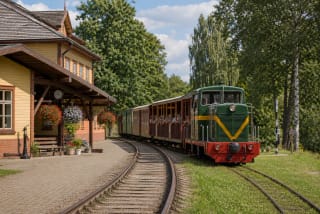
Half an hour is usually enough for a visit. Troškūnai combines well with the Troškūnai station of the Anykščiai narrow-gauge railway, the town's partisan monument, and other Anykščiai-region sights. Check parish information for Mass times.