- Place
- Švendubrė surroundings, Viečiūnai Eldership, Druskininkai Municipality
- Region
- Druskininkai Municipality
- Type
- mythological and geological boulder in Raigardas Valley
- Coordinates
- 53.98530, 23.92919
Švendubrė Stone, Devil's Stone
Which Devil's Stone: the Švendubrė boulder near Druskininkai
Lithuania has more than one Devil's Stone, so the name needs precision. This page is about the Švendubrė Stone in Druskininkai Municipality, Viečiūnai Eldership, north of Švendubrė village. VLE presents it as Švendubrė Stone, or Devil's Stone, and identifies it as a natural-heritage object: a geological and mythological monument.
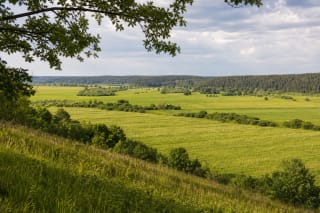
This distinction matters for travellers. If you search only for Devil's Stone on a map, you may find a different Lithuanian object. VLE states that Švendubrė Stone is in Raigardas Valley, on the north-western edge of Raigardas Reserve, about 0.5 km from the Nemunas. That is the specific place to look for.
Granite-gneiss block: size, cup marks, and origin
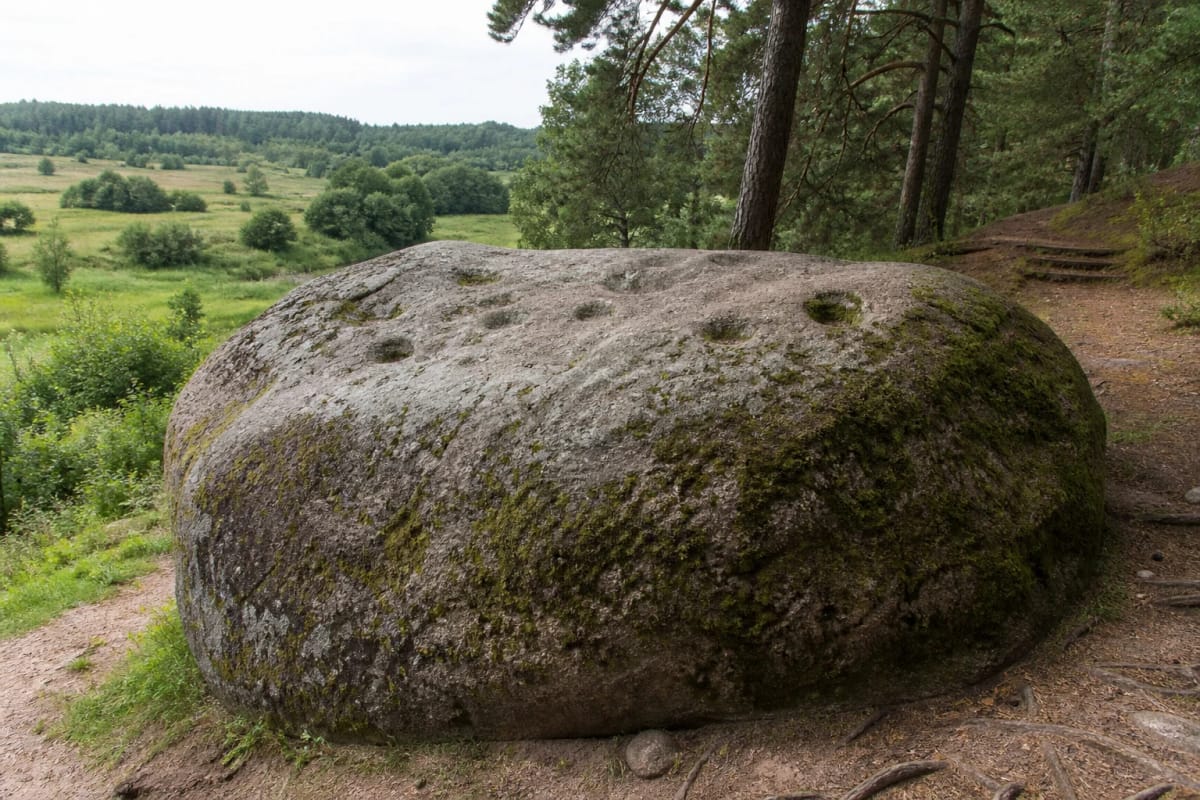
Švendubrė Stone is one of the largest boulders in southern Lithuania. VLE gives precise measurements: 6.29 m long, 5.67 m wide, 3.3 m high, with a maximum horizontal circumference of 19.87 m. Its shape resembles an irregular triangular pyramid with a cut-off top, and the surface is partly lichen-covered. Petrologically it is reddish-grey amphibole-biotite granite gneiss.
VLE states that the stone was brought from Scandinavia by the Pleistocene continental glacier and, after the ice melted, was washed out of moraine deposits as the ancient Nemunas valley widened, when the river level was 10-15 m higher than today. On the eastern side of the stone, seven cup marks were carved, 2.5-4 cm in diameter and 0.2-0.5 cm deep, dated to the Bronze or early Iron Age. For this reason, Švendubrė Stone is also classed among cup-marked ritual stones.
A sacred stone: from threat of breaking to a cross
The documented history of the stone is no less interesting than the legends. VLE states that in the late nineteenth or early twentieth century people wanted to break up the stone and use it for the construction of churches in Druskininkai and Ratnyčia, but local residents, who regarded the stone as sacred, prevented its destruction. That explains why the block has survived whole.
In 1936 a cross was fixed into the stone, with a separate hole carved for it; the cross was broken off during the Soviet occupation. In 2004 wooden sculptures representing the legends of the stone's origin were installed nearby: the Bell Ringer, the Raigardas Legend, and the Shepherd Girl, by V. Dabrukas, Antanas Lastauskas, and Juozas Videika. VLE also notes that M. K. Čiurlionis and A. Žmuidzinavičius visited the stone, so the site is rooted in Lithuanian art memory as well.
The legend of the devil and the Nemunas
Legends say that the devil dropped the stone while trying to dam the Nemunas. Such stories should be presented as folklore: they explain the place through imagination, not through the geological history that VLE records as an Ice Age phenomenon.
The name Devil's Stone fits the wider mythology of Raigardas Valley. The same valley has a legend about a sunken city, and in the Baltic worldview the devil often explained large boulders and strange landforms. A good account of Švendubrė Stone keeps both layers distinct: documented natural heritage and living local folklore.
Research and protection
Švendubrė Stone has long interested researchers. VLE states that archaeologist P. Tarasenka wrote about the boulder in 1928; scholars from the Institute of History studied it in 1962; later it was examined by archaeologists Juozas Markelevičius in 1974, Jonas Balčiūnas in 1988, and V. Vaitkevičius in 1998-1999; and A. Linčius described it in 1989. The stone has been protected since 1964.
In practical terms, the stone is a state-protected natural and cultural heritage object, not a landscape element that can be freely altered. The carved cup marks and traces of the cross are part of the heritage, so they must not be deepened, enlarged, or damaged.
What to look for and how to visit
First, walk around the stone and sense its scale from different sides. On the eastern side, look carefully for the seven cup marks and for the wooden legend sculptures installed in 2004. The stone is an outdoor object without normal museum opening hours, and no ticket is needed for an ordinary self-guided visit, though path and access conditions may depend on season.
Second, give time to the surroundings. Švendubrė Stone works best together with Raigardas Valley and the nearness of the Nemunas, which inspired the stories. On a broader route, combine the stone with Raigardas Valley, the surroundings of Švendubrė village, Druskininkai, and the direction of Dzūkija National Park. After rain, choose footwear that can handle wet ground.