- Place
- Marijampolė Municipality
- Region
- Suvalkija
- Type
- public 88 m barefoot sensory course divided into short contrasting surfaces and fitted with support rails
- Address
- Šunskai town park, Šunskai, Marijampolė Municipality
- Coordinates
- 54.64486, 23.33195
- Visit duration
- 20-35 minutes for the trail alone; 45-90 minutes with the Šunskai park, wood sculptures, and small cherry-tree hill
- Best time
- a dry, warm day from late spring to early autumn; choose daylight, when every surface can be inspected before stepping onto it
Kneipo terapijos pojūčių takas Šunskuose, Šunskai sensory trail, Šunskai barefoot trail, Kneipo takas
The 88-metre course is in a manicured town park, not a forest
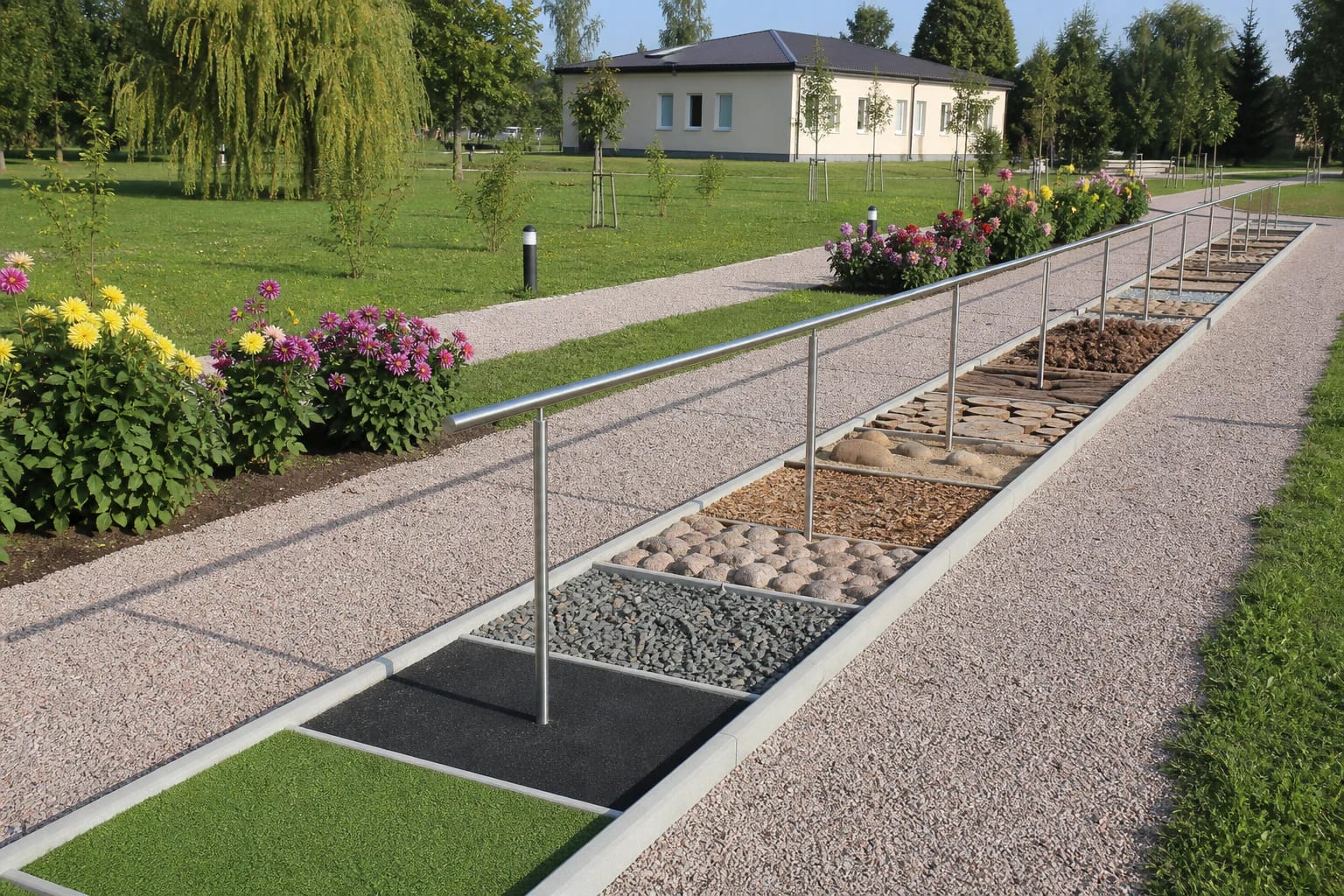
The Kneipp Trail lies in Šunskai town park at the precise Google Maps point 54.6448591, 23.3319458. It is a long, narrow installation in a grassed public space: low borders divide it into short fields of material, while shiny metal handrails run alongside the course to help with balance. Pale gravel paths, flower beds, young and mature trees, and small park lights frame the structure.
Marijampolė Municipality gives an exact length of 88 m. This does not mean 88 m of one uninterrupted material. Visitors cross numerous short sections whose textures change abruptly. Allow 20-35 minutes if you test each surface slowly and put your shoes back on when needed. It can be crossed faster, but rushing removes the point of the carefully staged contrasts.
The adjacent park paths make it possible to examine the installation without removing footwear. The sensory course itself is not a smooth step-free route: it contains loose ballast, uneven stone, logs, and low borders. The rails provide support, but their presence is not proof that the trail is wheelchair accessible or suitable for every visitor with limited mobility.
The opening surfaces tell a local story about football, Via Baltica, Rail Baltica, and old Marijampolė paving
The official visitor description identifies the opening sequence by more than material. Artificial turf from a football hall comes first, followed by Via Baltica asphalt, Rail Baltica railway ballast, and old Marijampolė paving. This gives a simple barefoot trail a local narrative about sports infrastructure, the major transport corridors crossing Suvalkija, and the material memory of city streets.
These names are best understood as identities assigned to the sections by their creators, not as a claim that visitors are walking on a motorway or an active railway bed. The asphalt patch is hard and even, the railway section uses angular ballast, and the paving section brings larger irregular stones underfoot. The contrast matters more than completing the course as quickly as possible.
More natural textures replace the technical materials further along. Official photographs show fields of sand with larger boulders, rounded stone, bark and wood chips, cylindrical logs laid crosswise, timber discs, and pine cones. Materials can be topped up or rearranged during maintenance, so the sequence visible on the day is more reliable than treating an older written list as permanent.
The glass section is real, but inspect it before putting a bare foot down
The course's most unusual section contains pieces of green and brown glass with round timber discs set among them. Official photographs show visitors crossing it barefoot, but a photograph cannot guarantee that every piece will always remain safely rounded or in the same position after winter and maintenance. Judge the surface in front of you rather than assuming its present condition.
Skip the section if you see a sharp edge, glass outside the infill, a metal fragment, animal waste, or any other foreign object. A lower-risk option is to hold the rail and step only on the timber discs, or simply put your shoes on. On a hot sunny day, first test the temperature of asphalt, stone, and metal with a shoe sole; after rain, polished stones and timber can be slippery.
Barefoot walking is optional and should not become a pain-endurance contest. Open wounds, impaired sensation in the feet, diabetic neuropathy, significant balance problems, or a recent injury are reasons to keep footwear on or seek medical advice before trying the course. Children should move beside an adult, not race across the sections.
The municipality awarded €8,100 to the 2019 project by the association Trys plunksnos
Marijampolė Municipality's 2019 public-health support programme funding table lists the association Trys plunksnos and its project to install a Kneipp therapy sensory trail with an allocation of €8,100. This is the official grant amount; it should not automatically be presented as the final cost of every material and hour of work.
The municipality's 2020 account of projects in Šunskai confirms that the 88 m Sebastian Kneipp sensory trail was installed in the park in 2019. The same source connects it with an active local community and the association's initiative, not with an older spa or treatment-centre tradition. The documented history of the trail begins with this modern community project. Stories about herring mines and bears in Šunskai belong to the town's separate creative folklore, not to the proven origin of the course.
The sensory trail is only one element in the small park. A 2020 woodcarvers' plein air added five sculptures, while the municipality also mentions outdoor exercise equipment, a children's playground, and a cultivated hill of flowering cherry trees. It is therefore worth reserving time for a short circuit beyond the trail; the cherry blossom period itself varies with the weather each year.
Sebastian Kneipp's name signals movement here, not a water-treatment complex
Sebastian Kneipp was born in Bavaria in 1821 and died in Bad Wörishofen in 1897. The Lithuanian Universal Encyclopedia describes him as a German priest, hydrotherapist, phytotherapist, and populariser of naturopathic medicine. He began applying water treatments in 1849 and also promoted a regular daily rhythm, drinking water, and a diet rich in grain products. His book My Water Cure appeared in 1886 and was published in Lithuanian in 1909.
Šunskai adapts the Kneipp name to movement, balance, and contrasting sensations underfoot. There is no arm bath, cold-water wading pool, or mineral-water procedure of the kind found in Birštonas's Kneipp Garden. Visitors looking for a water station should not assume it is broken or turned off: this attraction was conceived as a course of dry surfaces.
Therapy appears in the project's official name, but a walk here is neither a diagnosis nor medical treatment. The supportable experience is simpler: feet meet hard, loose, smooth, and uneven materials, while the visitor slows down and consciously maintains balance. Claims that individual points on the sole treat internal organs should not be regarded as proven medical effects.
Google lists 24-hour access, but a dry daylight visit is the sensible choice
On 15 July 2026, the Google Maps entry for Kneipo takas showed a 5.0 out of 5 average from 22 reviews and listed the site as open 24 hours. It is a small place in a public park, and the municipality's descriptions identify neither a ticket office nor an admission charge. Map hours and access conditions can change, however, so check current municipal or local information before making a special journey.
A 24-hour park listing does not mean every part of the course is always illuminated, cleared, or freshly inspected. Daylight makes it easier to notice displaced glass, loose material, wet timber, and hot asphalt. After heavy rain, frost, snow, or maintenance, examine the entire route in shoes before deciding which sections to try barefoot.
Easily removable footwear and a small towel or wet wipe for the feet are more useful than hiking gear. Begin on a smoother surface, keep one hand available for the rail, and stop as soon as a cutting, burning, numb, or unstable sensation appears. The short visit combines naturally with the parks of Marijampolė or Bukta Nature Trail, but the Šunskai course itself requires no long-distance equipment.