- Place
- Vytogala, Šilalė District Municipality
- Region
- Samogitia
- Type
- Lithuanian Aviation Museum branch in a protected birthplace site, using a Samogitian cottage reconstructed in 1988 and a later barn built by Girėnas's brother Petras
- Address
- 24 S. Girėno Street, Vytogala
- Coordinates
- 55.45705, 22.37309
Stasio Girėno gimtinės muziejus, Lakūno Stasio Girėno gimtinė-muziejus, Birthplace of pilot Stasys Girskis-Girėnas, Stasys Girėnas Birthplace
Five ordinary opening days are followed by a free last Sunday that changes the next week's schedule
The museum is at 24 S. Girėno Street in Vytogala, coordinates 55.457051, 22.373088. It is roughly 17 kilometres from both Šilalė and Skaudvilė and about 10 kilometres from Dionizas Poška's Baubliai. In 2026, the Lithuanian Aviation Museum listed ordinary hours as Tuesday-Saturday 10:00-17:00. Monday was closed, while public-holiday changes were announced separately.
On the last Sunday of every month the exhibition opened free of charge from 10:00 to 16:00, but the following Tuesday was closed. This is not an every-Sunday schedule, so check the calendar and call +370 691 88 349 before making a special journey for the free day.
In 2026, regular admission was €4 and concession admission €2. A family ticket cost €6 for one adult and two children or €8 for two adults and two children. A 60-70 minute Lithuanian tour for 5-30 people cost €20, or €30 in English, Russian, or German, with admission tickets still required. Hours and tariffs age quickly, so consult the official museum page again before a later visit.
The register protects the real birthplace, but the cottage visitors enter is not the surviving 1893 house
The Cultural Heritage Register calls this the Birthplace Farmstead Site of Pilot Stasys Girskis-Girėnas and assigns code 11214. It is a state-protected national-level site of historical and memorial significance, associated with Girėnas's life here from 1893 to 1910. Its registered area is about 4,486 square metres, so the protected asset is the biographical place in its landscape, not merely the appearance of a museum building.
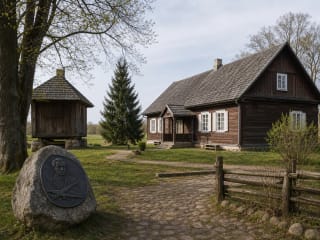
For the 55th anniversary of the Lituanica flight in 1988, a Samogitian dwelling was reconstructed and fitted as a museum. It had to stand elsewhere within the farmstead because Girėnas's brother Petras had already erected a barn on the old house footprint in the late 1930s. The present cottage evokes the type of childhood setting, but its logs, roof, and fitted rooms are not the untouched building in which Stasys was born in 1893.
That distinction strengthens rather than weakens an honest visit. The most authentic exhibit is the location and its family connection; the cottage is a 1988 memorial reconstruction, while Petras's barn is a separate, later layer of family history. Since 1991 the homestead has belonged to the Lithuanian Aviation Museum, which supplements its memorial display with Samogitian ethnographic objects.
A memorial boulder and the restored Independence cross record how the birthplace was reclaimed before 1990
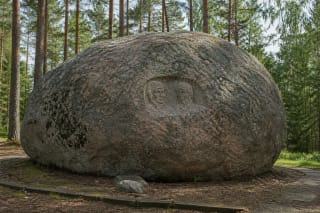
On 10 May 1969, Vilnius University hikers and aviators cleared the neglected birthplace and erected a memorial boulder to Stasys Girėnas. This happened almost two decades before the cottage reconstruction, so the stone marks the first sustained effort to preserve the place, not merely a decorative feature added to a finished museum garden.
Beside the road stands an ornamented double-armed cross originally raised in 1928 for the tenth anniversary of Lithuanian independence. It was toppled during Soviet rule and restored in 1990. The boulder, cross, traditional zigzag split-rail fence, cottage, and barn therefore belong to different dates; walk the whole site before treating the museum as a single reconstructed interior.
Vytogala commemorates the Darius and Girėnas flight and deaths every year in mid-July. The programme changes: the 2026 event advertised traditional musicians, an illuminated model-aircraft display, and virtual flying. The anniversary supplies living community memory and a busier atmosphere, whereas an ordinary weekday is better for unhurried reading.
Childhood in Vytogala and emigration explain why Girėnas became a mechanic before he became a pilot
Stasys Girėnas was born Stanislovas Girskis on 4 October 1893, the youngest child in a large family; twelve of sixteen children did not survive. His father died in 1904 and his mother in 1908. In 1910 Stasys and his brother Petras joined relatives in the United States. The homestead's ethnographic half makes this migration concrete as a departure from a poor rural Samogitian household rather than an abstract change of country.
In Chicago he continued primary schooling, worked as a printing-shop messenger, and learned the printer's trade. A bicycle, motorcycle, and a motorboat used to carry passengers on Lake Michigan show a steady fascination with machinery. He served as an aviation mechanic in the United States military from 1917 to 1919, then drove professionally while learning to fly.
VLE records a temporary pilot certificate in 1927 and a transport-pilot licence in 1931, authorising passenger and freight work; from 1931 he worked as a civil transport pilot. This gradual professional formation is the important thread at Vytogala: the Atlantic came only after mechanical work, flight school, aircraft ownership, instructor experience, and a reputation for precision.
The Lituanica story is told through Girėnas's life, while the original wreckage belongs to another museum
Girėnas met Steponas Darius in 1927. In June 1932 they bought a six-seat high-wing Bellanca CH-300 Pacemaker and rebuilt it during 1933 for extreme range, fitting longer wings, enlarged fuel and oil systems, and a more powerful engine. The orange aircraft took the name Lituanica.
They left Floyd Bennett Field in New York on 15 July 1933 and crossed the Atlantic without landing. After 37 hours 11 minutes and 6,411 kilometres measured in a straight line, the aircraft crashed at 00:36 on 17 July in Pszczelnik Forest near the then German town of Soldin, now in Poland; the final cause remains unresolved. The flight ranked second in the world at the time for nonstop distance on a transatlantic route and fourth for endurance.
Vytogala presents panels, documentary material, and interpretation rather than the wrecked original aircraft. Lituanica's wreckage, the pilots' clothing, and personal possessions are held by Vytautas the Great War Museum, while the flyable replica built by Vladas Kensgaila belongs to the Lithuanian Aviation Museum in Kaunas. The birthplace's strength is Girėnas's beginning and village context, not a large collection of crash relics.
The cottage display, Vytogala history, and simulators work best as three deliberately different experiences
One end of the reconstructed cottage covers Stasys Girėnas, Steponas Darius, and the transatlantic flight; the other recreates aspects of Samogitian domestic life. The barn documents Vytogala through residents, photographs, and local objects. Aviation is thus connected to the community that formed an emigrant rather than isolated as a purely technical feat.
In 2026, the paraglider simulator cost €3 in addition to admission and the aircraft-control simulator €4 for ten minutes, also plus admission. These are contemporary learning devices, not machines used by Girėnas. A 45-60 minute activity for 5-30 people cost €3 per participant. The primary-school programme Following Stasys Girėnas's Path of Light ends with beeswax candle-making, while other sessions explore Girėnas and Lituanica's engineering. Advance booking is required.
The Lithuanian Aviation Museum's 2024 report said its outlying branches were not adapted for disabled visitors. Conditions may improve, so call before travelling to discuss the cottage and barn entrances, toilet, simulator access, and assistance. On 13 July 2026, the exact Google Maps listing averaged 4.7 out of 5, supported by more than one hundred user ratings.