- Place
- Salos, Kamajai Eldership, Rokiškis District Municipality
- Region
- Rokiškis District
- Type
- Classical manor estate on a lake island
- Coordinates
- 55.81150, 25.36740
Salos Manor Estate, Salos Manor Palace
A manor on a lake island
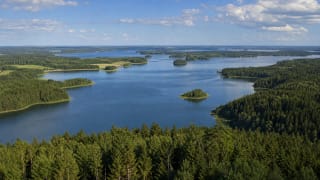
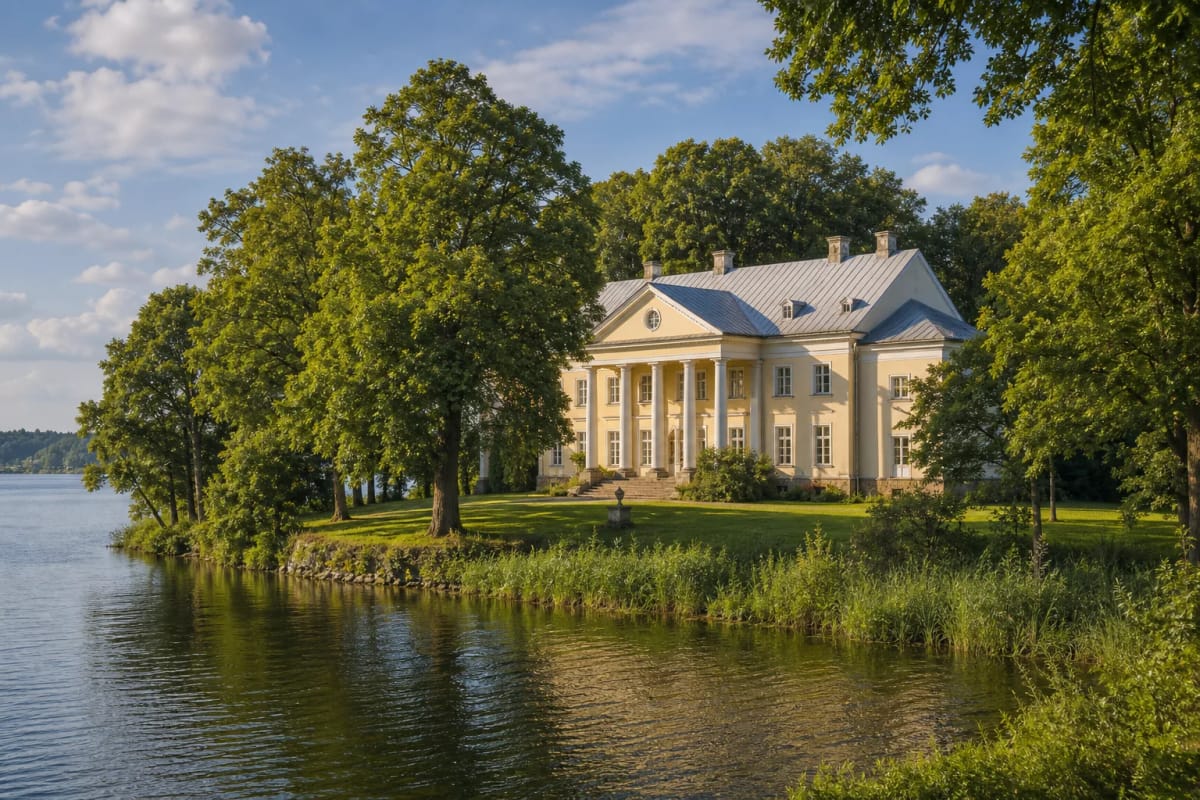
Salos Manor is one of Lithuania's most unusual manor sites because it stands on an island in Lake Dviragis. VLE states that Salos is connected to the shore by a bridge in the east and a causeway in the west. The island is regarded as one of Lithuania's largest inhabited lake islands, although priority claims depend on the source and should be phrased cautiously.
The distinctiveness lies in the combination of monumental Classical palace, old park, and surrounding lake. The manor is mentioned from the sixteenth century, while Salos appears in written sources even earlier, so this is a long-lived residential and administrative place, not just one building.
Owners from Kęsgailai to Przeździecki
VLE states that in 1450 Salos was mentioned among the estates of the Kęsgailai magnates of the Grand Duchy of Lithuania, and later it passed to the Radziwiłłs. In the second half of the seventeenth century the Moriconi acquired Salos Manor and began shaping the present ensemble. In 1806 Ignacy Moriconi finally acquired the estate, and it flourished especially from then.
In 1855 Count Reinhold Tyzenhauz bought the manor with its park and turned it into a cultural centre; later it passed to the Przeździecki family. The last owner is traditionally said to have been diplomat and writer Reinhold Przeździecki, but this should be treated as local tradition because authoritative sources do not clearly confirm the final owner's name.
Palace, park, and Holy Cross Church
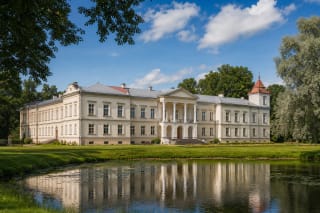
The first manor palace of 1766 was wooden, while the present masonry palace was built in the early nineteenth century under the Moriconi. It is a monumental late Classical building with eclectic features and a strong columned portico; a museum now operates in eighteenth-century cellars. Popular accounts link the palace design to Italian architect Pietro de Rossi, but scholarly sources do not confirm the attribution, so it should remain an assumption.
Around the palace is a mixed-plan manor park, usually given as about 7-9 ha, with surviving service buildings, a smithy, and other structures. Nearby stands the Neo-Gothic wooden Church of the Holy Cross, built in 1873-1888 by architect G. Werner, with a bell tower. The whole complex is protected in the Cultural Heritage Register.
From schools to manor residence
In the twentieth century the manor served education. VLE states that agricultural schools operated here, and in 1923 Lithuania's first state girls' household school was established in Salos. This use helped preserve the buildings in the Soviet period, when many other manors were neglected or damaged.
Since 2004 the manor has hosted Vilnius University summer camps, conferences, and cultural events, and today Salos Manor functions as a culture and leisure residence. It is therefore interesting as both historic architecture and an active events and education centre.
Visiting: access and what to see
You reach Salos Manor by bridge from the eastern shore of Lake Dviragis, so the trip onto the island is part of the experience. Walk around the palace, cellar museum, park, and lake edge, and view the nearby wooden church as part of the context. A normal visit takes 1-2 hours.
The manor operates as a residence, so access to interiors, tours, and educational activities should be arranged in advance. Check current visiting and ticket information on the official Salos Manor page or with Rokiškis tourism information, because event rules and prices change.