- Place
- Raguvėlė, Anykščiai District Municipality
- Region
- Anykščiai District
- Type
- mature Classical manor-estate ensemble
- Address
- Parko g. 2, Raguvėlė, Anykščiai District
- Coordinates
- 55.65550, 24.66800
Raguvėlė Manor Estate
Raguvėlė Manor: one of Lithuania's largest estates
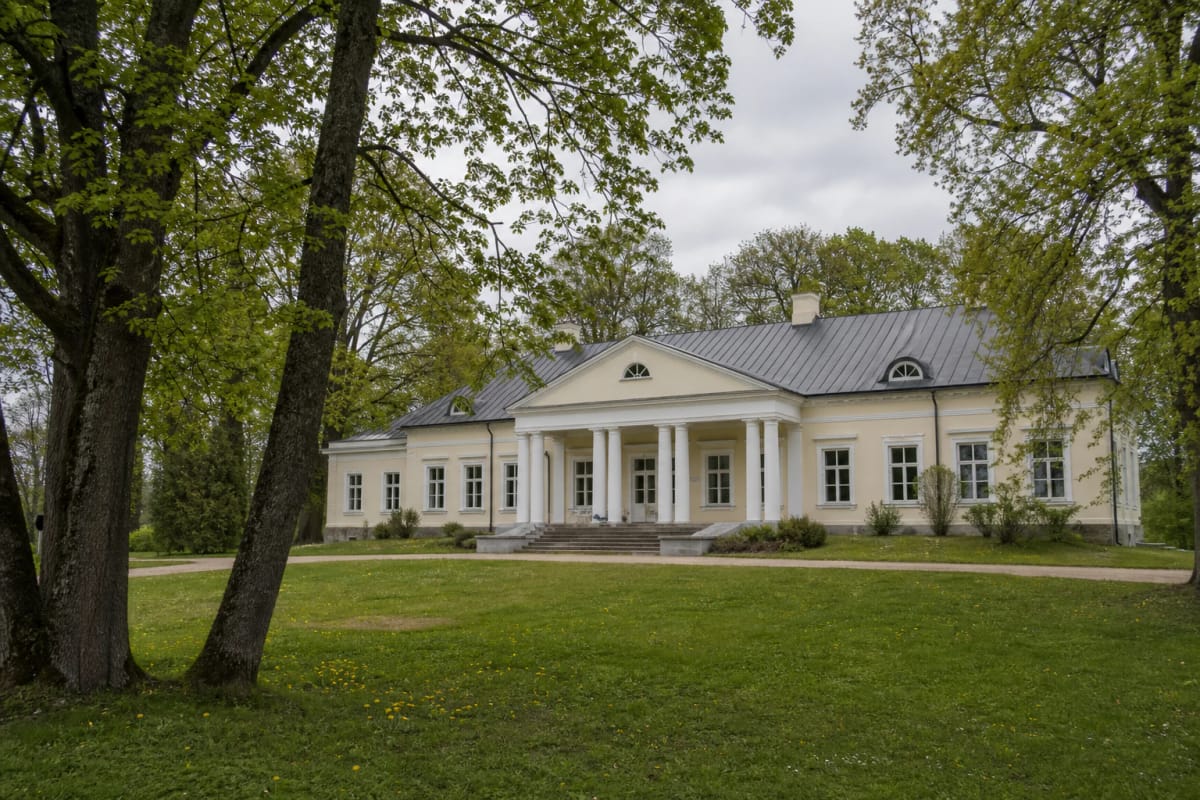
Raguvėlė Manor stands in Raguvėlė village, Anykščiai District, by the Juosta River. It is one of Lithuania's largest and most coherently preserved manor estates: the Universal Lithuanian Encyclopedia states that the estate covers about 20 ha and includes more than twenty structures. Because of this coherence, the manor is considered one of the country's most valuable Classical manor ensembles.
The representative buildings stand on the right bank of the Juosta, while the service part is across the river; a wooden footbridge, known as the monkey bridge, connects them. This composition helps visitors feel how a large manor economy once worked.
History of the Komarai family
From the eighteenth century, the Raguvėlė estate belonged to the Komarai family, as confirmed by the Universal Lithuanian Encyclopedia. The representative part of the estate, with palace, officina, granaries, and church, formed in the late eighteenth and first half of the nineteenth century. In 1796 the wooden Church of St. Stephen the Deacon was built, with an old organ.
In 1940 the manor was nationalized, and an agricultural school operated in the palace. Restoration began in 1985, and in 1992 the ensemble was returned to a descendant of the Komarai family. Since then it has gradually been restored privately, making it one of the better-known examples of privately revived Lithuanian manors.
The ensemble: palace, granaries, chapel
The centre of the estate is the mature Classical palace with a Doric-column portico and pediment. Nearby stand two octagonal late-Classical granaries, one adapted as a cafe, as well as a carriage house, officina, watermill, stables, and Neo-Gothic distillery buildings.
The estate cemetery contains the Komarai chapel-mausoleum. Sources differ on its dating: the encyclopedia links it with late eighteenth-century Romanticism, while heritage-research data gives 1849 and Neo-Gothic architecture attributed to Laurynas Cezaris Anichinis. This difference is worth knowing when looking at the chapel.
Park and Juosta valley
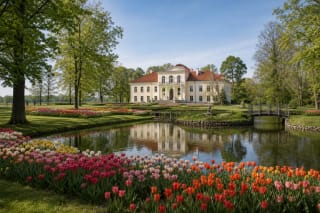
The manor is surrounded by a mixed-plan park with a pond, created in the late eighteenth and early nineteenth centuries. Old alleys, a pond, and the Juosta valley create a calm manor setting where a slow walk makes sense.
The building line stretches along the river, so the best way to see the manor is to walk from the palace toward the granaries and onward to the watermill and distillery remains. This reveals the full scale of the ensemble.
How to visit Raguvėlė Manor
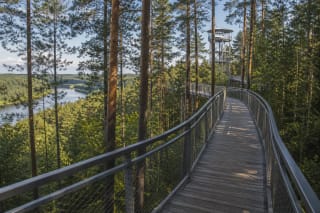
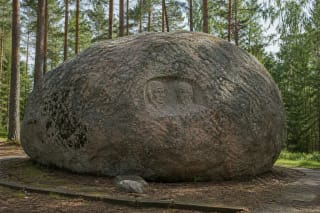
The manor ensemble is easy to combine with other Anykščiai-region sights, such as the canopy walk, the narrow-gauge railway, or Puntukas Stone. For the estate exterior and park, 1-1.5 hours is usually enough.
The manor is private and partly used for events and accommodation, so interior access is not guaranteed and should be arranged in advance. No exact public visiting schedule or ticket prices are officially announced, so check current information before travelling.