- Place
- Pienionys, Anykščiai District Municipality
- Region
- Aukštaitija
- Type
- former wooden Classical manor estate with a park
- Address
- Pienionys village, Kavarskas elderate, Anykščiai District
- Coordinates
- 55.46778, 24.89056
Pienionys Manor Estate
Pienionys Manor: traces of a famous wooden estate
Pienionys Manor is in Anykščiai District, Kavarskas elderate, about 4 km north-west of Kavarskas. It was famous for one of the most beautiful wooden Classical manor houses in Lithuania, but the wooden manor house has not survived. It was demolished, and local accounts say the timber was used for a Kavarskas parish building. Today Pienionys is first of all a place where the reflection of a once-decorative manor can still be felt.
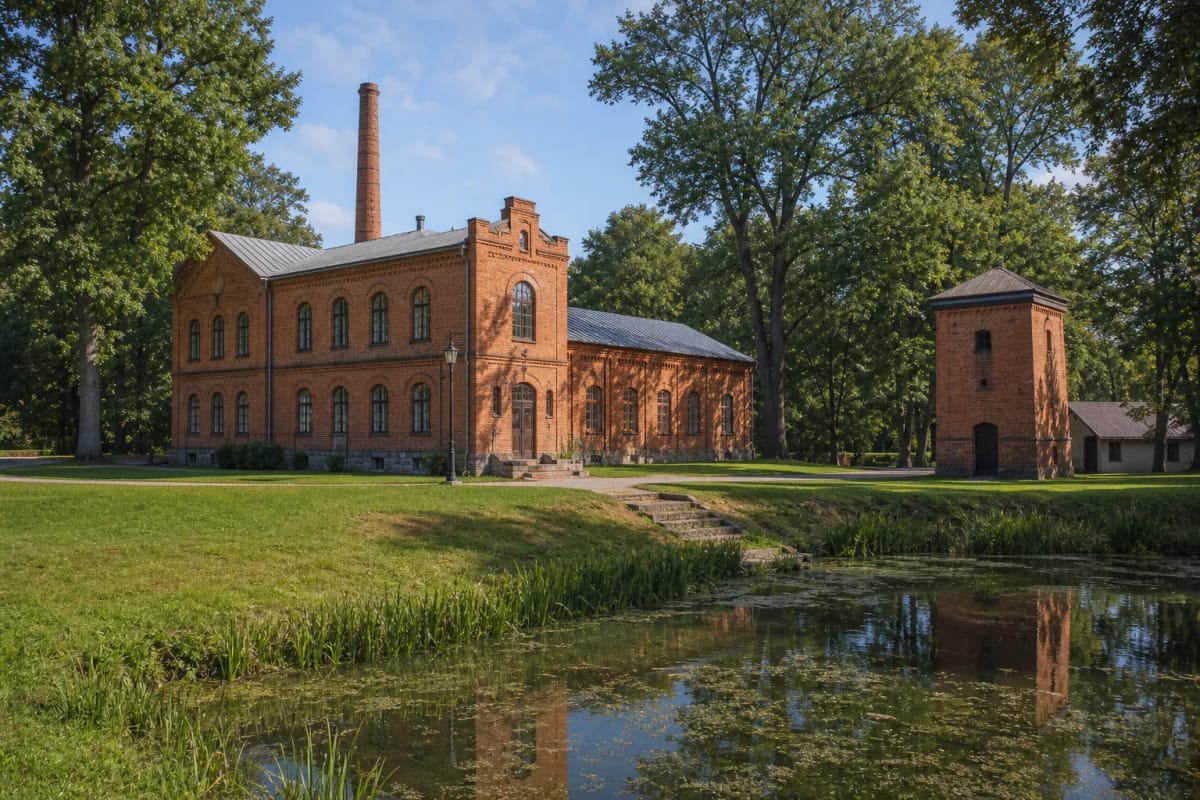
Although the manor house is gone, the estate remains worth visiting for its surviving service buildings and park. VLE states that beside the pond stand parts of the nineteenth-century manor complex: a distillery with romantic folk decoration, a smokehouse resembling a bell tower, a granary, gates with lion sculptures, and a 9 ha landscape park.
Daumantai-Siesickiai and the manor's flourishing
Pienionys volost is mentioned as early as the fifteenth century, and the manor formed from the sixteenth century. Until the mid-seventeenth century it was owned by the noble Sapiega and Pac families, and later, in the mid-seventeenth century, passed to the Daumantai-Siesickiai, who held it until the early twentieth century. Their main residence was Siesikai, so Pienionys was long a secondary estate, often mortgaged.
From the second half of the eighteenth century the estate was substantially reorganized: a new wooden manor house was built, a park was planted, and an orangery was created. Around 1859 a distillery began operating at the manor, and beer was also made there until the early twentieth century. After the First World War the owner set up a chapel in the manor hall, and after the estate was parcelled out in 1926, a primary school operated in the manor-house hall.
Park, orangery, and the Czech gardener tradition
The 9 ha landscape park is the most important surviving part of the manor. The main paths are planted with maples, poplars, and chestnuts; there is an artificial pond with a small island; and in the orangery that once stood at the centre of the park, sources say apricots, grapes, bay trees, and tropical plants grew.
A beautiful but cautious tradition is linked with the park. It is said that from 1870 the park was tended by a professional Czech gardener, Pranciškus Leineris, and that about two hundred rare plant species grew there; before the First World War, Pienionys Park was counted among the best-maintained parks in Lithuania. These claims circulate in manor and regional overviews, so they are best presented as a tradition rather than as an encyclopedic fact.
What survives and how to visit
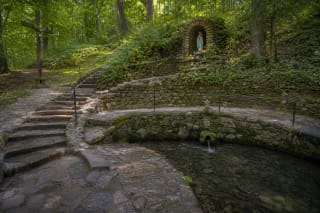
The protected Pienionys Manor Estate complex consists of more than a dozen parts: the manor-house cellar, an officina, granary remains, smokehouse, icehouse, labourers' house, distillery, several cellars, orangery, grotto with a statue of the Blessed Virgin Mary, gates, and park. The most visible accent is the brick distillery, which VLE says was restored in 2010.
The manor is private; public opening hours and ticket prices are not officially announced, so it is best viewed from outside as an open heritage object: walk around the service buildings, lion gates, and park by the pond. A visit usually takes half an hour to an hour, and Pienionys combines well with Kavarskas and other Šventoji valley sites. Check recent information before travelling, because the manor's condition and restoration work can change.