- Place
- Menčiai, Akmenė District Municipality
- Region
- Akmenė District
- Type
- limestone quarry and industrial landscape
- Coordinates
- 56.27570, 22.91960
Menčiai limestone quarry, Menčiai quarry
Menčiai Limestone Quarry: an unusual Akmenė landscape
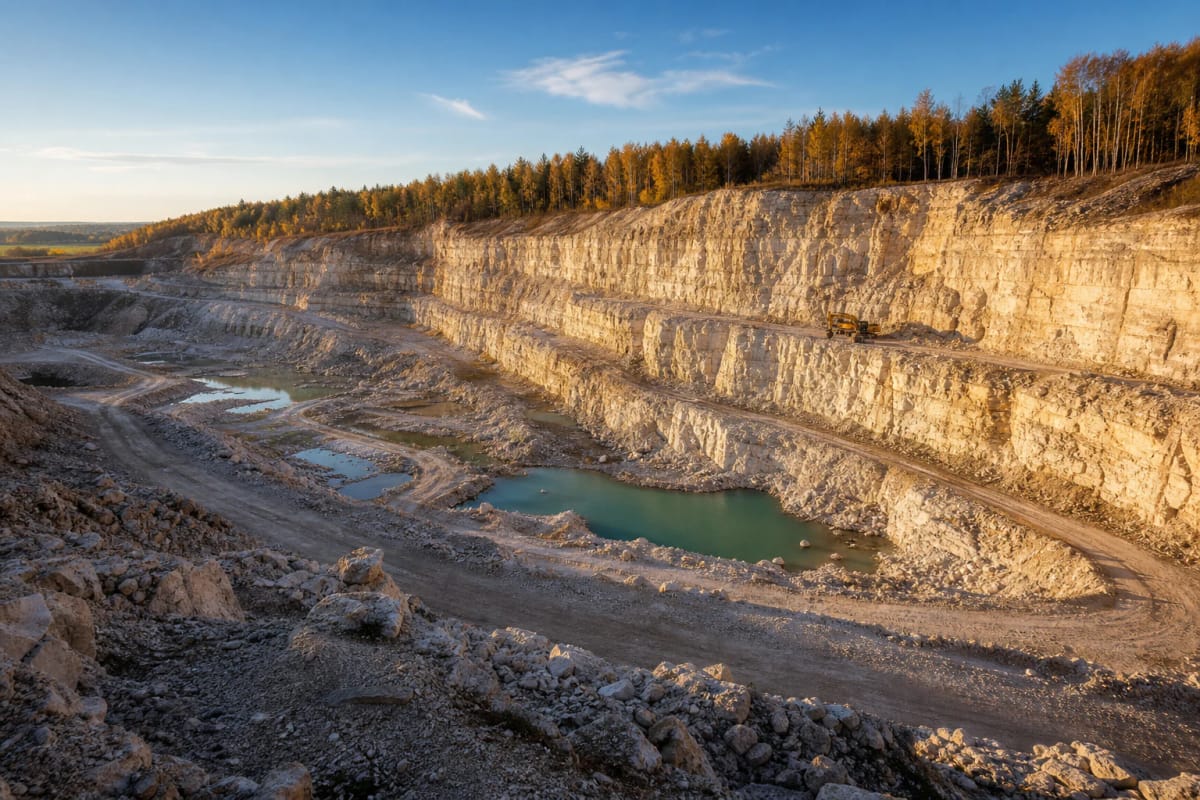
Menčiai Limestone Quarry stands out because in the flat Akmenė region a deep industrial landscape suddenly opens, bounded by pale rock walls. The Akmenė District Municipality page calls it one of the largest and most impressive limestone quarries in Lithuania.
Travellers are drawn here not by a forest trail or observation tower but by the experience of a cut through the earth. Quarry walls reveal limestone outcrops, and some excavated areas are now flooded, forming artificial lakes that wash against remaining rock walls.
Why Menčiai is geologically important
Menčiai extracts Upper Permian dolomitic limestone; VLE calls it the Menčiai limestone deposit. The rocks formed in the Late Permian, about 250-260 million years ago, when the territory of present-day Lithuania lay near the equator in a shallow, increasingly saline sea basin. Limestone beds in the Akmenė area were discovered in 1926 by geologist J. Dalinkevičius.
The quarry exposes rock layers usually hidden under soil; the average thickness of the limestone layer is about 24.7 m. That is why the place looks almost un-Lithuanian: whitish and yellow cliffs, water basins, and steep walls create a canyon-like impression unexpected in a flatland region.
Extraction, cement, and landscape change
Akmenė District Municipality states that limestone extraction in Menčiai began in 1932, with other data giving 1934, for lime production and the sugar industry. Since 1997 the deposit has been operated by Naujasis kalcitas. Menčiai is separate from the nearby Karpėnai quarry, where Akmenės cementas, Lithuania's only cement producer, operates; the company was founded in 1952.
According to VLE, about 200 ha have already been exploited and about 179 ha reclaimed; part of the quarry has been flooded, creating artificial lakes. At the end of the twentieth century, up to about 1.5 million tonnes of limestone were extracted here annually.
Giant mining machinery
The official description singles out a walking excavator. Its boom is 70 m long and 35 m high; the machine weighs 720 t, the cabin height is 9.6 m, its walking speed is 200 m per hour, and the bucket volume is 10 cubic metres.
These numbers matter because they change how visitors understand scale. Even wide photographs make it hard to judge the size of the machinery and rock walls, so Menčiai is one of the best places to discuss the relationship between Lithuanian industry and landscape.
Access restrictions and safer alternatives
Menčiai Limestone Quarry is not a freely accessible educational trail. The Akmenė District Municipality page clearly states that independent visiting of the object is strictly prohibited. The quarry has steep slopes, machinery zones, bodies of water, and industrial-territory hazards, so access must be arranged only through legal channels.
If you do not have arranged access, treat Menčiai as a contextual topic in Akmenė regional history. For geological and nature context, choose Kamanos Observation Tower, Mūša Tyrelis Trail, or Venta Regional Park landscapes, gaining experience without entering a restricted industrial zone.