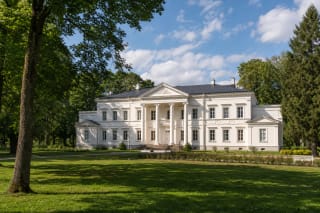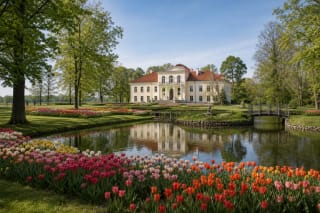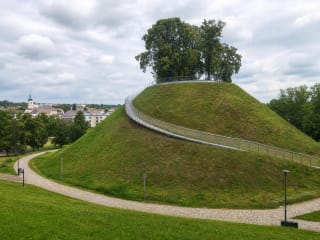
- Place
- Pakalniškiai, Radviliškis District Municipality
- Region
- Radviliškis District
- Type
- hillfort with a foothill settlement by the Daugyvenė
- Coordinates
- 55.77353, 23.85447
Kleboniškiai Hill, Kleboniškės, Piliakalnis
Which Pakalniškiai Hillfort?
This page is about Pakalniškiai Hillfort in Radviliškis District by the Daugyvenė, associated with the name Kleboniškiai Hill. This needs to be clear because the Pakalniškiai place-name repeats in Lithuania and can mislead trip planning. VLE states that Radviliškis-region Pakalniškiai lies about 5 km east of Šeduva, the Daugyvenė flows through the village, and the Šiauliai-Panevėžys road passes through it.
The Cultural Heritage Register lists the site as Pakalniškiai Hillfort with settlement, also called Kleboniškiai Hill, Kleboniškės, or simply Piliakalnis. It should therefore be understood not only as a hilltop but as a wider archaeological complex with a foothill settlement layer.
Platform, slopes, and the Daugyvenė valley
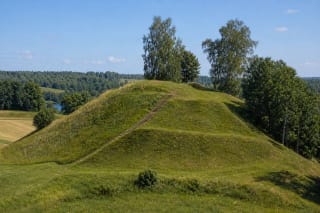
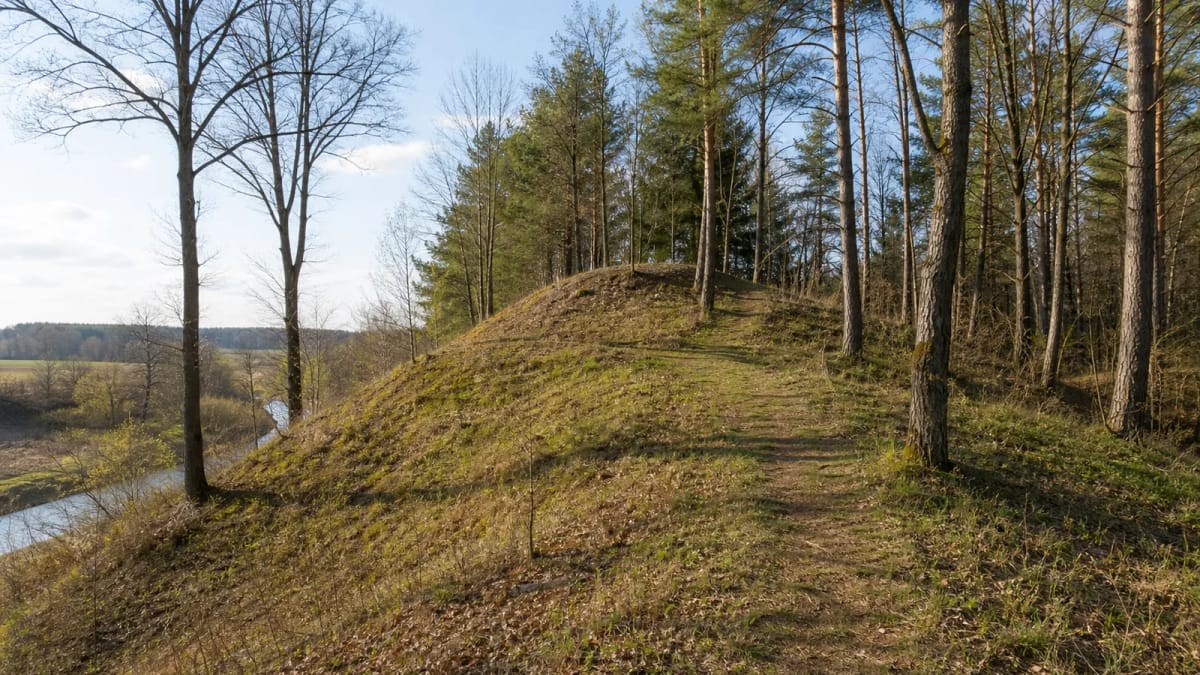
The hillfort was built on a separate hill on the right bank of the Daugyvenė. Public archaeological data describe an irregular triangular platform elongated north-east to south-west, about 25 m long and up to 15 m wide at the north-eastern end, with steep slopes 6-8 m high. It is lower and more local than the great Samogitian or Nemunas-valley hillforts.
Visitors should not expect a grand panoramic hill. The interest here lies in reading the relief, river proximity, and idea of a foothill settlement. Such places often look modest, but their significance lies in relation to river, settlement, and local routes.
First millennium BC: dating and excavations
Archaeological data date Pakalniškiai, or Kleboniškiai, Hillfort to the first millennium BC, making it an early Iron Age site in the region. Archaeologist Bronius Dakanis investigated it in 1986 and 1996. The 1986 excavations found stone paving, burnt remains, and a handmade pottery sherd; 1996 research also revealed remains of stone paving.
South-east of the hillfort lay a foothill settlement of about 0.2 ha, whose roughly 30 cm cultural layer contained smooth pottery and clay daub, characteristic of first-millennium-BC living. A burial mound from the middle of the first millennium was also recorded on the western slope, so the protected site is broader than the hilltop.
Daugyvenė Landscape Reserve
Pakalniškiai lies by Daugyvenė Landscape Reserve. Saugoma.lt states that this reserve, established in 1992 and covering about 3,864 ha, protects the expressive Daugyvenė river-valley landscape with rich cultural heritage. The hillfort is one of the valley's heritage sites and should be understood in that wider protected-area context.
In practice, visitors should follow protected-area rules: use existing paths, do not drive onto slopes, and do not make unauthorized descents toward the river. This helps preserve both the hillfort relief and the surrounding valley landscape.
Caution with facts and legends
There are fewer authoritative public narratives about Pakalniškiai Hillfort than about national-park or major hillfort sites, so this page relies on specific archaeological facts: dating, platform dimensions, B. Dakanis excavations, and finds, rather than forced legends or false historical dates.
If more official research publications appear, the page can be expanded with new finds and more precise dating. Until then, the most reliable line is the heritage fact, site identity, local names, and its relationship with the Daugyvenė valley and landscape reserve.
How to visit Pakalniškiai Hillfort
Pakalniškiai Hillfort usually takes 30-60 minutes. Choose dry weather, because smaller hillfort slopes quickly become slippery and easily eroded after rain. This is a local site without intensive tourist infrastructure, so plan a quiet visit.
Use existing paths, do not damage slopes, and protect both the hilltop and the surroundings of the foothill settlement and burial mound. In Radviliškis District, Pakalniškiai combines well with Baisogala and Burbiškis manors, and for wider context with other Lithuanian archaeological sites.