- Place
- Kaunas City Municipality
- Region
- Kaunas
- Type
- interwar student corporation palace and current performing-arts education building
- Address
- Parodos g. 26, Kaunas
- Coordinates
- 54.89849, 23.93084
Neo-Lithuania Palace, Neo-Lithuanian Palace, Student Corporation Neo Lithuania Palace, Kaunas Children and Pupils Leisure Palace, Kaunas Mikas Petrauskas School of Performing Arts building at Parodos g. 26
A palace on Parodos Hill
The Neo-Lithuania Student Corporation Palace stands at Parodos g. 26, beside Vytautas Park and the slope of Parodos Hill. It is not a typical Laisvės aleja or Naujamiestis administrative block. It belongs to a greener, sloping setting where the facade works together with trees, terrain, and the climb toward Žaliakalnis.
AUTC describes the building as a palace of expressive historicist forms that fits harmoniously into the natural landscape. The place is best understood as a meeting point between student organizational culture and the representative architecture of interwar Kaunas.
KVR heritage status
In the Cultural Heritage Register the object is called the Neo-Lithuania Student Corporation Palace. Its unique code is 48818, its status is registered, its significance level is regional, and its type is a single object.
KVR values the palace for architectural and historical reasons. The entry also notes that the building lies within the Kaunas Žaliakalnis 1st historic part and the 1st Žaliakalnis cultural reserve territory.
What Neo-Lithuania was
VLE defines Neo-Lithuania as a Lithuanian nationalist student organization. The corporation was founded on November 11, 1922, on the initiative of Valentinas Gustainis and Bronius Banaitis, and its aims were tied to national and state consciousness, morality, discipline, culture, and science.
At first it operated as an association; from May 1923, after its statutes were changed, it worked as a corporation. VLE gives the scale clearly: 13 members in 1922, 250 in 1932, and more than 500 in 1940. That growth explains why the organization needed its own representative house.
From cornerstone to opening
KVR frames the palace construction as a 1923-1928 process. On November 11, 1923, marking the corporation's first anniversary, canon Juozas Tumas-Vaizgantas blessed the cornerstone.
AUTC metadata dates the object to 1925-1928, so the most accurate wording is that the idea and construction process began earlier, while building work proceeded with interruptions and was completed in 1928. The Kaunas County Public Library's Kaunas Dates and Facts page gives the ceremonial opening date as February 16, 1928.
Project and architect
KVR and AUTC name Edmundas Alfonsas Frykas as the architect. KVR's historical note also mentions an earlier design by Petras Steikunas: it was approved, then rejected, and Frykas's project was chosen instead.
AUTC observes that Frykas used a similar principle in the Palace of the Ministry of Justice, today the Kaunas State Philharmonic, which was being built at about the same time. In both cases the representative centre, symmetrical composition, and clearly staged entrance are essential.
How the building looks
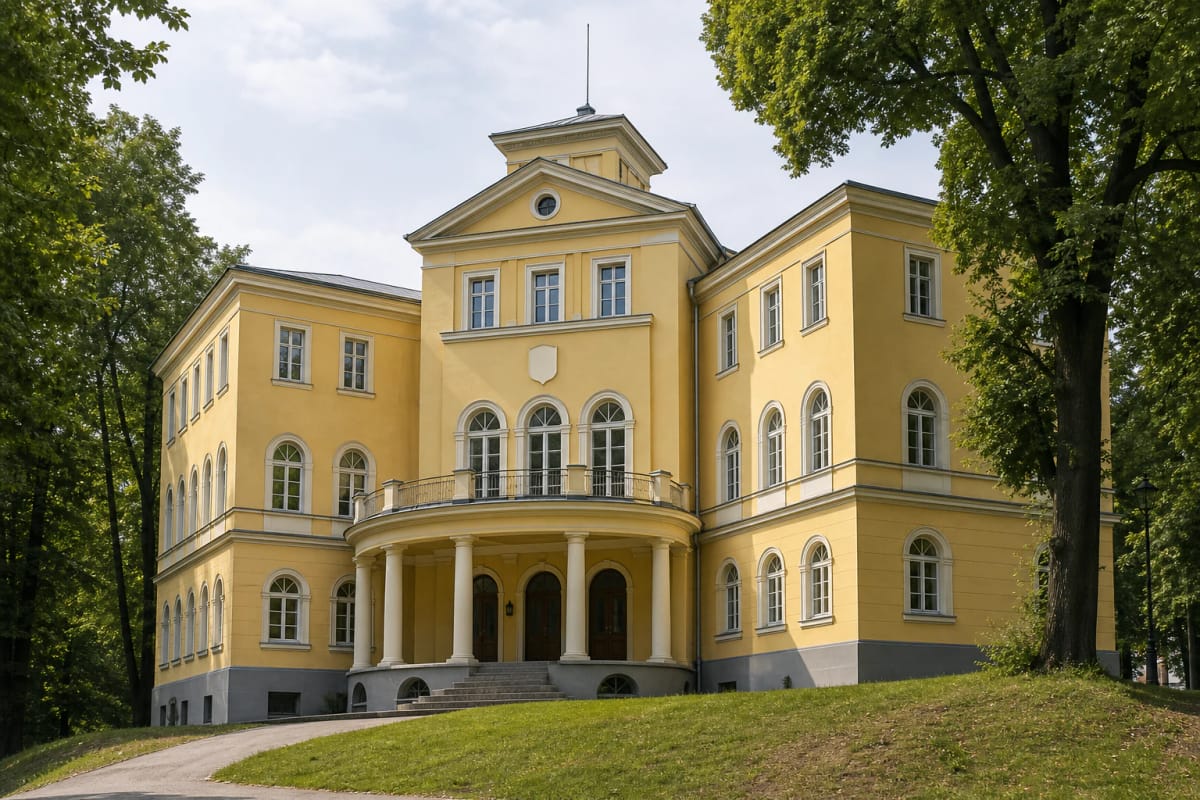
AUTC describes the plan as symmetrical and V-shaped: two side wings are joined by a central facade part. The side wings have projections and heavy cornices, while the central part is formed as the main representative focus.
KVR details the central north-eastern part: a semicircular terrace with a balcony, four plastered square-section pillars and six Tuscan-order columns, a triangular pediment, and above it a square three-tier tower with a small domed roof.
The cartouche and facade signs
One of the key exterior accents is the relief cartouche above the entrance with the Neo-Lithuania coat of arms. KVR states that sculptor Antanas Aleksandravicius created the cartouche around 1932-1934.
The facade is not modernist in a strict sense. It speaks in historicist forms, but in interwar Kaunas this was a deliberate strategy of representation: the student corporation wanted not only rooms, but a place that embodied status, tradition, and public visibility.
What worked inside before the war
KVR states that the palace concentrated the corporation's organizational life. It held administrative rooms, editorial offices for the newspapers Jaunoji Lietuva, Jaunoji karta, Studentu balsas and the journal Akademikas, a library with reading room, residential rooms for corporation members, a dining room, and a ceremonial hall.
Kaunas Dates and Facts summarizes the same functional mix: the palace, built with money collected by corporation members, housed a library, student newspaper editorial offices, a ceremonial hall, a dormitory, and other rooms. It was not just a club, but infrastructure for student social life, publishing, and everyday living.
The Great Hall and destroyed decor
KVR gives special attention to the two-storey hall in the northern wing, with balcony and stage. In the interwar period it was the main ceremonies and events space, and Antanas Aleksandravicius created its decor.
In 1931-1932 the sculptor made a wooden Neo-Lithuania coat of arms, busts of Vytautas the Great, Mindaugas, and Kęstutis, and later city and town coats of arms and reliefs. KVR states that when the corporation was closed in 1940, part of the hall decor was removed and the remaining part was destroyed by Soviet soldiers occupying the palace.
Soviet period and youth institutions
VLE states that after the USSR occupied Lithuania the corporation was closed in July 1940. KVR writes that in the first days of Soviet occupation the palace was turned into barracks, and later the Palace of Pioneers was established in the building.
Kaunas Dates and Facts adds that in the Soviet period the Palace of Pioneers operated here and in 1961 was given Yuri Gagarin's name. This is an important rewriting of function: the representative space of a student corporation became an institution of Soviet children's and youth education.
After 1990 and today
After Lithuania restored independence, the Pupils' Creative House moved into the building, and in 1998 it was named Kaunas Children and Pupils Leisure Palace. KVR also states that part of the premises was used by the student corporation Neo-Lithuania, re-established in 1990, under a use agreement.
Kaunas Dates and Facts and KVR state that in 2021 the Kaunas Mikas Petrauskas School of Performing Arts began operating in the building. OSM still marks the building as the Kaunas Children and Pupils Leisure Palace, so a travel text should keep both layers: the historic corporation name and the later youth and performing-arts function.
How to view it on site
Start from the Parodos Street side and look at the central columned terrace, balcony, pediment, and small tower with its domed roof. Then walk around toward Perkuno Avenue, because AUTC photographs mention this side as one of the important viewing points.
The interior is not a regular museum, and KVR does not list public visiting hours. Interior heritage details - the Great Hall, balconies, main staircase, arched openings, parquet, and mosaic-concrete steps - are best linked with events, institutional activity, or an arranged visit.
UNESCO and Žaliakalnis context
The building stands in the Žaliakalnis historic environment, while the UNESCO World Heritage property Modernist Kaunas: Architecture of Optimism, 1919-1939 covers the broader transformation of interwar Kaunas. This palace, however, should not be called a separate UNESCO site.
Its value for the UNESCO story is wider: the palace shows that the modernization of interwar Kaunas involved not only state ministries and banks, but also student organizations, publishing, rituals, mutual aid, sport, and youth culture.