- Place
- Vilnius City Municipality
- Region
- Vilnius
- Type
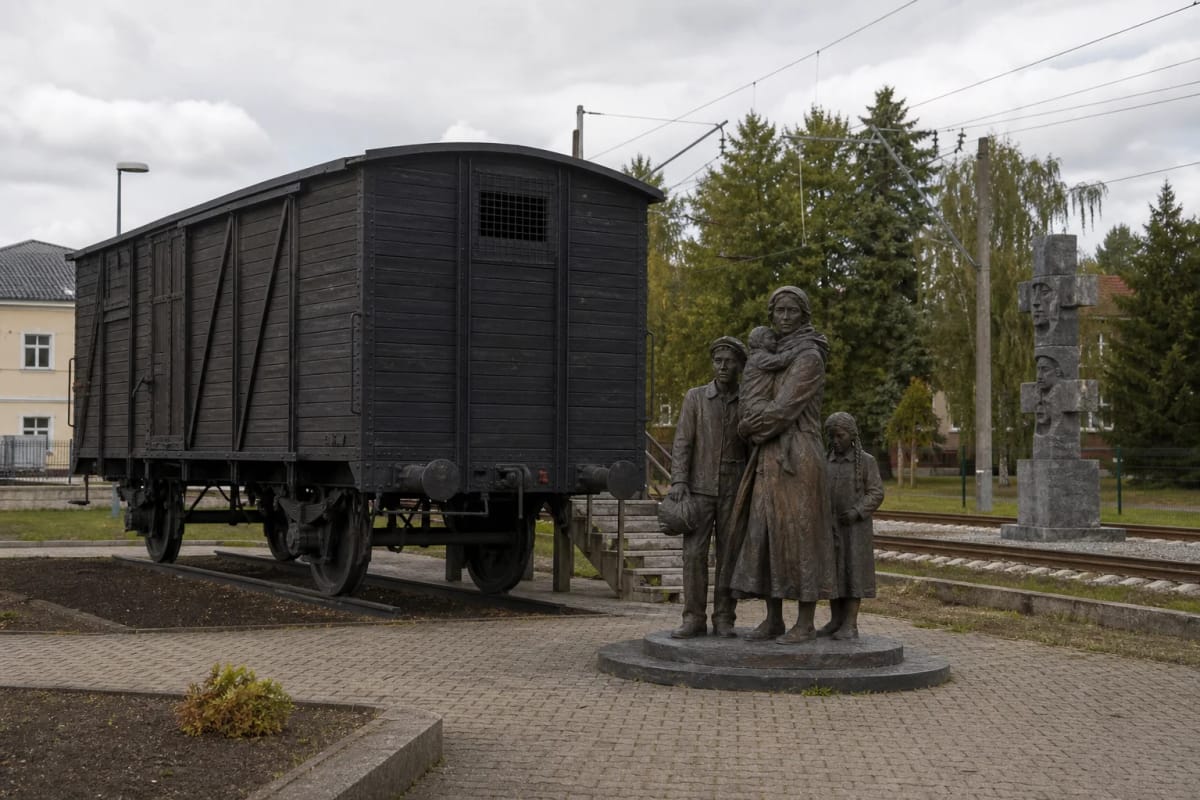
- deportation memorial by a railway station, with a railcar and sculpture
- Address
- Naujosios Vilnios geležinkelio stotis, Stoties a., Vilnius
- Coordinates
- 54.69400, 25.40870
Deportation Memorial in Naujoji Vilnia, Lost Generation
What the Naujoji Vilnia Deportation Memorial marks
The Naujoji Vilnia Deportation Memorial stands in eastern Vilnius, by Naujoji Vilnia railway station. The location was not chosen by chance: this was an important railway junction where echelons of deportees arriving from across Lithuania were formed for the journey deep into the Soviet Union.
The memorial recalls the deportations of June 1941 and the later postwar deportations. It is not only a monument, but a specific historical place where thousands of people saw their homeland for the last time before being taken to Siberia.
The June 1941 deportations
The first mass deportation of Lithuanian residents began early on June 14, 1941. According to LGGRTC, over several days more than 18,000 people were deported deep into the Soviet Union, including the Komi ASSR, Altai and Krasnoyarsk territories, and Novosibirsk region. Families were arrested at night and forced into cattle railcars, in which the journey could last for weeks.
People were transported from nineteen of Lithuania's largest railway stations, and Naujoji Vilnia became one of the most important junctions. The second major wave of deportations took place in 1944-1953, so the memorial is dedicated both to the deportees of 1941 and to postwar deportees.
The Lost Generation sculpture and the railcar
At the centre of the memorial is the sculpture Lost Generation, unveiled in 1991, a title also confirmed by VLE. It became one of the first memory signs of restored independence dedicated to victims of Soviet repression. The sculpture gives form to an entire generation interrupted by deportation.
Beside it stands an authentic cattle railcar, the kind in which people were transported to Siberia. Later, a shelter was installed over the railway object, and the railcar was adapted for a small exhibition about deportations. Visitors can therefore not only see but physically sense the conditions in which deportation took place.
Memory and visiting
The memorial is an open site by the station, freely accessible and free of charge at any time. Every year on June 14, the Day of Mourning and Hope, official remembrance ceremonies take place here, making that date the symbolic day of the memorial.
A visit usually takes 15-30 minutes, but the impression can be strong. It is meaningful to connect the site with a wider Vilnius occupation-history route: the Museum of Occupations and Freedom Fights and Tuskulėnai Peace Park.