- Place
- Vilnius City Municipality
- Region
- Vilnius
- Type
- Holocaust and mass-murder memorial
- Address
- Agrastų g. 17, Vilnius
- Coordinates
- 54.62640, 25.16173
The largest mass-murder site in Lithuania
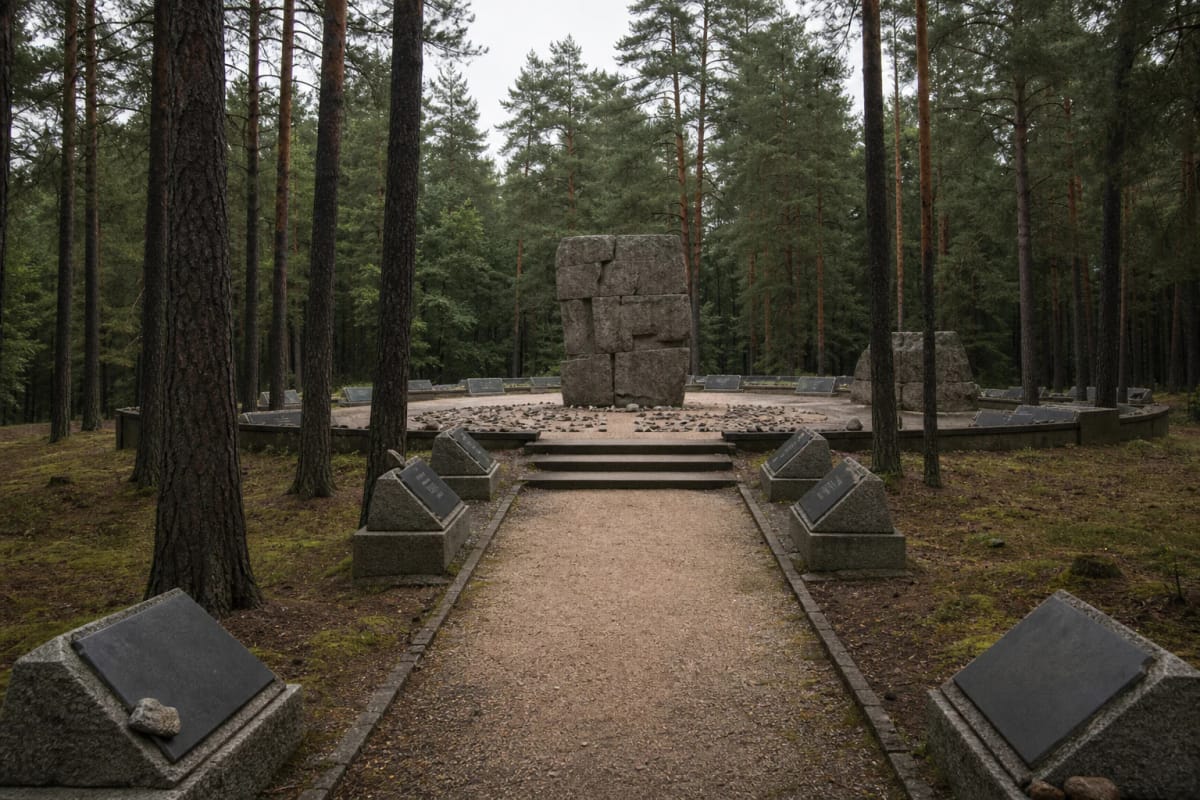
Paneriai Memorial is in the south-western part of Vilnius, in Paneriai Forest near Agrastų Street. It is the largest mass-murder site in Lithuania, so visiting should be slow, respectful, and grounded in historical context.
The official museum page presents Paneriai as a place of Holocaust and mass-murder memory. The memorial is dedicated not to one date or one monument, but to the whole territory where systematic destruction took place in 1941-1944.
How Paneriai became a killing site
In 1939-1940, Soviet authorities began constructing a fuel and ammunition storage base in Paneriai, about 27 ha in size, with pits. After Nazi Germany invaded and occupied Vilnius in June 1941, these unfinished pits were used for mass murder, and the Nazi-controlled territory expanded to about 70 ha.
This technical starting layer matters because it explains why the place became so deadly. Already-dug infrastructure was used for killings, while the forest edge and closeness to the railway helped carry out and conceal the crimes. The killings were carried out by German Security Police and SD, aided by the Vilnius Special Squad, known in German as Sonderkommando.
Victims and the scale of memory
VLE states that about 100,000 people of different nationalities were murdered at Paneriai, including about 70,000 Jews, as well as Red Army prisoners of war, Poles, priests, soldiers of the Lithuanian Territorial Defence Force, and others. The Register of Cultural Property gives a separate breakdown of victim groups, including about 40,000 Jews; the numbers differ because the exact number of victims will become clear only after the whole territory is systematically investigated.
The people murdered at Paneriai were primarily Jews of Vilnius and Lithuania, so the tragedy of the Jewish community is central here. At the same time, the memorial also preserves the memory of other groups destroyed by the Nazi occupation authorities. Every victim should be respected while the scale of the Holocaust remains clear.
Burning of bodies and the prisoners' escape
In 1943, while concealing traces of the crimes, the Nazis formed a brigade of about 80 prisoners from Vilnius ghetto prisoners and prisoners of war. They were forced to dig up and burn victims' bodies; tens of thousands of remains were burned. The brigade was held in one of the pits.
Over several months, the prisoners dug a tunnel about 30 m long and tried to escape through it on the night of April 15, 1944. Some were killed, but several, with sources mentioning 11-13, reached Rūdninkai Forest and survived. This is one of the most important resistance episodes at the site. The tunnel remains were later studied by ground-penetrating radar and archaeology.
The memorial and signs of remembrance
The first monument to victims of Nazi terror was erected in 1948. Paneriai Museum was founded in 1960, at first as a branch of the Vilnius Regional Museum, and the name memorial has been used since 1977. The present shape of the memorial was created in 1985 according to a design by architect Jaunutis Makariūnas, who had won a 1961 competition.
Separate memorial signs stand in the territory for victim groups: Poles in 1990, Jews in 1991 and 1999, Lithuanians in 1992, Soviet prisoners of war in 1996, the family of Enzys Jagomastas in 2001, and soldiers of the Lithuanian Territorial Defence Force in 2004. Today the memorial is cared for by the Vilna Gaon Museum of Jewish History; visitors should understand the territory plan: pits, paths, monuments, forest silence, and the distances between memory points.
Visiting and practical information
At the time of research, official museum pages confirmed the Paneriai Memorial address as Agrastų g. 17 and provided arrival information. A reliable separate, permanently valid opening-hours and ticket page for the memorial could not be identified.
Because the memorial is a sensitive memory site, contact the official Vilna Gaon Museum of Jewish History for guided tours, visitor-centre access, or special programmes. Check current information before travelling, especially if you want a guide or group visit.