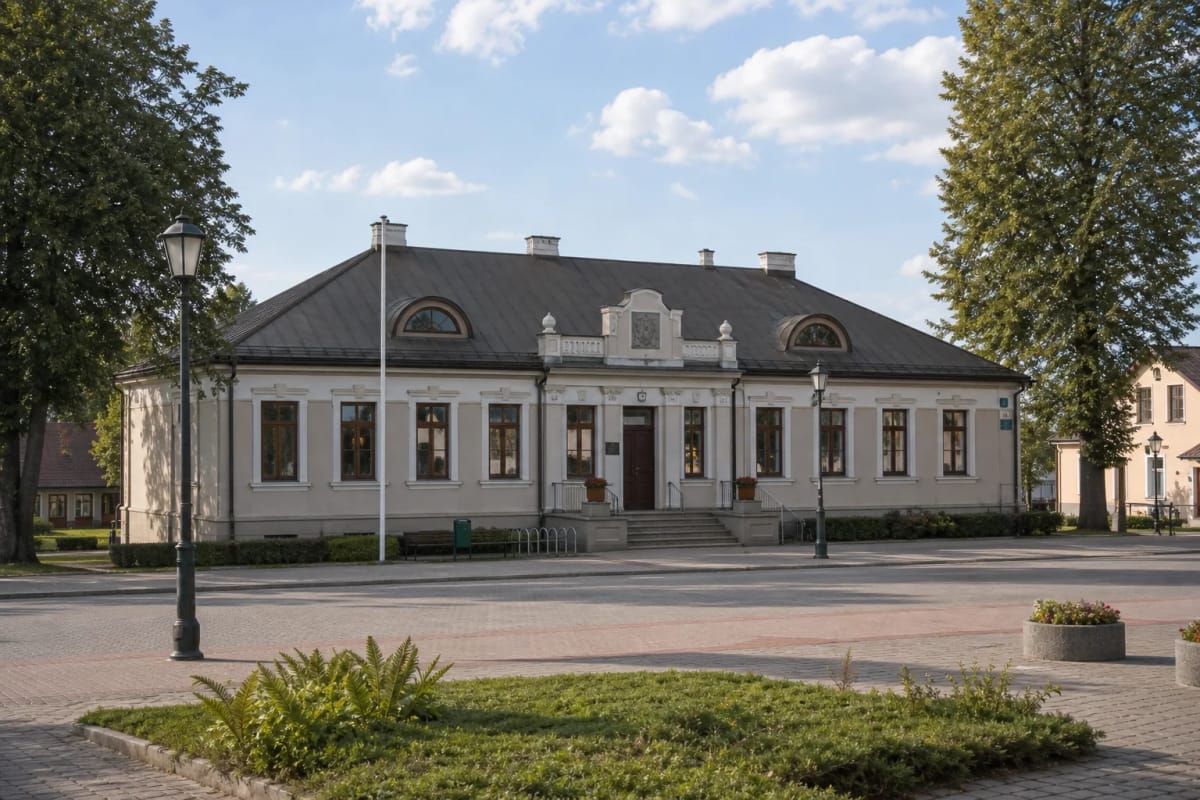
- Place
- Švenčionys District Municipality
- Region
- Aukštaitija
- Type
- regional local-history museum
- Address
- Laisvės a. 1, Švenčionys
- Coordinates
- 55.13500, 26.16000
Švenčionys Local History Museum, Nalšia Museum
Nalšia Museum: museum of the old Nalšia land
Nalšia Museum is the local-history museum of the Švenčionys region, named after the old Lithuanian land of Nalšia. According to VLE, it holds more than 60,000 exhibits arranged around four permanent exhibitions: archaeology, ethnography, nature, and history.
It is the richest window into the past of Švenčionys and the Aukštaitija borderlands. The collections span from Stone Age settlements to twentieth-century partisan warfare. The museum also has a Reškutėnai branch with a traditional crafts centre continuing living practices.
What Nalšia is
Nalšia, also called Nalšėnai, is one of the old Lithuanian lands mentioned in thirteenth-century sources: the Hypatian Chronicle, the Livonian Rhymed Chronicle, and acts of Mindaugas and the Archbishop of Riga. Švenčionys and Utena are associated with it, and Švenčionys is traditionally regarded as the centre of Nalšia, explaining the museum's name.
The exact borders of Nalšia are debated by scholars, so they should be presented as a hypothesis, not a finally established fact. Known rulers linked with the area include Daumantas, later prince and saint of Pskov.
Since 1945: museum history
Local museum activity goes back to 1912, when Ignotas Šilkinis began privately collecting historical and ethnographic material. A public museum was founded in 1934 but closed by the Polish authorities in 1937, and its exhibits did not survive.
The present museum was founded in February 1945 as Švenčionys Local History Museum. On November 19, 1992, it was named Nalšia Museum, and on February 14, 2000, it opened in its current building with several exhibition halls. The museum is directed by Alytė Šiekštelienė.
Exhibitions and collections
The archaeology collection is one of the museum's largest, with more than 18,000 finds from the Stone Age to the Iron Age. The richest material comes from Stone Age settlements studied by Lake Kretuonas. The ethnography collection contains more than 3,500 objects, from household technology to folk art and textiles; among the artworks is Mihály Munkácsy's painting Piršlybos.
The nature exhibition presents minerals, boulders, and bird and animal taxidermy. The history collection includes photographs, weapons, numismatics, part of the Labanoras hoard, personal belongings of geographer Česlovas Kudaba, and resistance archives, including headquarters documents of the Tiger partisan detachment.
Reškutėnai branch and crafts centre
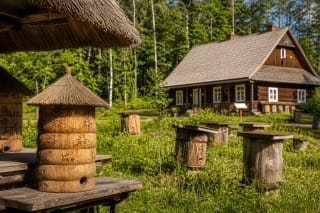
The museum has a branch in Reškutėnai. The Reškutėnai Museum was founded in 1974 by teacher Izidorius Kazakevičius and became a Nalšia Museum branch in 2001. It holds archaeological finds, locally woven textiles, a sacred collection, and old-craft displays.
Beside it operates the Reškutėnai Traditional Crafts Centre, with weaving, braiding, felting, woodworking, ceramics, and traditional-food activities. This branch is best visited by prior arrangement so you can see craftspeople at work.
Visiting
The main museum operates Tuesday-Friday and Saturday morning, and is closed on Sundays and Mondays. During research, the adult ticket price was listed as 4 EUR and pupils/students as 2 EUR, but check the official museum page because hours and prices may change.
For the main museum, 1-1.5 hours is usually enough. A trip around the Švenčionys region combines well with Lake Kretuonas, Sirvėta Regional Park, or Aukštaitija National Park, and with more time, the Reškutėnai crafts centre.