- Place
- Vilnius City Municipality
- Region
- Vilnius
- Type
- nineteenth-century wooden manor estate, park, and Vilnius Museum branch
- Address
- Subačiaus g. 124, Vilnius
- Coordinates
- 54.67400, 25.32561
Markučiai Manor Museum, Alexander Pushkin Literary Museum, Markučiai Park
Markučiai Manor: why the place is interesting today
Markučiai Manor is a quieter Vilnius site set away from the main old-town flow. The key here is not a grand representational palace facade, but an authentic wooden suburban manor house, a park, ponds, and a fairly complex memory story.
The official Vilnius Museum page emphasises that Markučiai Manor is now a branch of the Vilnius City Museum. It was previously called Markučiai Manor Museum and the Alexander Pushkin Literary Museum, but today's museum consciously distances itself from the Soviet-era Pushkin museum legacy and turns attention to the contested heritage of the Russian Empire in Vilnius.
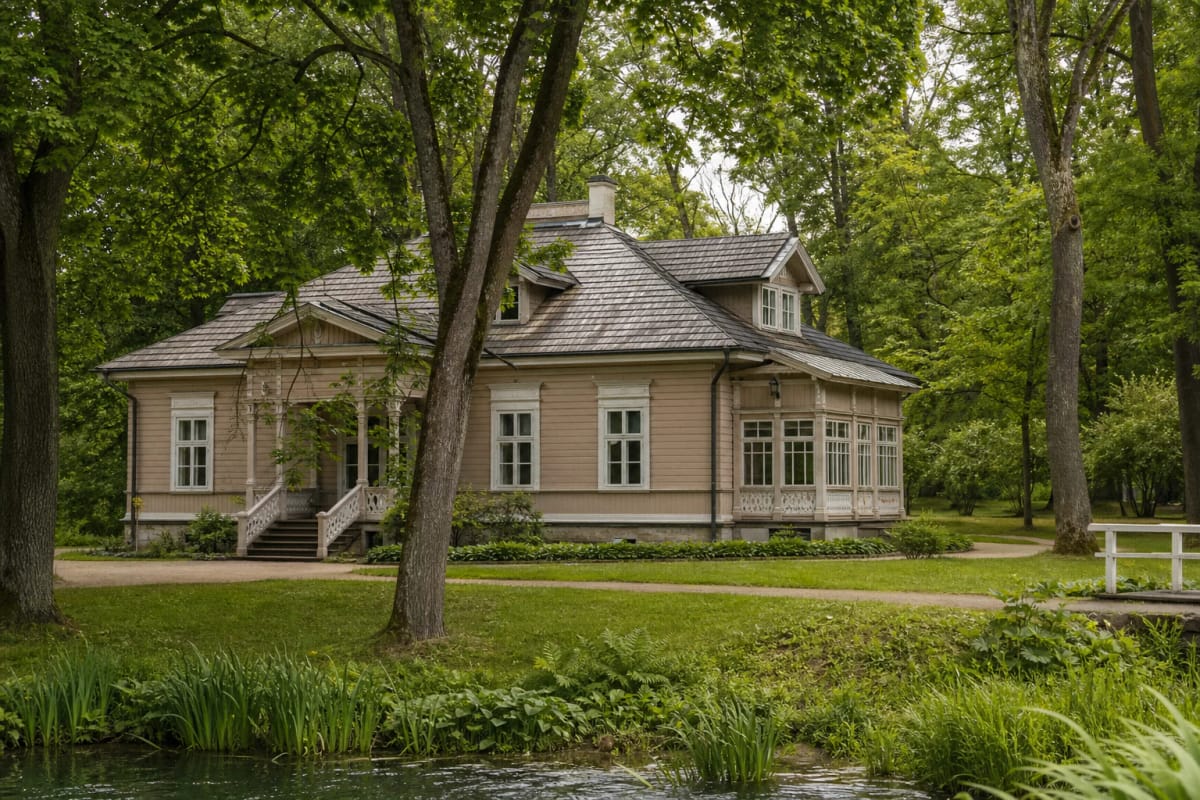
The 1867 wooden manor house
The main object is the wooden residential house built in 1867. Vilnius Museum states that its layout has survived unchanged for more than 150 years, and that late-nineteenth-century interior elements remain inside: furniture, dishes, books, and artworks.
It is one of the few Lithuanian manors whose furniture and household objects were not scattered during the war and postwar years. Markučiai is therefore valuable not only as a family story, but also as a material fragment of nineteenth-century manor everyday life.
Aleksejus Melnikovas and the start of the manor
The official history states that in 1867 engineer-general Aleksejus Melnikovas, one of the builders of the St Petersburg-Warsaw railway line, bought land in Markučiai from Polish landowner and physician Ignacy Godlewski. Construction of the manor began the same year and was completed within a year.
Alongside the residence, auxiliary buildings were built: a servants' house, stables, and a carriage house. The working part of the estate was downhill, with an orchard, ponds, orangery, icehouse, wine cellar, croquet lawn, and other elements that show nineteenth-century manor life.
Varvara Pushkina and Grigory Pushkin
In 1875, Melnikovas gave Markučiai Manor to his daughter Varvara as her dowry. In 1880 she met Grigory Pushkin, the younger son of Alexander Pushkin and Natalia Pushkina, in St Petersburg, and in 1883 the couple married in Vilnius.
After marriage, Varvara and Grigory lived between different places for a time, but in 1899 they sold the Mikhailovskoye estate and moved permanently to Markučiai. This family story shaped the museum's identity for a long time, but today it is told more widely: as part of Vilnius, imperial culture, manor economy, and twentieth-century politics.
Park, chapel, and manor ensemble
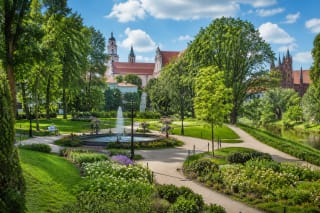
The official Markučiai Manor description states that the ensemble consists of the residence, an 18 ha park with ponds, St Barbara Chapel, and the family cemetery beside it. It is worth giving time not only to the interior, but also to the surrounding landscape.
During the nineteenth-century manor period, the park was carefully maintained, several ponds lay within it, an orangery held exotic plants, and summer houses and wooden villas later appeared on the manor lands. Today the park helps explain why Markučiai was not only a house, but also a suburban landscape.
The Soviet Pushkin museum and today's reinterpretation
Vilnius Museum states that the manor was nationalised in 1940, and Soviet authorities decided to create a museum here. The first exhibition in the institution named the Alexander Pushkin Literary Museum was created in 1946-1948, and during the Soviet period Pushkin's figure was interpreted politically according to the ideology of the time.
The Alexander Pushkin museum at Markučiai operated until 2023. That year it became Markučiai Manor Museum, and in 2025 it was incorporated into Vilnius City Museum as one of its branches. This change matters for visitors: today the place does not simply honour one literary figure, but analyses a wider and more contested heritage.
How to plan a visit
Markučiai Manor is at Subačiaus g. 124. The official page states that you can arrive on foot, by bicycle, by car, or by buses 10 and 13, getting off at the Markučiai stop. Parking is on the Pavilnio Street side.
One practical detail matters: steep stairs lead from the public-transport stop and car park to the manor, and the second floor is accessible only by stairs. Wheelchair movement is possible on the ground floor, and museum staff can help with a mobile ramp if needed.
Because Markučiai joined Vilnius City Museum in 2025, check the official branch page before travelling. After a museum reorganisation, visiting conditions and temporary closures can change more often than the manor's history.